There is something interesting happening in digital marketing, but almost everyone is explaining it badly.
People keep talking about AI as if the change only concerned the tools. ChatGPT, Gemini, Perplexity, Claude, Google AI Overviews. New interfaces, new functions, new ways of searching for information.
In reality, the most important change is not about the tools.
It is about the criteria through which trust is distributed online.
And this is where terms like SEO, AEO, and GEO begin to appear.
The problem is that they are often treated like technical acronyms or just another SEO rebrand, when in reality they describe three different levels of modern digital visibility.
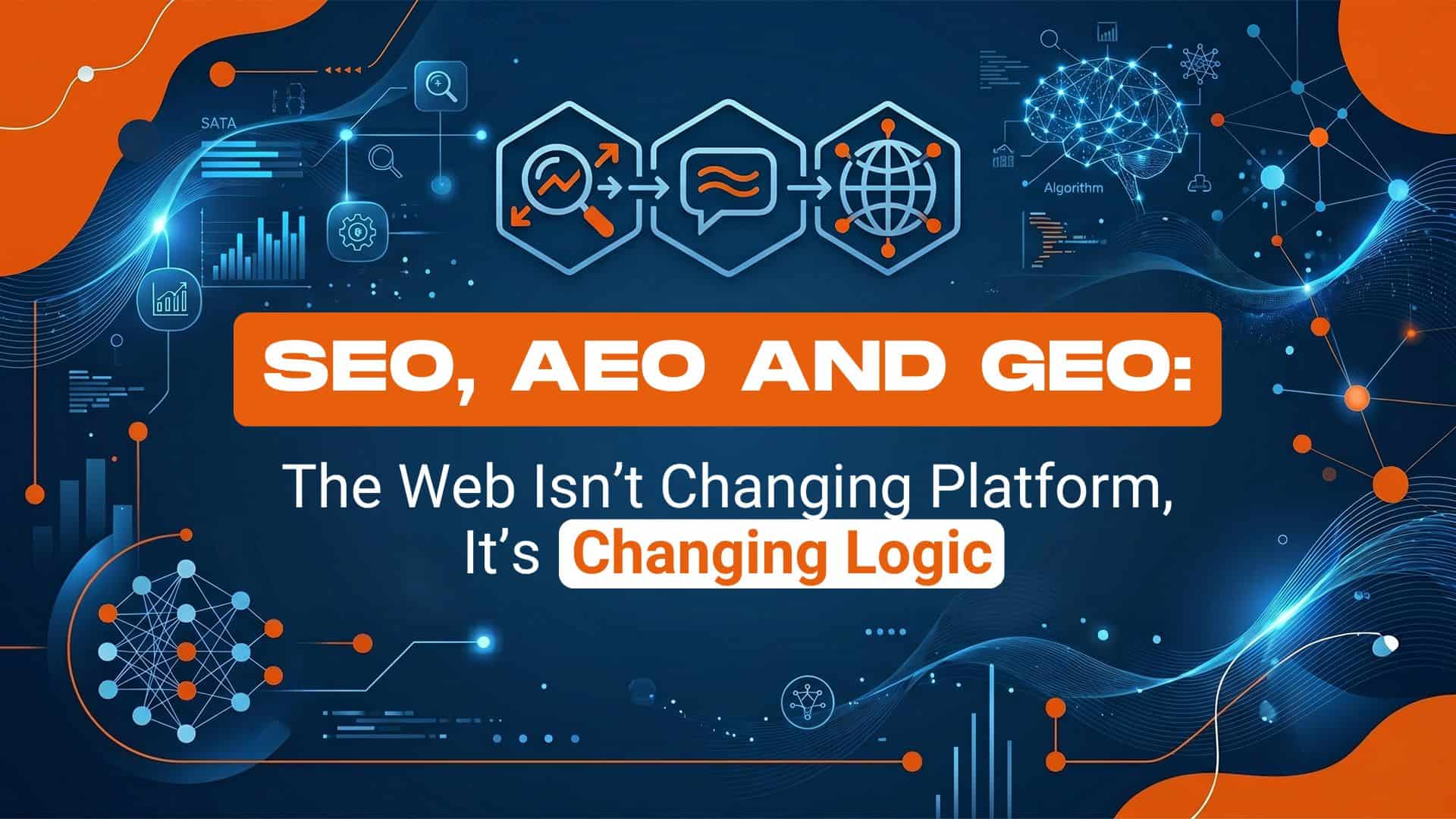
The slide that has been circulating a lot these days is useful precisely because it shows this transition clearly: today, being online is not enough. Ranking well is not even enough anymore. You need to understand how AI systems read, interpret, and validate a brand.
Because the point is no longer just “being found.”
The point is becoming a source that models consider reliable enough to use inside an answer.
SEO Remains Fundamental, But It Is No Longer the Final Level
SEO remains the foundation of everything.
A slow website, weak semantic structure, poor organization, or unclear architecture is still a huge problem. Even LLMs, just like search engines, need to clearly understand what they are reading.
But today, SEO increasingly looks like invisible infrastructure.
It is no longer the final goal. It is the prerequisite.
This is the point many companies are underestimating.
They still think publishing keyword-optimized articles is enough to gain stable organic attention. But online search is changing shape much faster than it seems.
Google is already transforming the SERP into an environment where the answer arrives before the click. Meanwhile, millions of users are starting to use conversational tools directly to get summaries, comparisons, and interpretations.
In practice, content no longer competes only for a position.
It competes to be included inside a generated answer.
And that is a huge difference.
AEO Begins When the Answer Matters More Than the SERP
Answer Engine Optimization is not simply “optimization for ChatGPT.”
It reflects a behavioral shift.
When someone opens Google and finds a list of results, the decision-making process still passes through the click. But when they open ChatGPT or Perplexity, they often receive a direct summary.
This changes how content is selected.
Because an LLM does not read a page like a human being would. It looks for semantic clarity, logical connections, interpretable structures, and content that can easily be transformed into an answer.
And this is where many pieces of content begin to lose strength.
Texts built only to fill space, artificially stuffed keywords, empty introductions, articles that circle around the point without ever reaching it—this works less and less.
AI models reward content that:
- reaches the concept quickly
- clearly explains context
- builds strong semantic relationships
- maintains argumentative coherence
- demonstrates real expertise
In other words, AEO shifts the focus from simple indexing to understanding.
You are no longer writing only to rank.
You are writing to be interpreted correctly by systems that must synthesize information.
And this is a much deeper shift than it seems.
GEO Is Probably the Most Important Part
The truly interesting part comes next.
Because SEO and AEO still mainly work on owned content: your website, blog, pages, and editorial structure.
GEO introduces another logic: distributed reputation.
And this is where the web is really changing its skin.
Citations
Discussions
Forums
Reddit
Industry articles
Podcasts
Wikipedia
Communities
Mentions
Directories
In practice, authority is becoming relational again.
It matters where you exist. It matters who mentions you. It matters in which conversations you appear. It matters whether your name is consistently associated with specific topics.
This deeply changes how a professional should build their online presence.
Because a well-made website alone may no longer be enough.
Online Trust Is Becoming a Distributed System
The central point of this transformation is this: we are entering a phase where online trust is built in a distributed way.
And AI systems reason exactly through these signals.
Consistency.
Persistence.
External consensus.
Freshness.
Citations.
Semantic presence.
Connections between sources.
It is also why these are becoming so important:
- editorial clusters
- multi-platform distribution
- vertical communities
- updated content
- presence in conversational spaces
The next step will probably be even more interesting: not just explaining platforms, but interpreting how LLMs build trust and select sources.
And this could become central to digital marketing in 2026.
The Real Risk Is Still Reading the Internet Like a Search Engine
Many companies are still designing content for a version of the web that is disappearing.
A web made only of keywords, SERPs, and clicks.
But people’s behavior is already shifting:
- more and more users read overviews without clicking
- many searches become conversations
- content gets summarized before it is even visited
- authority is filtered by AI models
This creates a massive change.
The battle is no longer only for attention.
It is for interpretation.
The Question That Will Really Matter
The important question will no longer be:
“How do I rank first on Google?”
But:
“Why should an AI system consider me a reliable source?”
And that is a much more complex question.
Because it involves content, reputation, distributed presence, citations, ecosystem, semantic coherence, and perceived authority.
SEO will continue to be fundamental.
But the point will no longer be simply being present in the index.
It will be entering the trust system that AI is building on top of the web.