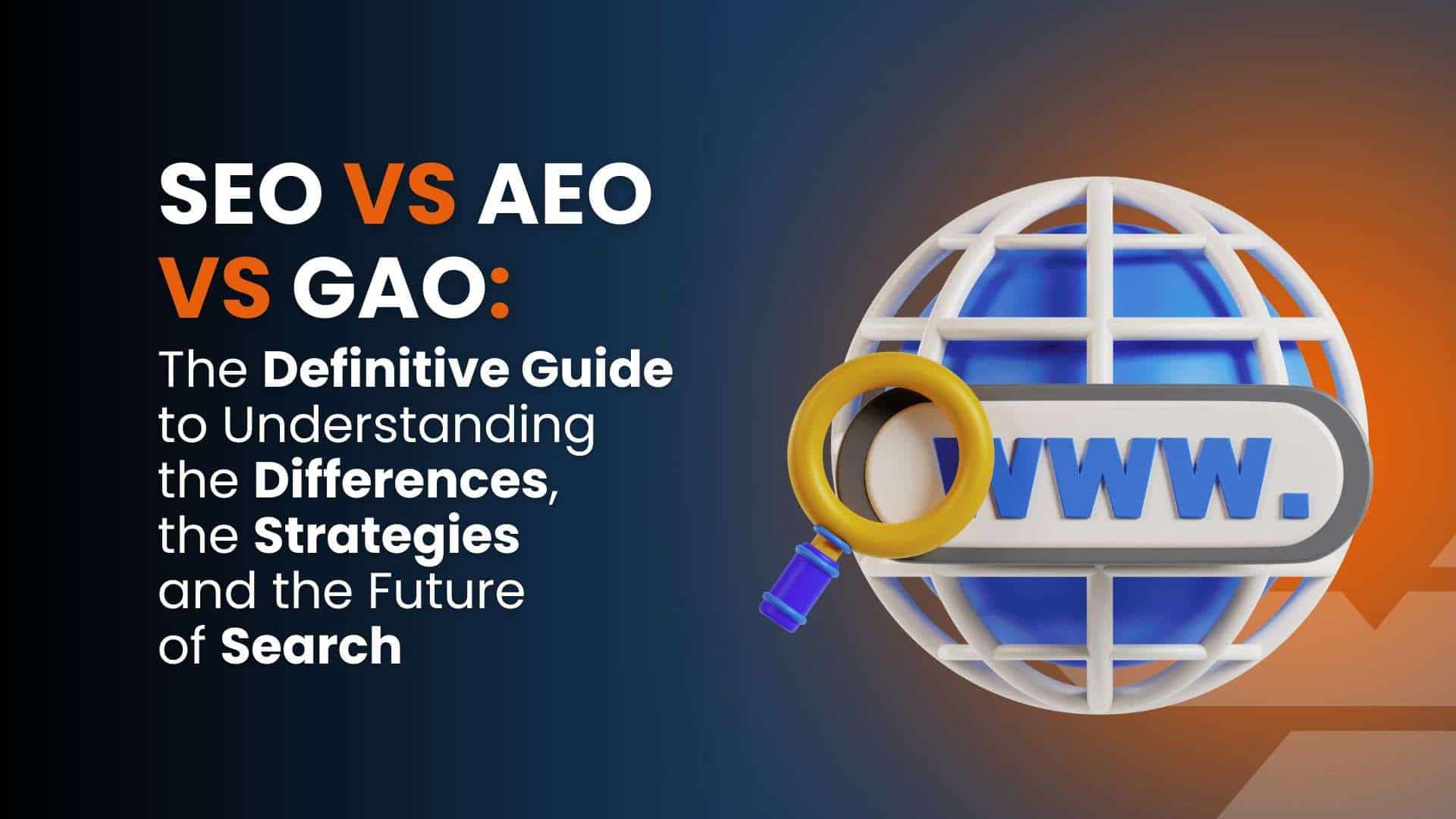
SEO vs AEO vs GAO has become one of the big questions for anyone working in digital marketing today, because the way search engines work — and the way users search — has changed so much that we now deal with three different layers of visibility. Understanding the difference helps you see how search is evolving, how platforms decide what to show, and what kind of content actually has a chance to rank or be surfaced. Knowing how SEO vs AEO vs GAO works also means investing your time and resources in strategies that still make sense in a world where queries are conversational and answers are generated, not just retrieved.
The differences between SEO, AEO, and GAO
When we talk about SEO, we’re talking about the classic world of optimizing for traditional search engines. Everything revolves around pages, search intent, content quality, internal structure, domain authority, and all the factors Google uses to rank websites. The dynamic is simple: a user types a query, and Google shows a list of results. The main goal of SEO is still the same — show up at the top and get qualified traffic that grows organically and stays consistent over time.
AEO takes that logic and shifts it toward answer engines. It’s not just about being found on Google anymore, but being chosen as the direct answer by systems like Google SGE, Bing Copilot, ChatGPT Search, and every platform that filters, interprets, and responds in a conversational way. AEO needs a more semantic structure, natural language, and content that aligns tightly with user questions. It also requires internal consistency so that language models recognize your content as reliable. This is where SEO vs AEO vs GAO really starts to split: you’re not just optimizing pages — you’re optimizing answers.
GAO: the new entry
GAO takes things further and focuses on optimization for generative engines — systems that don’t simply pull information but actually generate new content based on context. The goal with GAO is to create content that’s recognizable, deep, authoritative, and worth using as a reference for new generated responses. GAO rewards vertical expertise, real use cases, professional specificity, and anything that makes your content stand out from all the shallow content floating around online. GAO means producing content that the model feels is genuinely helpful for generating new ideas or explanations. It’s a new kind of authority that most marketers haven’t fully understood yet, and it depends on consistency, depth, and long-term value.
Understanding how generative engines work
Moving from search engines to generative engines is a real paradigm shift. With SEO, you can still rely on classic techniques. With AEO, you need to answer user questions directly and clearly. But with GAO, you enter a deeper content dimension: content must be substantial, non-superficial, long-lasting, and highly specialized. SEO vs AEO vs GAO becomes a map for understanding how engines “choose” the information they surface — and why deep, coherent, constantly updated content gets rewarded.
GAO requires writing that focuses less on keywords and more on informational density. It’s not enough to repeat a concept — you need to show it through concrete examples, professional experience, and unique viewpoints. SEO rewards structure and optimization. AEO rewards clarity and responsiveness. GAO rewards credibility, originality, and depth. A piece of content that works under GAO is never just a list of tips. It’s a full reasoning process that helps AI understand why your content deserves to be used as a generative source.
Optimizing for SEO, AEO, and GAO
Creating content that performs well in all three ecosystems means balancing structure, depth, and clarity. SEO needs proper keyword distribution, strong titles, optimized meta descriptions, and a structure that guides reading. AEO needs clearer phrasing and formats that reflect how people naturally ask questions. GAO needs a conversational, flowing approach that builds a coherent and recognizable reasoning path. The real strength of content aligned with SEO vs AEO vs GAO lies in its ability to be useful, readable, and authoritative across different platforms.
Applying SEO vs AEO vs GAO to future content
The digital landscape makes one thing clear: relying on a single strategy isn’t enough anymore. SEO alone doesn’t fully work if generative engines respond before users click anything. AEO alone isn’t enough if your content doesn’t have enough depth to be selected by LLMs. And GAO doesn’t work without a structured base that allows engines to find and index your work. Understanding SEO vs AEO vs GAO helps you create content that stays relevant over time and adapts to evolving algorithms.
SEO vs AEO vs GAO: building content for the future of search
Everyone today is asking the same question: which model will dominate the future of search? The truth is that there won’t be just one. Search is becoming hybrid. Users switch between classic search engines, answer engines, and generative engines depending on what they need.
This means that effective content must live in all three worlds — solid SEO structure, clear and direct AEO-style answers, and GAO-level depth. The goal isn’t to rank on one platform. It’s to become a recognizable, reliable source across a multi-layered information ecosystem.