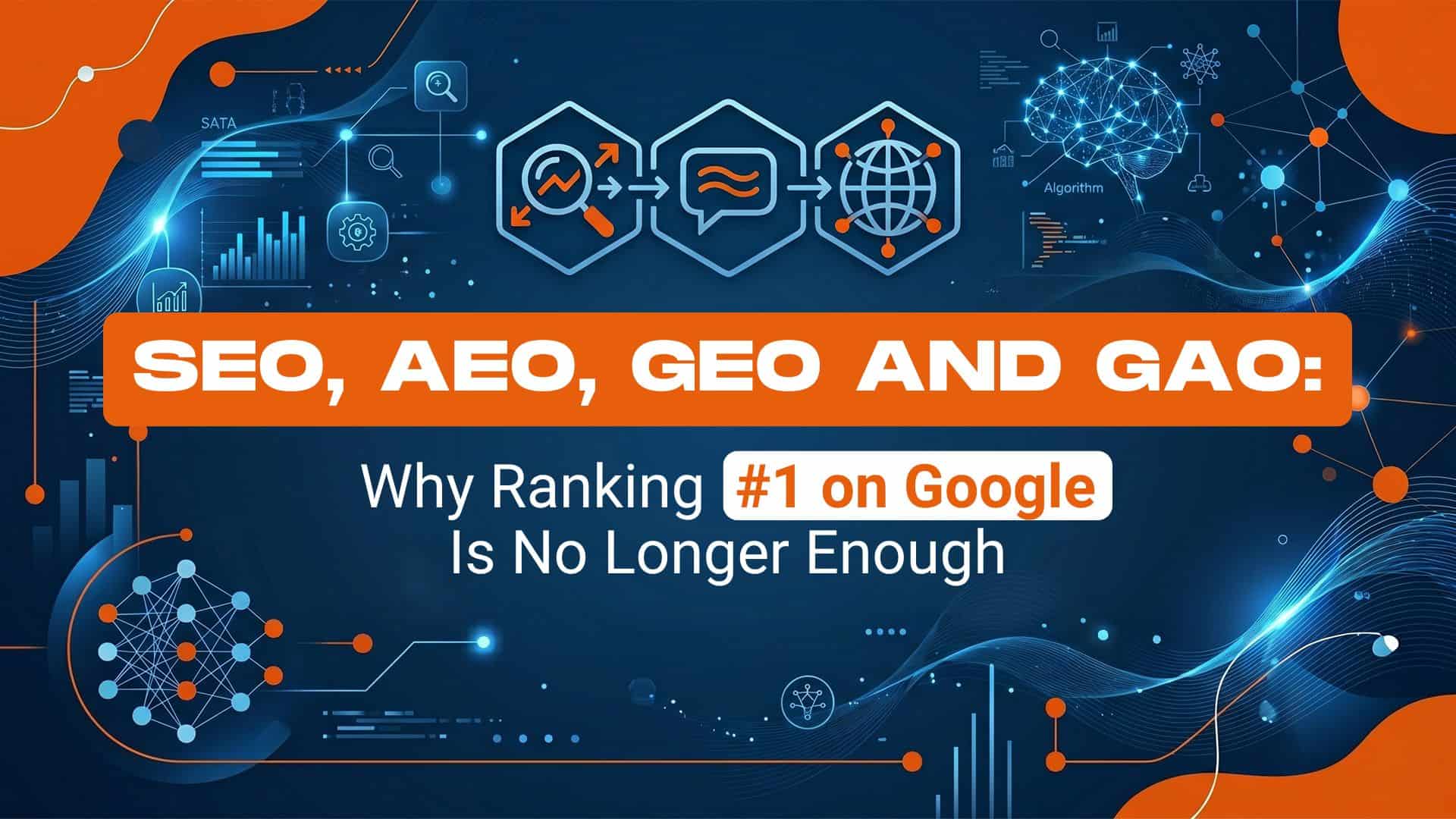
Ranking highly on Google is no longer enough to guarantee real visibility in today’s search ecosystem. A brand may occupy the top positions in Google’s search results while remaining almost invisible in the responses generated by ChatGPT, Perplexity, Claude, Gemini, or Google’s AI Overviews.
This shift fundamentally changes how content, reputation, and authority are evaluated online. It is not simply about new acronyms or marketing trends. It reflects a much deeper question:
Who does the internet actually consider trustworthy?
From Google Rankings to Competing for AI Answers
For years, digital marketing followed a relatively predictable formula. Businesses created content, optimized keywords, improved their pages, and worked to climb Google’s search rankings. Organic traffic largely depended on visibility within traditional search results.
Today, search behavior is changing.
People increasingly ask questions directly to AI systems instead of browsing lists of links.
As a result, content no longer competes solely for clicks or rankings. It now competes to be selected, summarized, and cited inside AI-generated answers.
This fundamentally changes the rules.
Visibility depends not only on indexing and rankings, but also on how clearly, accurately, and credibly information can be interpreted by generative AI systems that aggregate knowledge from multiple sources.
SEO: The Foundation Still Matters
Search Engine Optimization (SEO) remains the foundation of every successful digital strategy.
Its purpose is to make content accessible and understandable to search engines by helping them identify:
- Who the company or professional is.
- What the website is about.
- Which topics it specializes in.
- How information is organized.
Without strong SEO, building sustainable online visibility remains extremely difficult.
Site architecture, semantic relevance, topical authority, and content organization continue to be essential.
However, SEO alone is no longer enough.
Being indexed by search engines does not automatically make a website relevant to AI-powered answer engines.
AEO: Optimizing Content for Answer Engines
The second concept is AEO—Answer Engine Optimization.
AEO focuses on structuring content so it has a greater chance of being selected and incorporated into AI-generated answers.
Here, optimization extends beyond keywords.
Other factors become increasingly important:
- Clear explanations.
- Logical content structure.
- Sufficient context.
- Perceived authority and credibility.
Content designed for AEO should make extracting an accurate answer as easy as possible.
That means producing information that is organized, well explained, and free from ambiguity.
AI systems increasingly favor content that supports precise, reliable, and easily summarized responses.
In other words, success no longer belongs simply to the first person who writes about a topic.
It belongs to the person who explains it most clearly and credibly.
GEO and GAO: Reputation Is Built Across the Entire Digital Ecosystem
Alongside SEO and AEO comes a third layer: GEO (Generative Engine Optimization). Within Google’s ecosystem, this concept is often described as GAO.
The principle is straightforward but transformative.
Generative AI models do not evaluate only a company’s official website.
They also analyze the broader digital ecosystem surrounding that brand.
Important signals include:
- Online forums.
- Reddit discussions.
- Podcasts.
- YouTube videos.
- Customer reviews.
- Articles published on external websites.
- Online citations.
- Social media presence and conversations.
Digital reputation is therefore no longer evaluated in isolation.
AI systems seek distributed confirmation.
A company cannot simply claim expertise.
Multiple independent signals across the web must reinforce that claim.
From AI Search to Computational Trust
The biggest transformation is not technological.
It is reputational.
We are entering an era of what could be called computational trust.
This refers to AI systems assigning credibility based on numerous digital signals collected across the internet.
Authority is no longer determined by one perfectly optimized webpage.
Instead, it emerges from everything that exists around a person or brand online.
True authority increasingly results from the combination of:
- High-quality owned content.
- Consistent presence across multiple platforms.
- Mentions and endorsements from third parties.
- Reputation accumulated over time.
Generative AI looks for patterns of trust.
It evaluates whether a brand consistently appears in relevant contexts, is associated with expertise, receives citations, participates in credible discussions, and maintains a coherent digital presence across multiple platforms.
The Right Question Is No Longer “How Do I Rank #1?”
For years, digital marketing revolved around one dominant question:
How do I reach the first position on Google?
Today, that question remains important—but it is no longer sufficient.
A far more strategic question has emerged:
If someone asks an AI who can solve their problem, why should it recommend your brand?
This shifts the focus away from rankings and toward trusted recognition.
It is no longer just about page performance.
It is about whether AI systems recognize your business as a credible recommendation.
What Changes for Businesses, Professionals, and Creators
Today’s digital environment requires a broader, more integrated strategy.
Online presence should be viewed as an interconnected system rather than a collection of disconnected marketing activities.
That means simultaneously focusing on:
- Strong SEO to ensure websites are crawlable, indexable, and semantically organized.
- Effective AEO by creating structured, understandable content that AI can easily transform into answers.
- GEO or GAO by building authority outside the website through mentions, reviews, citations, media coverage, and participation in trusted communities.
Businesses that continue thinking only in terms of keywords and rankings risk losing visibility across a growing portion of online discovery.
Those who build distributed trust are far more likely to remain visible in both traditional search engines and generative AI platforms.
The Foundations of Digital Authority in the AI Era
In this new environment, a strong digital presence relies on several essential principles:
- Consistency across websites, content, citations, and social channels.
- Clear explanations of services, expertise, and positioning.
- Content architecture that helps both users and AI systems understand information.
- Distributed reputation built through multiple touchpoints.
- Verifiable authority supported by independent signals rather than self-promotion.
Trust is no longer something brands simply claim.
It must be demonstrated in ways that search engines, large language models, and generative AI platforms can all recognize.
Conclusion
SEO, AEO, GEO, and GAO are not simply new marketing buzzwords.
They represent the different layers through which visibility is earned in the modern web.
SEO remains the foundation.
AEO makes content easier for AI answer engines to understand.
GEO and GAO extend authority beyond the website into the broader digital ecosystem.
The winners are no longer just the brands that rank highest in search results.
They are the brands that AI systems consistently recognize as trustworthy sources of information.
In the AI era, sustainable competitive advantage belongs to organizations capable of building credibility that is clear, consistent, and recognizable wherever digital trust is formed.