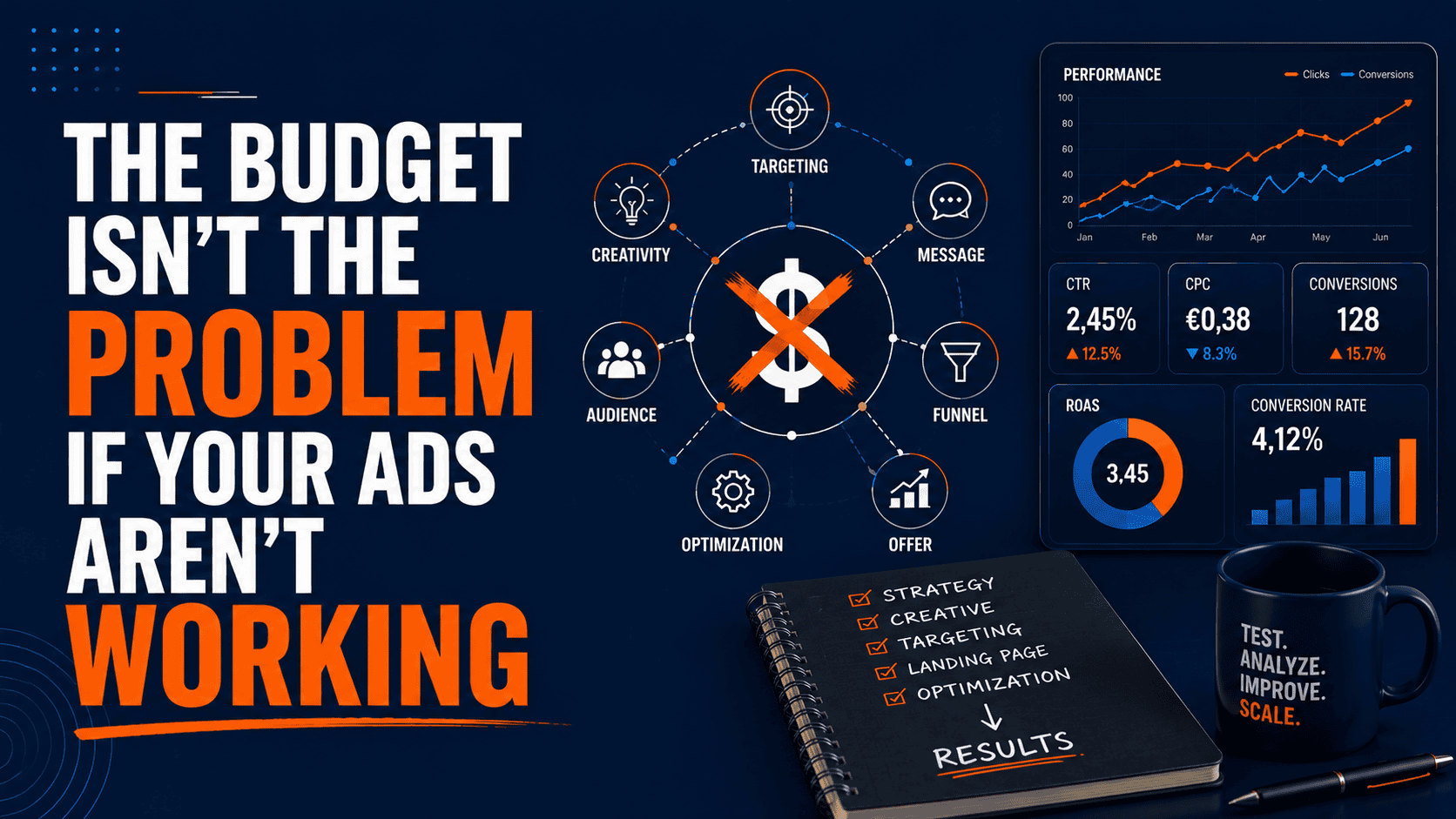
When a Meta Ads campaign underperforms, the most common reaction is to blame the budget. People assume they are spending too little, not reaching enough users, or simply need to increase investment to improve results.
But very often, the issue is not financial at all. The real problem is the way the campaign is communicating with the algorithm.
Advertising platforms no longer operate the way they did a few years ago. Today, Meta depends far less on rigid segmentation, hyper-specific interests or overly detailed audience construction. The system works primarily through signals: attention, interaction, watch time, clicks and conversions.
If those signals are weak, the algorithm struggles to understand who should receive the ad. If the content generates strong responses, the system becomes significantly better at finding the right people.
This is why, before increasing spend, it usually makes more sense to optimize three strategic levers first:
- audience breadth
- creative quality
- creative testing volume
Why the Problem Isn’t Always the Budget
The idea that increasing spend automatically fixes a campaign is misleading.
If an ad is not sending clear signals to the platform, increasing the budget simply accelerates inefficient distribution.
Meta continuously evaluates user behavior:
- who stops scrolling
- how long they watch
- who clicks
- who engages
- who converts
- who ignores the message
Based on these signals, the algorithm decides whether to expand or correct delivery.
In other words, it is no longer enough to manually “pick the right audience.” What matters now is giving the system enough strong material to learn from quickly.
This shift becomes even more relevant when considering modern optimization systems and algorithmic frameworks like Andromeda, where the logic is increasingly clear: less unnecessary manual control, more signal quality and more room for machine learning.
Step 1: Broaden the Audience Instead of Narrowing It
The first mistake to fix is overly restrictive targeting.
Many advertisers still build campaigns around highly specific interests, narrow audience stacks and complex segmentation structures. That approach belongs to an older version of the platform, where the advertiser’s main role was manually “finding” the right audience.
Today, in many cases, that strategy actually limits the machine instead of helping it.
Why Broad Audiences Perform Better
Using broad targeting gives the algorithm more freedom to identify users with the highest probability of responding positively.
The more data the system collects, the more accurately it can optimize.
When audiences are artificially restricted, the algorithm receives fewer learning opportunities. As a result:
- exploration capacity decreases
- optimization data becomes weaker
- distribution relies on human assumptions that may be wrong
A broad audience does not mean a lack of strategy. It means recognizing that the platform is often better at identifying behavioral patterns than manual segmentation.
When Manual Targeting Becomes the Obstacle
Manual targeting feels reassuring because it creates the illusion of control.
But if the goal is stronger performance, the more important question becomes:
“Is this control improving results, or preventing the algorithm from working efficiently?”
In many modern scenarios, the limitation is not Meta’s lack of precision. It is the advertiser imposing too many restrictions on the system.
Step 2: Invest the Budget Into Creative, Not Audiences
The second major shift concerns how testing resources are allocated.
A very common strategy is testing multiple audiences using the exact same creative. It feels logical, but it is often ineffective. If the message itself is weak, changing audiences does not solve the problem. It simply distributes weak content to different groups of people.
The most important variable today is the creative itself.
What You Should Actually Test
Instead of testing ten audiences with one ad, it is often smarter to test ten creatives on the same audience.
The key variables include:
- copy and messaging
- visual structure and style
- format and content structure
These elements directly influence the signals Meta uses for optimization.
A strong creative generates:
- more attention
- more engagement
- longer watch time
- higher click-through rates
And once those signals improve, the algorithm gains a much clearer understanding of who the ideal customer actually is.
Creative Is a Language for the Algorithm
Every ad communicates with two audiences simultaneously:
- the user receiving the ad
- the algorithm distributing it
To the user, the ad must feel relevant, interesting and emotionally clear.
To the algorithm, it must generate readable behavioral signals.
This is why creative is no longer just an aesthetic asset. It has become the primary tool used to guide machine learning.
If the content produces no response, the system lacks enough information to optimize properly.
If the content generates meaningful reactions, Meta becomes dramatically better at finding the right people.
Step 3: Create Volume Using the Hook, Body, CTA System
The third step is what transforms random ad creation into an actual scalable system.
The goal is no longer creating “one good ad.”
The competitive advantage comes from building a process capable of generating multiple creative variations quickly, testing them efficiently and identifying winners faster.
The framework works through three modular blocks:
- Hook
- Body
- CTA
How the System Works
Instead of developing one ad at a time, the process becomes modular:
- first create 15 different hooks
- then develop 3 message bodies
- finally define 2 or 3 CTAs
By combining these elements, you instantly create dozens of testable variations.
This produces two major advantages:
- Testing volume increases without restarting from scratch each time.
- Algorithmic learning accelerates because the system can compare more signals faster.
Why Volume Is a Strategic Advantage
Brands creating one ad at a time move slowly.
Every test takes longer. Every mistake becomes more expensive. Every insight arrives later.
By contrast, a structured variation system dramatically accelerates learning speed.
This is not about producing random content in bulk.
It is about generating creative volume strategically through structured combinations of hooks, messaging and calls to action.
And this is exactly why the Hook–Body–CTA framework becomes so powerful: it aligns the creative process with the way Meta actually optimizes campaigns.
The Three Core Ideas to Remember
If a campaign is burning budget without results, the priorities should usually be:
- Broaden the audience to give the algorithm room to find high-response users autonomously.
- Shift focus toward creative quality because signals come from messaging, visuals and structure.
- Build a scalable variation system using Hook, Body and CTA combinations.
This changes how performance itself gets interpreted.
The question stops being:
“How much should we spend?”
And becomes:
“How effectively is the message helping the algorithm learn?”
Conclusion
In modern Meta Ads, budget is not always the first problem to solve.
Before spend comes signal quality.
An audience that is too narrow limits optimization opportunities.
Weak creatives prevent the algorithm from understanding who should receive the ad.
An unstructured creative process slows testing and makes it harder to identify winners.
By contrast, when campaigns use broad audiences, strong creatives and a structured variation system, the algorithm learns faster and distributes budget more efficiently.
And that is what actually makes campaigns scale: not spending more blindly, but creating the conditions that allow Meta to optimize properly.