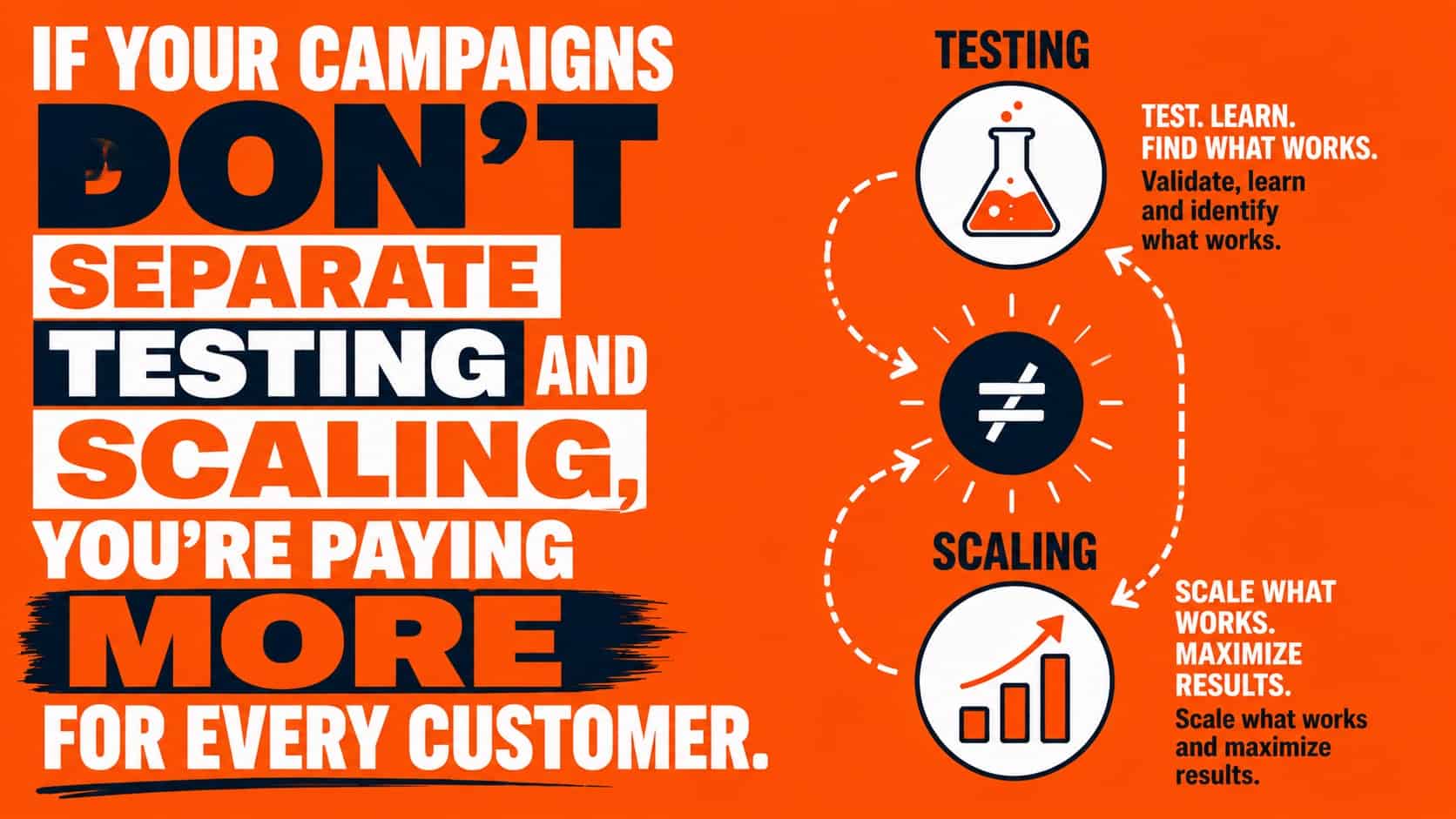
One of the most expensive mistakes in Meta Ads today comes from a confusion that seems harmless at first: using the same campaign environment both to test new creatives and to scale winning ones.
On the surface, it feels efficient. In reality, it usually creates the exact opposite effect:
- higher CPLs
- unstable delivery
- wasted budget
- weaker algorithmic signals
- inconsistent performance
And this is exactly where separating testing and scaling stops being a technical preference and becomes a strategic advantage.
Why Testing and Scaling Require Completely Different Logic
Testing and scaling serve two fundamentally different purposes.
During the testing phase, the system needs exploration.
It needs to compare hooks, messaging angles, visuals, opening sequences, storytelling structures and creative variations to understand what generates strong signals.
Scaling, on the other hand, is not about discovery anymore. It is about amplification.
The problem begins when both objectives coexist inside the same campaign structure.
At that point, budget inevitably starts flowing toward creatives that are still immature and have not yet collected enough data to prove they can sustain larger distribution.
And this creates a very simple consequence: you are paying to teach the system using the same budget that should be driving performance.
The Most Stable Structure Today: ABO for Testing, CBO for Scaling
The accounts that maintain the most stable performance over time increasingly follow a very clear structure.
ABO Campaign for Creative Testing
The ABO campaign exists for exploration.
This is where you introduce:
- new creatives
- new messaging angles
- new copy variations
- different hooks
- alternative visuals
- new promises
- different formats
The goal here is not immediate scale.
The goal is understanding which creatives are capable of generating strong signals.
At this stage, clarity of data matters more than immediate performance.
And this is exactly why ABO still remains one of the most effective frameworks for creative testing: it offers more control over early distribution and makes creative analysis significantly cleaner.
CBO Campaign for Scaling
The CBO campaign enters later.
This is not where you place “potentially good” creatives.
This is where you place only ads that have already proven themselves during the testing phase.
That distinction changes everything.
Because now the budget is no longer spread across unstable assets. Instead, it gets concentrated on creatives that already generated:
- retention
- CTR
- hook rate
- conversions
- strong behavioral signals
At that point, the CBO stops being a discovery environment and becomes an amplification engine.
And that difference is massive.
The Real Point Is Not ABO vs CBO. It’s the Flow Between Them.
A lot of marketers still interpret this structure as a purely technical division.
But the real value lies in the relationship between the two systems.
The framework works when there is a continuous operational flow:
- Test new creatives inside ABO
- Analyze signal quality
- Identify winning ads
- Move them into the CBO
- Let the CBO scale only validated creatives
This creates something incredibly important for the algorithm: cleaner signals.
And Meta today operates almost entirely through signals.
The cleaner the environment, the easier it becomes for the platform to correctly interpret what is actually working.
What Happens When Everything Gets Mixed Together
When testing and scaling coexist in the same campaign environment, the algorithm starts reading data with conflicting intent.
Some ads are still trying to prove themselves.
Others are already performing.
The result is predictable:
- weaker creatives absorb budget
- CPL increases
- distribution becomes unstable
- optimization slows down
- data interpretation becomes less reliable
And the dangerous part is that this usually happens gradually.
The account keeps spending.
It may even continue generating conversions.
But underneath the surface, it is quietly paying far more than necessary for each acquisition.
Meta Now Rewards Operational Clarity
Good creatives alone are no longer enough.
The context in which those creatives are allowed to learn now matters just as much.
Separating testing and scaling creates:
- cleaner data
- faster decisions
- more stable learning
- stronger signal consistency
- more efficient distribution
And most importantly, it reduces one of the most invisible forms of ad waste: scaling creatives that never truly earned the right to scale.
The Most Important Question Today
Most advertisers still ask:
“Which creative will perform best?”
But the more valuable question is often:
“Am I allowing this creative to learn inside the correct environment?”
Because in modern Meta Ads, performance is no longer just about having strong ads.
It is about building a system capable of identifying strong ads as quickly and efficiently as possible.
And this is exactly where separating testing and scaling stops being a technical setup decision and becomes a direct performance lever.