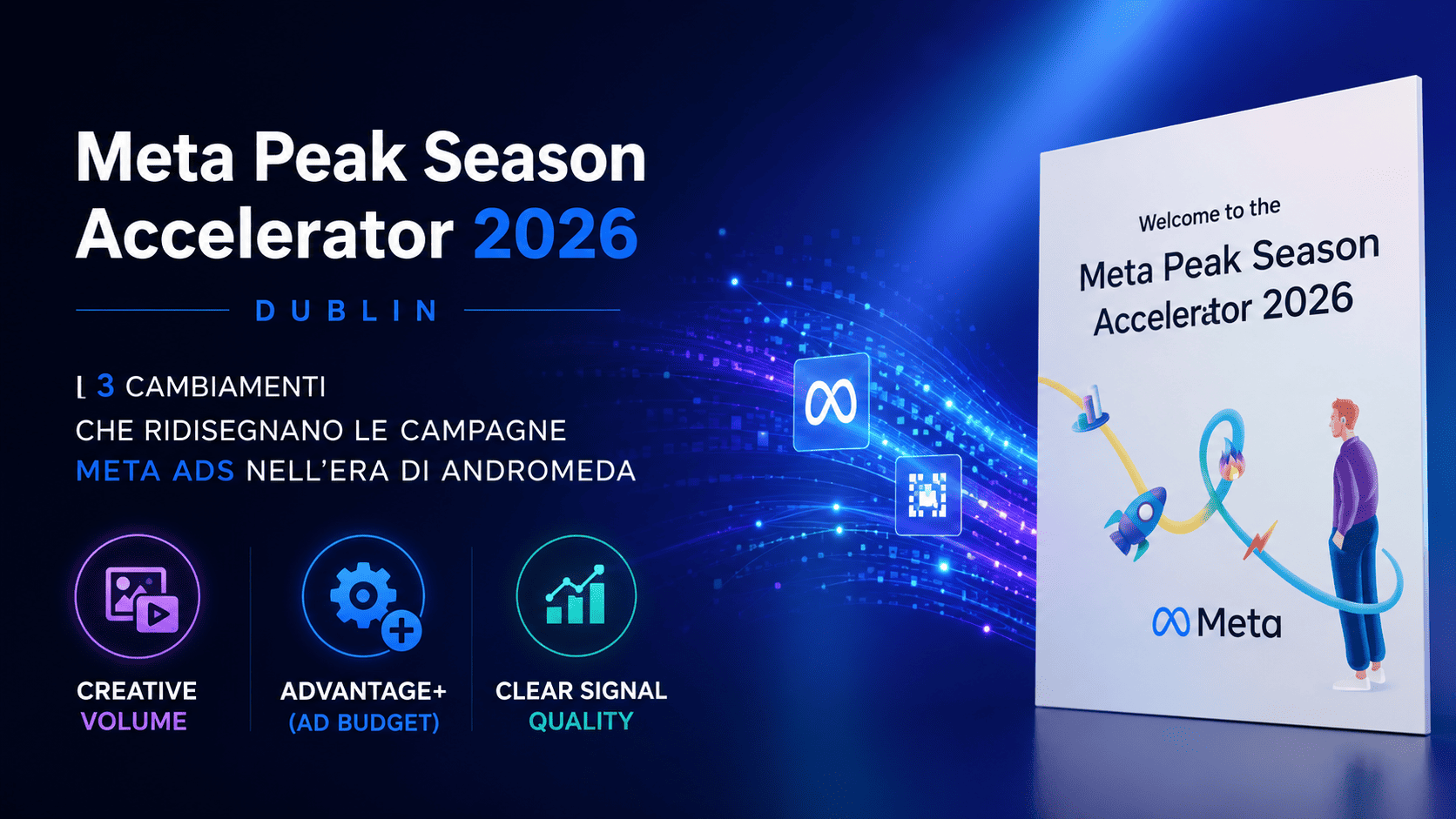
In recent days, Dublin hosted a new edition of the Meta Peak Season Accelerator, the annual event Meta organizes at its EMEA headquarters to prepare agencies and brands for the year’s busiest shopping season. It is not open to the public, no downloadable slides are released, and no official transcripts are published. Yet anyone who has followed this industry for years knows that when the same themes are repeated at every event of this kind, they are no longer simply food for thought. They represent the direction the platform has already taken, and media buyers need to stop treating them as hypotheses.
That direction has a name: Andromeda.
And it comes with three highly practical consequences. Understanding them is increasingly the difference between wasting advertising budget in 2026 and multiplying its effectiveness.
What Is the Meta Peak Season Accelerator and Why Does It Matter?
The Meta Peak Season Accelerator is designed to bring together brands and agency partners several months before the busiest shopping period of the year, from Black Friday through Christmas, although consumer purchasing behavior now begins shifting much earlier than it once did.
Its objective is straightforward: to share consumer insights and operational recommendations that help advertisers align their campaigns with how the platform actually works today rather than how it functioned several years ago.
The reason these events have become increasingly significant over the past two years can be summarized in one word: Andromeda.
Meta’s advertising retrieval system has fundamentally changed the way campaigns are delivered, making many traditional account structures significantly less effective than they once were. Advertisers who still rely on highly granular targeting, layered remarketing, and complex audience segmentation are already discovering that strategies which worked only a short time ago no longer produce the same results.
From Targeting to Signals
To understand why the three major changes are connected, it helps to grasp one core concept.
Andromeda is not an optional feature that advertisers can enable or disable. It is the engine responsible for determining which advertisement enters an auction for which user, often within milliseconds.
Historically, this decision relied heavily on manually selected audiences, interests, demographics, and lookalike segments.
Today, it depends far more on:
- what the advertisement communicates;
- how users respond to it;
- and how reliable the conversion signals are.
In practical terms, targeting has not disappeared.
It has shifted from being the primary driver to becoming merely an initial suggestion.
Creativity has effectively become the new targeting mechanism, while conversion data has become the fuel that teaches the system how to identify future customers.
1. Creative Volume Is No Longer a Best Practice—It Is a Requirement
For many years, creative development was treated as the final stage of campaign production, following audience selection, structure, and budgeting.
Andromeda reverses that hierarchy.
Because the system uses creative assets to understand who should receive an advertisement, providing only two or three active creatives gives it very little information from which to learn.
What This Means in Practice
A practical minimum of five or six genuinely distinct creatives per ad set provides Advantage+ with enough variation to identify meaningful patterns.
Creative refresh cycles must also accelerate significantly.
Ads that previously remained effective for several weeks may now experience creative fatigue within only a few days, especially during periods of increased advertising competition.
Most importantly, differentiation must be genuine rather than cosmetic.
Changing background colors or making small headline edits does not create meaningful variation. What improves performance are different angles, hooks, offers, storytelling approaches, and formats, including static images, UGC, and video.
Creative volume should therefore be treated as an operational process rather than simply an output metric.
The more meaningful variation advertisers provide, the more effectively the system can identify winning audience relationships.
2. Advantage+ Is Becoming the Default Starting Point
The second major shift concerns campaign architecture itself.
For ecommerce advertisers, Advantage+ Shopping Campaigns, and for many other objectives, Advantage+ Audience, are no longer experimental features to test occasionally.
They are increasingly becoming the platform’s recommended default.
Operational Implications
Original Audience comparisons may still be useful during the first weeks of launching a new objective or account to benchmark automation.
After that period, however, continuing to split budget between manual and automated structures often dilutes performance.
Simpler account structures frequently outperform fragmented funnels containing dozens of narrowly segmented campaigns and ad sets.
This is not because simplicity is fashionable.
It is because Andromeda requires concentrated conversion data to learn efficiently, while excessive fragmentation limits learning by dividing available signals into datasets that are too small.
Strategic control has not disappeared.
It has moved upstream toward creative quality, conversion event selection, and essential exclusions such as geography or age, rather than detailed audience construction.
3. Signal Quality Determines Who Wins
Perhaps the most immediately impactful theme is signal quality.
If Andromeda learns from conversion events, incomplete, duplicated, or inconsistent data does not simply reduce reporting accuracy.
It actively slows the platform’s learning process.
Critical Areas to Verify
Pixel and Conversion API implementations should be carefully maintained to avoid duplicate events or inconsistent parameter values.
Optimization should focus on the deepest conversion event capable of producing sufficient weekly volume.
Optimizing only for landing page views may generate inexpensive traffic while providing weak learning signals.
Deduplication across Pixel, Conversion API, and CRM integrations is equally important.
When identical events are counted multiple times, the platform receives misleading information about user behavior, reducing optimization accuracy across the entire campaign.
For many lead generation businesses, this also means moving beyond generic lead events toward downstream qualification events whenever possible.
The Common Thread
Creative diversity, Advantage+ automation, and signal quality are not independent topics.
They reinforce one another.
The more creative variation advertisers provide, the more effectively Advantage+ can perform retrieval.
The cleaner the conversion signals, the faster the system identifies valuable audiences.
Ultimately, all three principles serve the same objective: giving Andromeda less reason to guess and more reason to know.
A Reflection on the Andromeda Framework
Looking across the discussions emerging from the Meta Peak Season Accelerator, one consistent pattern becomes impossible to ignore.
At first glance, creativity, Advantage+, and signal quality appear to be separate topics.
In reality, they represent different expressions of the same transformation.
For years, media buying revolved around maximizing manual control through audience definitions, exclusions, layered remarketing, and increasingly complex campaign structures.
Meta’s evolution points in the opposite direction.
Control has not disappeared.
It has shifted.
Competitive advantage now comes less from building intricate account architectures and more from supplying better inputs: stronger creatives, cleaner data, more reliable conversion events, and faster testing processes.
This observation forms the foundation of what many describe as the Andromeda Framework: an approach that focuses not on individual platform features, which inevitably evolve, but on the broader principles driving Meta’s automation strategy.
From that perspective, the ideas highlighted during the Peak Season Accelerator are not surprising.
They simply confirm a direction that has been visible for some time.
Targeting continues to lose importance, while creativity, data quality, and signal integrity increasingly determine whether the system can identify the right person at the right moment.
The challenge is no longer learning how to manually locate the ideal customer.
It is learning how to help the algorithm recognize them.