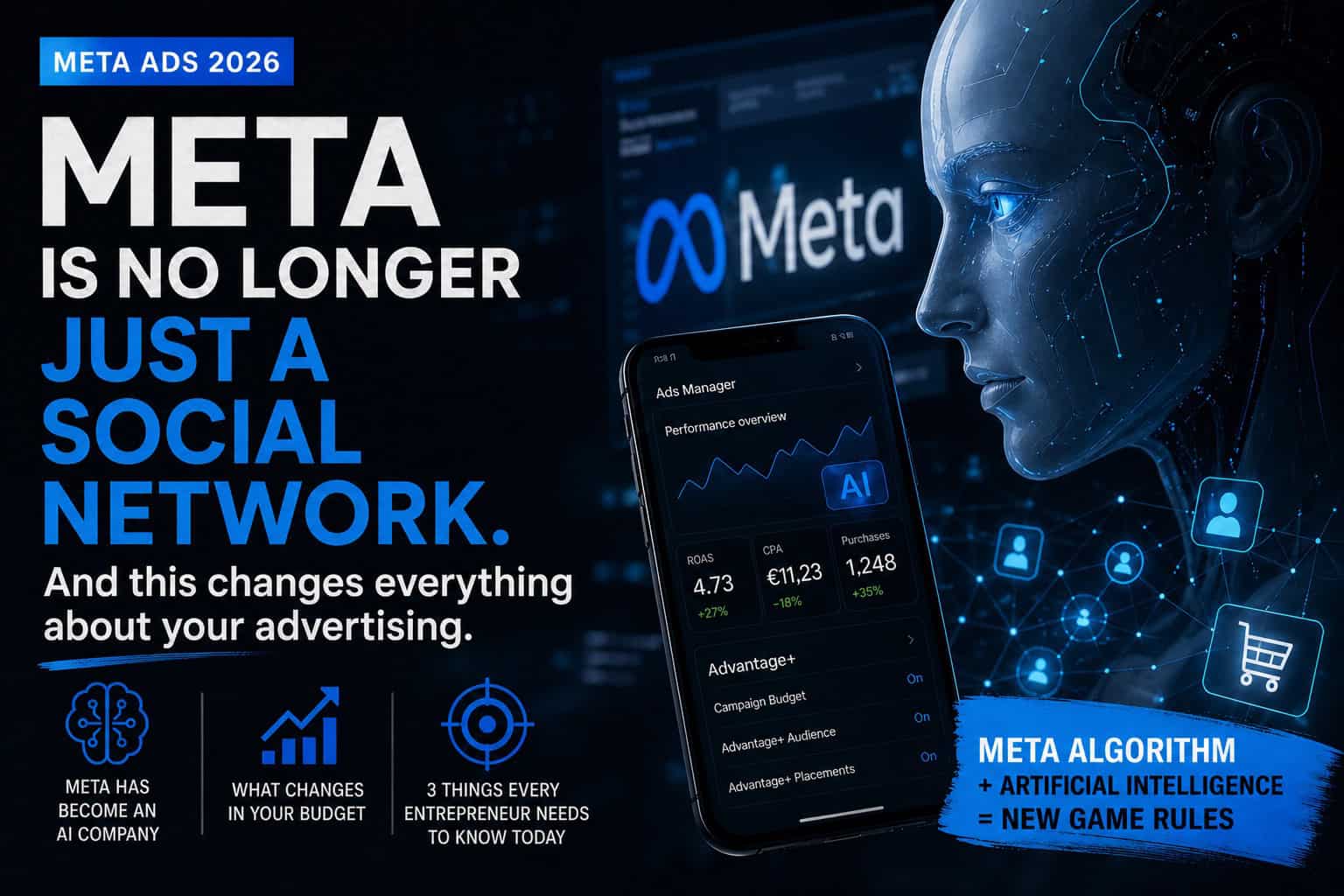
In 2026, Meta spent more on artificial intelligence than Facebook invested during the early years of its history. This is not just a financial report detail, it is a structural signal. It means that what we are using today for advertising is no longer a social platform in the traditional sense, but a decision-making system based on predictive models that read, interpret, and distribute content according to signals.
And this is exactly where Meta Ads 2026 begins to change its nature.
What has really changed in Meta Ads 2026
When talking about updates, people often make the mistake of reading them as isolated features: a new option, a new button, a new metric. In reality, what has happened over the last few months is much deeper and concerns the architecture of the system itself.
The introduction of models like Muse and Spark, together with the exponential increase in AI capex, is not an incremental evolution but a real paradigm shift: Meta no longer simply distributes content, it decides which content deserves distribution.
This shift is already visible when looking at how delivery logic changed after the introduction of systems like Andromeda AI, where the concept of manual targeting is progressively replaced by a probabilistic reading of behavior.
It is no longer “who should I show this ad to,” but “how likely is this content to generate a useful signal for the system.” And this is the real transformation of Meta Ads 2026.
Why this directly impacts your advertising budget
If the system decides based on signals, your budget is no longer buying visibility, but learning capacity.
This is the point that is often underestimated.
When you invest in Meta Ads 2026, you are not paying to reach a defined audience, but to feed a model that needs to understand what works and what does not. And this is exactly where the difference appears between those who scale and those who stay stuck.
A budget spread across weak or inconsistent creatives generates useless data. A budget concentrated on content structured to produce clear signals accelerates learning and lowers the system’s decision cost.
This change in logic is consistent with what we have already seen in parallel areas, such as the shift from traditional SEO to AI-focused optimization, where the goal is no longer keyword optimization, but semantic interpretability.
Advertising is following the same path.
Meta has become AI-first: what this means operationally for Meta Ads 2026
Saying that Meta has become an AI company is correct, but it risks remaining too abstract if we do not translate it into practical implications.
An AI-first system has three main characteristics.
The first is that it prioritizes dynamic signals over static rules. This means your campaigns are no longer read as rigid structures, but as evolving data flows.
The second is that it progressively reduces manual control in favor of automated optimization. We have seen this clearly in the evolution of Advantage+ campaigns and in the gradual loss of importance of manual targeting.
The third is that it shifts competitive advantage from technical setup to content quality. It is no longer about who configures the campaign better, but who generates better signals.
This is perfectly aligned with what emerges in broader analysis: structure matters less than the ability to feed the system with useful data.
Three things every business owner needs to know today
The first is that the effective minimum budget has increased, not because of a commercial decision, but because an AI-based system needs more data to function properly. Spending too little does not mean being cautious, it simply means not giving the system enough information to optimize.
The second is that creativity is no longer an accessory variable, but the core of performance. In Meta Ads 2026, every piece of content is a test, every test is a signal, and every signal becomes a system decision. Continuing to work with only a few creatives means slowing down the decision-making process.
The third is that time has become a strategic variable. There are no more “instant campaigns.” There is a learning phase that must be respected and used properly. Interrupting, changing, or judging a campaign too early means interfering with the optimization process.
Conclusion: it is no longer about the platform, but the model
The point is not whether Meta works or whether Facebook Ads are still effective. The point is understanding that we are working with a completely different system compared to just a few years ago.
Those who continue thinking in terms of audience, interests, and manual segmentation are using a logic the system has already left behind.
Those who start thinking in terms of signals, creativity, and learning are simply aligning their advertising strategy with the way the platform now makes decisions.
And in Meta Ads 2026, this difference is not theoretical. It is what separates those who get results from those who keep chasing them.