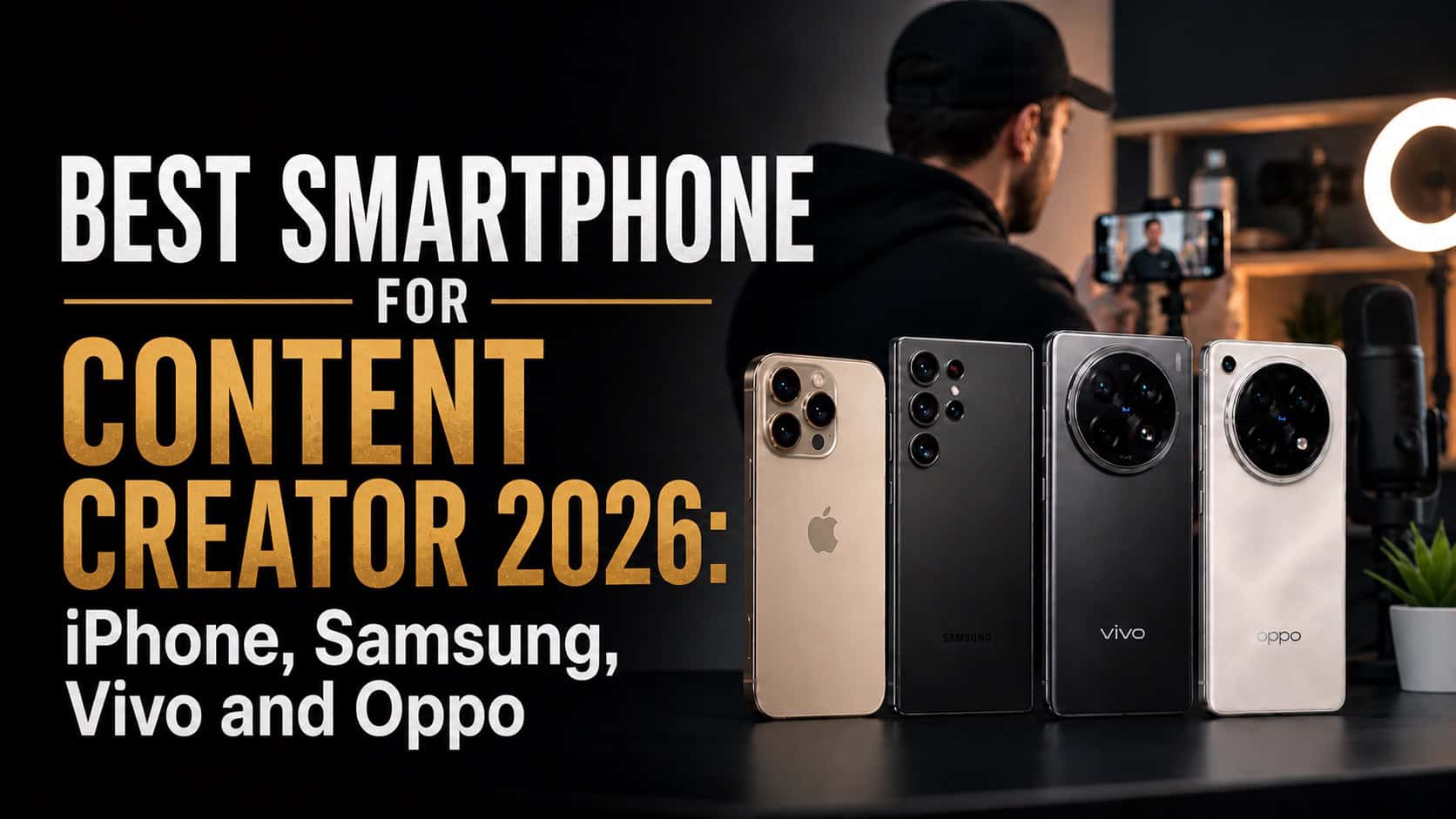
Choosing the best smartphone for creators in 2026 is no longer something that can be solved by simply looking at a spec sheet or comparing numbers, sensors, and megapixels. The context in which these devices are used has changed radically, and today the real difference is not the absolute image quality, but the ability to quickly turn an idea into published content, maintaining operational continuity and reducing as much technical friction as possible.
In recent years, creator work has progressively shifted toward a completely mobile-first model, where the smartphone is no longer a support tool but the center of the production process. This means that choosing the right device must take into account not only visual quality, but also audio management, compatibility with external accessories, app stability, and how easily you can move from recording to publishing.
The paradigm shift: from image quality to content production capacity
The smartphone market stopped competing only on photographic quality a long time ago, because that level is now so high that it is more than enough for most uses. The real difference today lies in how smoothly the device fits into a content production system that needs to be fast, continuous, and interruption-free.
For a creator, the decisive variables are processor speed for handling video files, real compatibility with microphones, gimbals, and external tools, and above all, interface quality—how easy it is to use the device without constantly dealing with settings, workarounds, or technical friction that wastes time and focus.
Apple iPhone 17 Pro: operational continuity and reduced friction
The iPhone 17 Pro continues to be the benchmark for a wide category of creators, not because it is necessarily the most advanced device in absolute terms, but because it offers the highest level of operational continuity.
Apple highlights its A19 Pro chip, Pro camera system, 48MP rear cameras, and 4K Dolby Vision video at 120 fps, with strong stability across recording and editing workflows .
The real advantage appears in daily use: connecting an external microphone, opening the camera app, recording, and publishing requires almost no friction. This linear workflow drastically reduces the time between idea and published content, which is often the most important metric for social-first creators.
Samsung Galaxy S26 Ultra: technical control and advanced versatility
The Galaxy S26 Ultra positions itself very differently. It does not focus on simplicity, but on completeness, offering a high level of technical control for creators who want to intervene directly in every aspect of production.
It is heavier and less immediate for handheld use, but compensates with strong multitasking power and advanced video tools. For creators working on YouTube videos or more structured productions, the ability to manually manage audio sources, microphone levels, and video parameters can be decisive.
This control comes with more operational complexity, so it is ideal for those who want precision rather than speed.
Vivo X300 Ultra: image quality and visual output
The Vivo X300 Ultra stands out mainly for visual quality, positioning itself as one of the most advanced devices from a pure photography perspective.
Its strength lies in portraits, color management, depth, and high-end visual rendering. For creators whose priority is aesthetic output—fashion, portrait, beauty, editorial visuals—it can feel closer to a professional camera than a typical smartphone.
The limitation appears when considering the full workflow. Social platform integration and app ecosystem fluidity are still not as seamless as with the main competitors, which can introduce extra steps before publishing.
OPPO Find X9: the cameraphone as strategic direction
The Oppo Find X9 is probably the most interesting case because it shifts the focus from smartphone to cameraphone—a device designed first for visual production.
Oppo builds its positioning around the idea that the smartphone can increasingly replace a traditional camera, offering high-end results without requiring extra tools.
This approach is especially relevant because it captures a growing trend, but there are still some limitations regarding accessory compatibility, app management, and publishing speed. It is a strong direction, but not yet the most frictionless solution.
Camera, interface, and compatibility: what really matters
Looking at these devices together, it becomes clear that the comparison cannot be reduced to a simple ranking.
Each model responds to a different logic:
- iPhone minimizes friction and allows continuous work
- Samsung offers control and versatility for advanced technical needs
- Vivo maximizes visual quality
- Oppo anticipates a future where photography becomes the center of the workflow
None of them can be considered universally better without considering the creator’s actual workflow.
Other brands worth considering
Alongside these main models, there are other devices worth attention:
- Google Pixel for AI integration and computational photography
- Xiaomi for the balance between performance and price
- Huawei for photographic quality, although its creator workflow integration is still more limited
Which one should you really choose
The final choice depends on the type of content you produce and how you work.
Creators producing fast and frequent content will often find the iPhone the most efficient system.
Those who need deeper technical control may get more value from Samsung.
Those prioritizing pure visual quality may prefer Vivo.
And those looking ahead to where the market is going may find Oppo’s direction especially interesting.
The best smartphone for creators in 2026 is not the one with the most advanced spec sheet, but the one that allows you to work without interruptions, maintaining speed and continuity from recording to publishing.
Because in a world where content distribution matters more than content production, execution speed becomes the real competitive advantage.