In recent months, people have been talking more and more about AI agents, but in most cases the narrative remains superficial because it swings between two equally misleading extremes. On one side, there are those who present them as the ultimate solution that will completely automate marketing. On the other, there are those who reduce them to simple advanced chatbots, without understanding the paradigm shift they are introducing into the system.
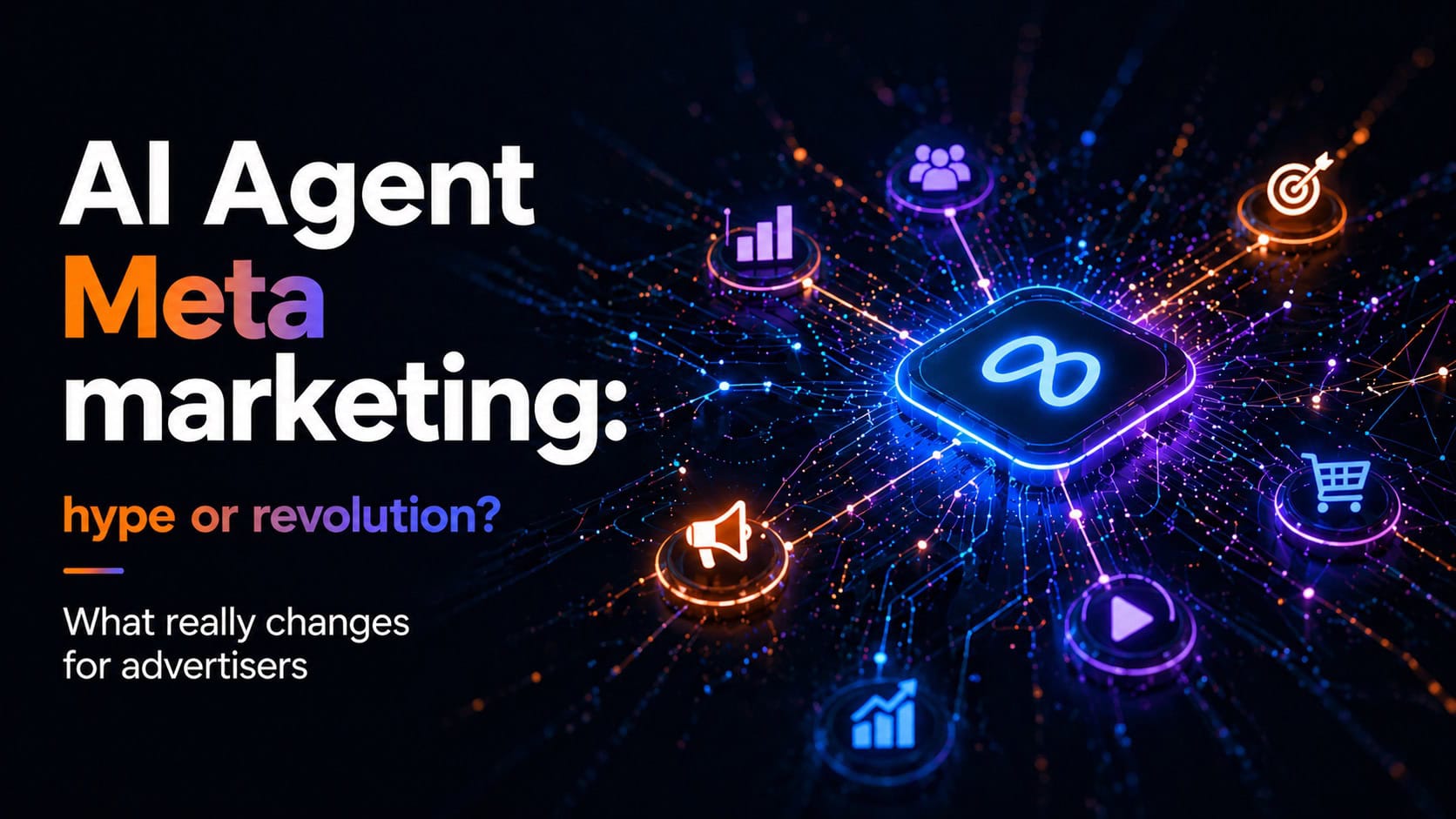
The truth, as often happens, lies somewhere in the middle, but above all in the way these agents fit into the ecosystem of Meta AI agent marketing, where they are not an isolated feature, but a coherent extension of the AI-first logic that Meta is building.
What AI agents really are in marketing
When we talk about AI agents, we are not talking about tools that automatically reply to messages or manage a chat in a more or less intelligent way. We are talking about systems designed to make operational decisions within a defined context, using data, memory, and adaptive capabilities.
In the context of Meta AI agent marketing, this means that user interaction stops being an accessory step and becomes an integral part of the conversion process. The agent does not simply reply, it interprets behavior, adapts the message, and guides the user toward a decision.
It is the same type of evolution we observed when the advertising system moved from static logic to predictive models, where the focus shifted from configuration to the system’s ability to learn.
AI agents are simply the next step: from optimizing distribution to optimizing relationships.
What Meta is building in this direction
To understand the direction, you should not look at individual features, but at the full set of moves Meta is making, because that is where the strategy becomes visible.
The integration of Meta AI inside the platform ecosystem, the development of systems like Manus, and the evolution of conversational shopping experiences all point toward a very clear trajectory: progressively reducing the number of steps between discovery and purchase.
In the traditional model, a user sees an ad, clicks, lands on a landing page, reads, evaluates, and eventually converts. In the model emerging through Meta AI agent marketing, this flow is compressed because conversation becomes the place where both discovery and decision happen.
This is perfectly aligned with what has already emerged in the evolution from passive interaction to guided interaction.
How the funnel changes: from click to conversation
The most relevant change is not the tool itself, but the structure of the funnel.
For years, we have reasoned in terms of a linear sequence: ads, click, landing page, conversion. A model that worked because it clearly separated attention, evaluation, and decision.
With the introduction of Meta AI agent marketing, this separation begins to disappear because the user is no longer directed toward static content, but enters a dynamic environment where they can ask questions, receive answers, and move forward in the decision-making process without leaving the platform.
This does not mean landing pages will disappear, but they will lose centrality, because part of the work that previously happened outside the platform is now absorbed into the conversational experience.
It is a transition similar to what we are seeing on the content side, where distribution and interpretation are becoming more important than creation itself.
Who should worry now and who can wait
Not everyone needs to react at the same time, and this is where a less emotional and more strategic reading is necessary.
For those already working with high traffic volumes and structured funnels, ignoring Meta AI agent marketing means progressively losing efficiency, because the system will increasingly favor smoother and more integrated experiences.
For those who still have a simpler structure or are still building the foundation, the change is less urgent, but not irrelevant. The direction is already clear, and arriving late will simply mean adapting under worse conditions.
The point is not whether to adopt these systems, but when and with what level of integration.
Conclusion: it is not hype, but a change in marketing’s interface
Reducing AI agents to a trend, or on the opposite side considering them an immediate and total revolution, are two mirrored mistakes born from the same lack of systemic understanding.
What is happening is subtler, but also more structural: the interface through which marketing happens is changing.
No longer static pages and linear paths, but dynamic environments where users interact, ask, receive, and decide.
And within Meta AI agent marketing, this means that competitive advantage will no longer be only in the ability to generate traffic, but in the ability to manage the conversation that follows.
Those who understand this shift early are not simply adopting a new technology, they are adapting their marketing model to a system that, once again, has already started to change.