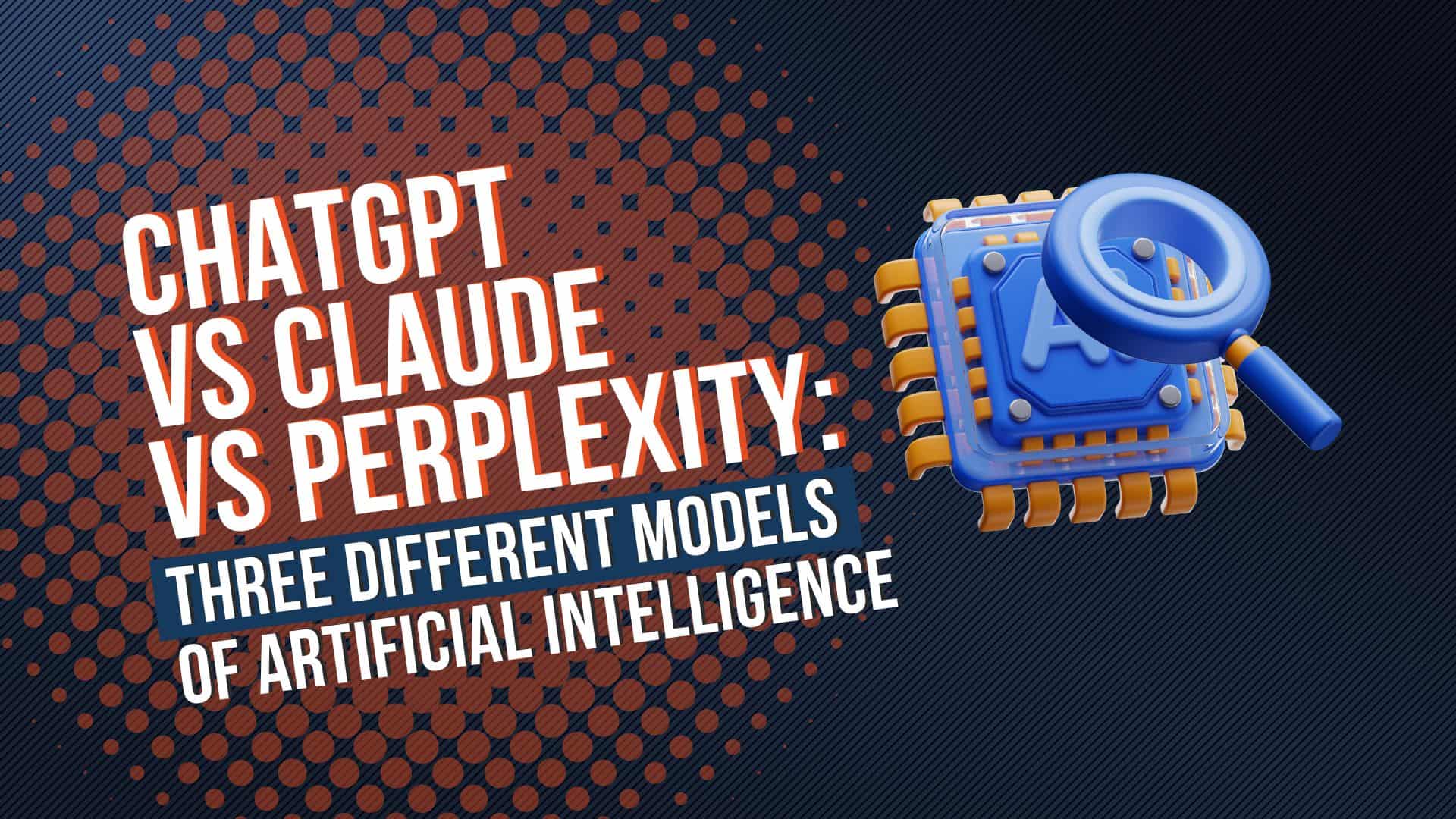
To truly understand these platforms, it’s important to look beyond their visible features. Each of these tools was designed with a different technological philosophy.
We can summarize the three main categories like this:
- ChatGPT → universal AI assistant
- Claude → analytical AI
- Perplexity → AI-powered search engine
A fourth emerging category is now joining them:
- AI agents → autonomous systems that execute tasks
These differences are not just technical. They define how artificial intelligence is integrated into everyday work.
ChatGPT: The Universal AI Assistant
ChatGPT, developed by OpenAI, is the most widely used conversational AI assistant.
Its main strength is versatility. It can be used for a wide range of tasks, including:
- content writing
- strategic brainstorming
- coding support
- text analysis
- idea generation
This flexibility makes ChatGPT one of the most widely used tools among professionals and marketers.
The main limitation concerns access to real-time information. ChatGPT is not designed as a search engine and often needs to be combined with other sources.
Claude: The Analytical AI
Claude, developed by Anthropic, represents a slightly different approach.
The system is designed with a strong focus on:
- reasoning quality
- safety
- handling very large contexts
One of its most interesting capabilities is the ability to analyze large volumes of text within a single conversation.
For this reason, Claude is often used for tasks such as:
- document review
- report analysis
- summarizing complex texts
- producing long-form content
Claude is therefore particularly effective when work requires deep analysis and organization of complex information.
Perplexity: The AI Search Engine
Perplexity AI represents a completely different model compared to conversational assistants.
The platform is designed as an AI-powered search engine capable of querying the web in real time and summarizing results.
The system performs three main operations:
- searches for information online
- analyzes available sources
- produces a documented summary
Its distinctive feature is the presence of sources directly within the generated responses.
This approach reflects a broader transformation in online search, linked to the evolution of SEO toward models such as Answer Engine Optimization (AEO).
Perplexity therefore becomes particularly useful for documented research and rapid information analysis.
AI Agents: The New Frontier of Artificial Intelligence
Alongside these platforms, a new technological category is emerging: AI agents.
Unlike chatbots, these systems do not only generate responses but can execute operational tasks directly.
Examples of tasks an AI agent can perform include:
- data collection
- information analysis
- report generation
- automation of digital workflows
One example of this new generation of tools is Manus.
AI agents may represent one of the most important evolutions of artificial intelligence in the coming years.
When to Use ChatGPT
ChatGPT is ideal for creative and strategic activities, such as:
- writing content
- brainstorming
- developing ideas
- marketing support
In these contexts, AI can accelerate the creative process and improve productivity.
When to Use Claude
Claude becomes particularly useful when work requires deep analytical processing.
It is often used for:
- document analysis
- reviewing long texts
- organizing complex information
In these scenarios, its ability to handle large context windows provides a significant advantage.
When to Use Perplexity
Perplexity is one of the most effective tools for information research.
It is especially useful for:
- verifying sources
- summarizing articles
- analyzing news
- gathering information quickly
In practice, it functions as a new generation of conversational search engine.
The Future of the AI Ecosystem
One of the most common mistakes in discussions about artificial intelligence is assuming there is a single best tool.
In reality, the market is evolving toward an ecosystem of specialized tools.
Conversational assistants, AI search engines, and autonomous agents represent three complementary directions of technological evolution.
In the future of digital work, these categories will likely be used together within the same workflow.
Conclusion
ChatGPT, Claude, and Perplexity are not simply three different platforms—they represent three distinct ways of using artificial intelligence.
- ChatGPT excels in creativity and content generation
- Claude stands out in analysis and information organization
- Perplexity redefines how we search and synthesize data online
Alongside these platforms, AI agents are emerging as systems designed to perform operational tasks autonomously.
For professionals and companies, the real question is not which AI is best, but which AI to use for each type of work.
Understanding these differences is the first step toward truly integrating artificial intelligence into digital workflows.