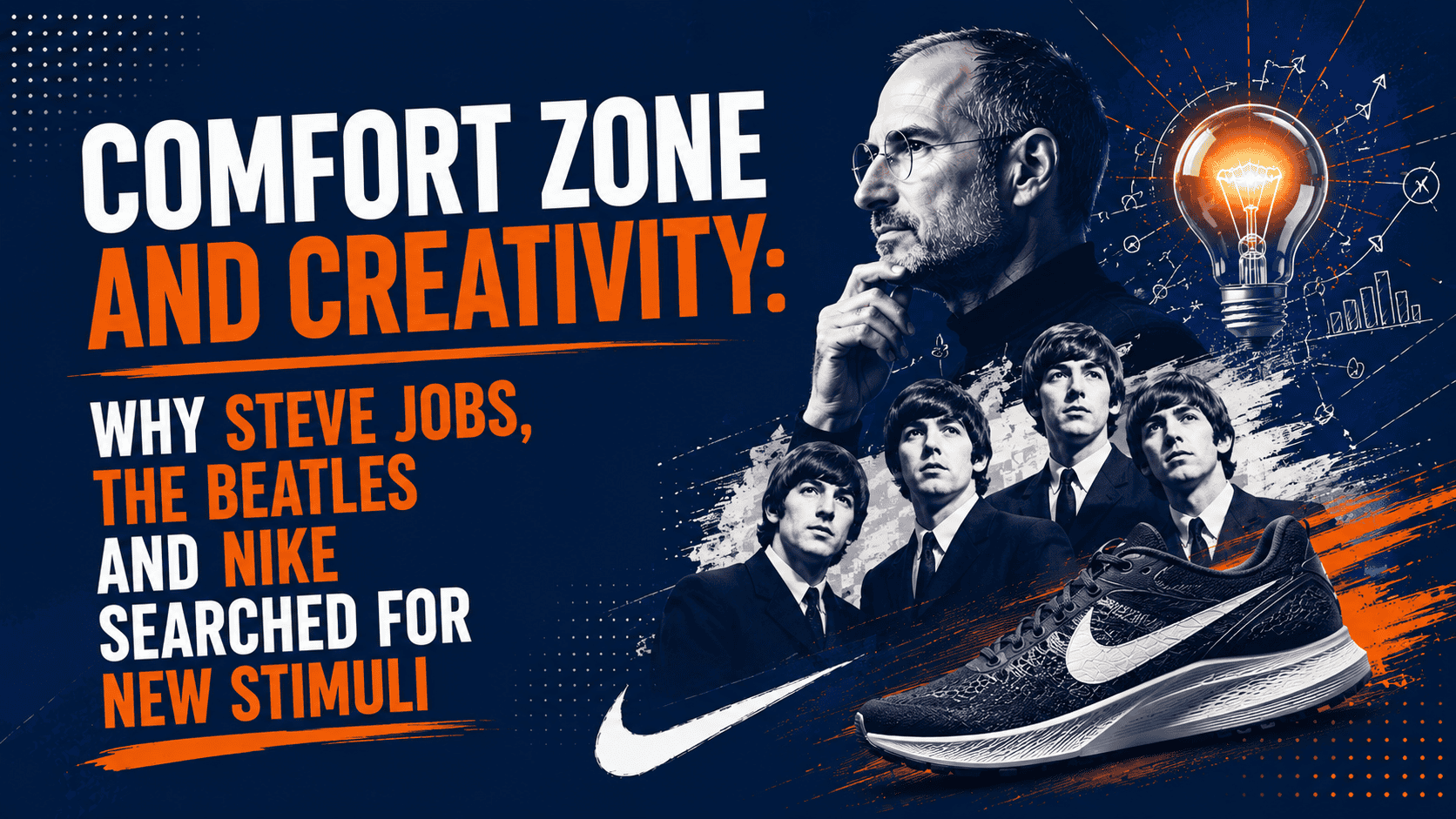
In the journey toward personal growth, innovation and the development of truly original ideas, one element appears far more often than people realize: changing environments.
This is exactly why the relationship between comfort zone and creativity becomes so interesting. It is a theme that connects profoundly different figures through one surprisingly similar dynamic.
Before building Apple, Steve Jobs spent time in India.
Before becoming the most influential band in modern music history, The Beatles spent years in Hamburg.
Before founding Nike, Phil Knight traveled through different countries, cultures and markets.
At first glance, these experiences seem unrelated.
But when analyzed more carefully, they all share the same principle:
moving away from familiar environments in order to expand the way reality is perceived.
And this is precisely where one of the most important aspects of modern creativity emerges.
New ideas rarely come from endlessly repeating what is already known.
More often, they emerge through exposure to unfamiliar stimuli, perspectives and situations capable of interrupting mental patterns and automatic thinking.
Comfort Zone and Creativity: Why Stability Can Become a Limitation
The comfort zone itself is not necessarily negative.
In many situations, stability creates organization, continuity and efficiency.
The problem appears when that same stability gradually turns into a closed environment where ideas, references and perspectives begin circulating in repetitive loops.
Spending too much time inside the same contexts often creates a subtle but powerful effect:
- conversations become predictable
- viewpoints start looking identical
- available solutions feel increasingly limited
In these situations, the absence of new ideas is often mistaken for a lack of talent or inspiration.
But in reality, the issue is frequently much simpler:
limited exposure to different experiences.
Sometimes creativity is not missing.
What is missing is an environment capable of forcing the mind to create new connections.
Why Changing Environments Stimulates New Ideas
There is also a more concrete explanation behind this dynamic.
Several studies in cognitive psychology have shown that exposure to different cultures, habits and environments increases mental flexibility.
One of the most frequently cited studies, conducted by William Maddux and Adam Galinsky, specifically explored the relationship between international experiences and creativity.
The research showed that immersion in different environments increases the ability to:
- connect distant ideas
- reinterpret problems
- develop unconventional solutions
This happens because change interrupts consolidated mental patterns.
When people encounter unfamiliar social behaviors, rhythms or cultural systems, the brain is forced to continuously reorganize its interpretation of reality.
From this process emerge several important effects:
- stronger associative thinking
- greater cognitive flexibility
- new ways of interpreting problems
And this is exactly why changing environments becomes such a powerful tool for creativity and innovation.
Steve Jobs, The Beatles and Nike: Three Stories Connected by the Same Principle
When observing the paths of some of the most influential figures of recent decades, one recurring pattern becomes obvious:
before growth often comes a phase of distancing from familiar environments.
Steve Jobs and India
Before becoming the symbol of modern technological innovation, Steve Jobs spent time in India searching for spiritual and cultural experiences radically different from the environment where he grew up.
Beyond the biographical aspect, what makes this experience significant is the transformative power of detachment.
Changing environments during formative periods interrupts existing references and opens space for entirely new mental associations.
Many of the ideas that later defined Apple’s philosophy — simplicity, intuitive design and the fusion between technology and human experience — were deeply connected to this broader perspective.
The Beatles and Hamburg
The Beatles experienced a very similar process before global success.
Their years in Hamburg represented far more than a musical residency abroad.
Performing every night in front of unfamiliar audiences, far from home and in a far less protected environment, accelerated their artistic and professional growth dramatically.
Hamburg became a creative laboratory where the band refined:
- stage presence
- musical identity
- performance discipline
Growth often accelerates in unfamiliar environments because adaptation becomes unavoidable.
Phil Knight and the Birth of Nike
Phil Knight also developed many of the ideas that would later shape Nike during long periods of travel and international observation.
This is one of the most powerful effects of changing perspective:
it reveals possibilities that routine often hides.
The Real Advantage of Leaving the Comfort Zone
Changing environments does not automatically generate talent.
Nor does it replace discipline, competence or consistency.
What it can do, however, is fundamentally alter the way reality is observed.
When people remain too long:
- in the same environments
- with the same habits
- surrounded by the same references
- inside the same mental structures
they often begin confusing what is familiar with what is actually possible.
Different experiences introduce interruptions, uncertainty and alternative perspectives.
And very often, innovation emerges precisely inside those moments of discontinuity.
Creativity, Business and Innovation Often Grow Outside Familiar Patterns
The relationship between comfort zone and creativity applies across multiple dimensions.
Personal Growth
Exposure to different environments helps redefine priorities, beliefs and ambitions.
People often evolve faster when repetitive behavioral patterns are interrupted.
Creativity
Creativity is not simply spontaneous inspiration.
It is frequently the ability to combine distant elements into something new.
The more varied experiences people accumulate, the more mental material becomes available for creating unexpected connections.
Business
In entrepreneurship, stepping outside routine often allows people to notice signals others completely miss.
New markets, cultures and behaviors can reveal opportunities impossible to recognize inside conventional frameworks.
Innovation
Innovation almost always requires breaking away from existing assumptions.
Changing perspective facilitates exactly this process because it forces people to question what normally feels obvious.
It Does Not Always Require Extreme Change
This principle should not necessarily be interpreted radically.
Leaving the comfort zone does not always mean moving across the world.
The essential point is intentional exposure to difference.
Sometimes this happens through travel or international experiences.
Other times it emerges by:
- entering unfamiliar professional environments
- meeting people outside one’s industry
- engaging with ideas far from daily routines
What truly matters is interrupting the automatic repetition of identical stimuli.
The Real Lesson Behind These Stories
The experiences of Steve Jobs, The Beatles and Phil Knight all reveal one surprisingly simple principle:
before growth often comes distance from what feels familiar.
Not to escape reality.
But to observe it differently.
Exposure to unfamiliar environments changes how people interpret problems, opportunities and possibilities.
And when perspective changes, ideas, decisions and long-term outcomes inevitably change as well.
Which is why, when creativity feels blocked or opportunities start looking repetitive, the most useful question may no longer be:
“What am I missing?”
but rather:
“Inside which environment have I continued thinking in exactly the same way?”