Meta is not introducing new tools.
It is changing the way advertising works.
For years, digital advertising has been built on a relatively clear structure: define the audience, create the content, distribute the budget, optimize performance. A process that, while complex, was still interpretable, controllable, and in many ways predictable.
Today, that model is no longer sufficient.
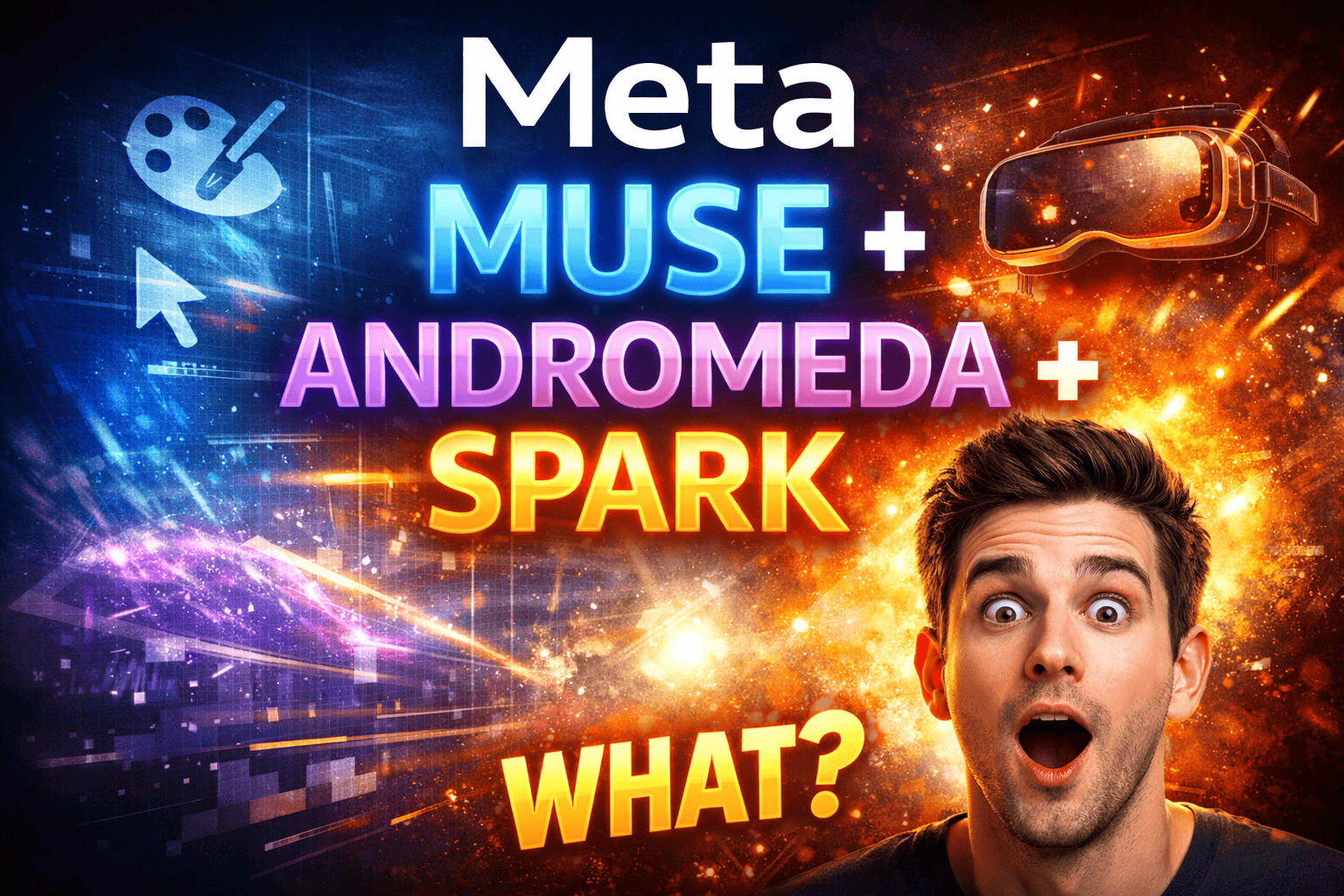
With the evolution of artificial intelligence, Meta is no longer working as a platform that executes instructions. It is becoming a system that interprets signals. And within this transformation, three distinct yet complementary directions are emerging: Muse, Andromeda, and Spark.
Understanding these three layers does not simply mean understanding new technologies. It means understanding how the relationship between creativity, distribution, and scale is being rewritten.
Meta Muse Spark and Andromeda: three layers, one transformation
When we talk about “Meta Muse Spark and Andromeda,” we are not referring to a single unified system, but to three different trajectories that operate on separate levels and, at the same time, define a new ecosystem.
Muse acts on creative generation.
Andromeda governs distribution.
Spark enables scale and execution.
The point is not the individual tool, but how these layers interact.
For the first time, creativity is no longer just a human output. Distribution is no longer just a budget decision. And scaling is no longer just a matter of increasing spend.
Everything becomes interconnected.
Meta Muse: when creativity becomes a system
Meta Muse represents a shift that many are still underestimating: creativity is no longer just produced, it is generated, tested, and iterated within the system.
Its logic is not simply to “create images,” but to structure content variations that can adapt to different contexts, formats, and audiences in real time. This means that the concept of a single creative asset begins to lose relevance.
In practical terms, this changes the entire approach to advertising.
It is no longer about finding the “winning creative,” but about building a system capable of continuously producing variations, where each output becomes a signal for the next iteration.
This is where many advertisers get it wrong: they continue to think in terms of static assets, while the system is already reasoning in terms of dynamic creative flows.
Andromeda: distribution is no longer control, it is interpretation
If Muse changes how content is created, Andromeda changes how it is distributed.
Here, the shift is even deeper.
For years, media buying has been based on control: choosing audiences, defining budgets, structuring campaigns, managing optimization. With Andromeda, this logic becomes secondary.
The system no longer executes targeting instructions. It interprets signals.
Every interaction — a view, a pause, a scroll, a click — becomes information that feeds distribution. And this means that performance is no longer determined only by what you set, but by how the system reads user behavior.
This is exactly the logic at the core of the Framework Andromeda (here the link to download the book and access additional free content), where the focus shifts from “who to target” to “how to generate readable signals for the system.”
The real change is not technical, but conceptual: you are no longer telling the algorithm who to find. You are building conditions so that the system can understand who is truly interested.
Spark: scaling is no longer just budget
The third layer, Spark, represents a dimension that is often misunderstood.
It is not simply about augmented reality or creative tools. It is about the ability to turn content into scalable experiences.
Scaling, in this context, is no longer just increasing budget or duplicating campaigns. It means amplifying what already works through formats, interactions, and experiences that can extend reach and engagement.
This is where many campaigns break.
They manage to produce good content, sometimes even generate strong signals, but fail to scale because they lack a system that transforms those signals into sustained growth.
Spark operates exactly at this level: it enables expansion, not just execution.
From media buyer to system designer
At this point, the shift becomes clear.
The role of the media buyer is no longer limited to managing campaigns. It requires a different level of thinking, where technical skills remain necessary but are no longer sufficient.
You need analytical capabilities to read signals, interpret data, understand how different layers interact. But at the same time, you need a systemic vision to connect creativity, distribution, and scale into a coherent structure.
The real risk today is not technological complexity.
It is continuing to apply old mental models to a system that no longer works that way.
Those who keep thinking in terms of audiences, budgets, and isolated creatives will find themselves increasingly disconnected from how platforms actually operate.
Those who understand this shift, on the other hand, will start building systems instead of campaigns.
Conclusion: what really changes for those doing advertising
Meta Muse, Andromeda, and Spark are not just new names to learn. They represent a structural transformation that forces a reconsideration of how advertising is designed.
Creativity becomes a continuous process, not a deliverable.
Distribution becomes interpretation, not control.
Scaling becomes system design, not budget increase.
For professionals, this means evolving their role.
>For companies, it means rethinking how they approach growth.
>For creators, it means understanding that content is no longer just expression, but data.
The difference, in the coming months, will not be between those who use these tools and those who don’t.
It will be between those who understand the system and those who are still trying to control it.