For years, advertising revolved around a seemingly untouchable dogma: one clear promise, unique and repeated over time until it became recognizable.
The Unique Selling Proposition shaped campaigns, messaging and brand identities for decades. It worked because audiences were treated as relatively homogeneous groups and because distribution systems were linear.
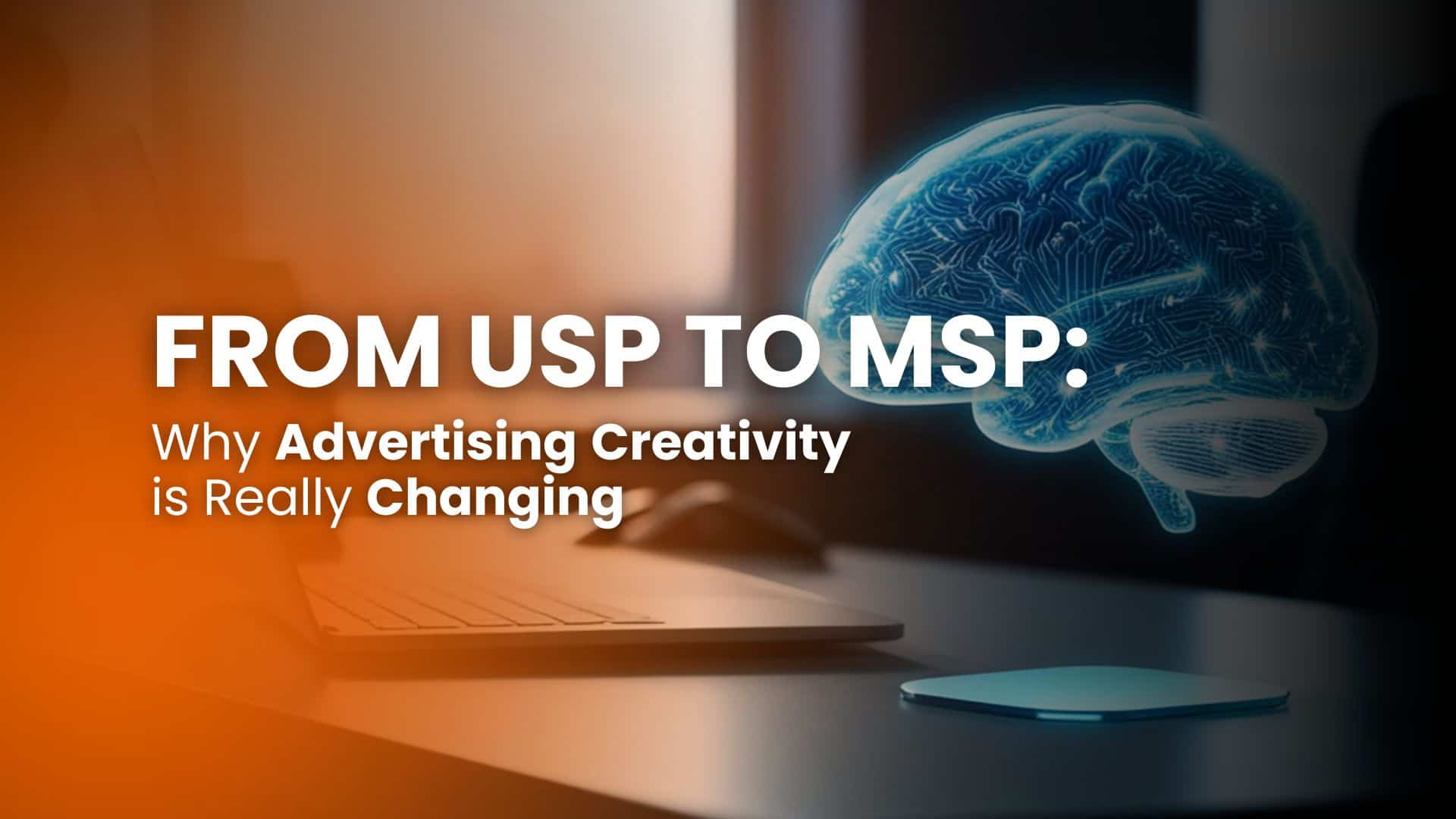
With the rise of Andromeda and Meta’s generative AI models, this conceptual framework is now showing its limits. The shift from USP to MSP is not a creative trend or a change in jargon. It is a direct consequence of how artificial intelligence now selects, interprets and distributes advertising messages.
Why USP is no longer enough in AI-driven advertising
A single message assumes a single audience.
AI, however, no longer reasons in terms of audiences, but in terms of context, probability and dynamic signals.
Each impression is evaluated through a combination of variables that include recent behavior, format, placement, time of day, device and interaction history. In this environment, one single promise becomes an informational bottleneck: too rigid to adapt to different contexts and too limited to provide the system with meaningful learning material.
The transition from USP to MSP emerges precisely from this need: offering AI multiple ways to interpret the same value proposition without sacrificing coherence.
MSP explained clearly: Multiple Selling Proposition without confusion
MSP does not mean “producing many creatives at random” or increasing ad volume in the hope that something will work.
The concept from USP to MSP represents a deeper shift: building a coherent system of promises, each relevant to a different motivational context, yet all aligned with the same brand positioning.
The big idea does not disappear. It evolves.
It is no longer a single central message, but an architecture of related ideas, designed to be read, combined and selected by AI depending on the user’s situation.
Creative matrices and AI readability
In this new paradigm, a creative asset is valuable only if it is readable by the system.
Readability is not aesthetic; it is structural.
Semantic families, controlled variations and intentional differences allow models to recognize reliable patterns. When creatives share a common logic but vary in format, tone, opening or call to action, AI can understand what is working and why.
On the contrary, creatives that are radically different and disconnected from one another generate noise. And noise does not produce learning.
This is another direct implication of the shift from USP to MSP: variety must be designed, not improvised.
GEM and learning through relationships, not isolated ads
One of the most common mistakes is evaluating each ad as an isolated entity.
Models like GEM do not analyze single assets, but relationships between format, message, user response and exposure context.
This is why random testing is increasingly ineffective.
Each test must answer a precise hypothesis, because learning happens in the relationships between variants. In the from USP to MSP model, creativity becomes a network of interconnected signals rather than a sequence of disconnected attempts.
Iteration without reset: improving while preserving memory
Another crucial mindset shift concerns iteration.
Constantly changing everything, chasing micro-trends or short-term fluctuations, resets system memory and weakens AI’s predictive capacity.
Iteration means improvement with continuity.
Small, documented and progressive variations allow models to refine predictions without losing accumulated context. This approach aligns perfectly with the logic from USP to MSP, where the goal is not to surprise the algorithm, but to educate it.
Creativity as cognitive input, not decoration
In Meta’s current ecosystem, creativity is no longer a decorative or purely aesthetic element.
It is a functional variable that determines what AI can learn and how deeply it can learn it.
The brands that perform best are not those producing the most content, but those that organize what they produce more effectively, offering the system a clear, coherent and signal-rich structure.
Ultimately, the transition from USP to MSP is not only about creativity.
It is about how we design communication in an environment where we no longer decide what is shown, but we are responsible for what artificial intelligence is able to understand.