The topic of ad creative budget in Meta Ads is emerging as one of the most interesting evolutions in how advertising campaigns operate. The risk, however, is interpreting it as a simple operational feature, when in reality it introduces a deeper shift in how the algorithm makes decisions.
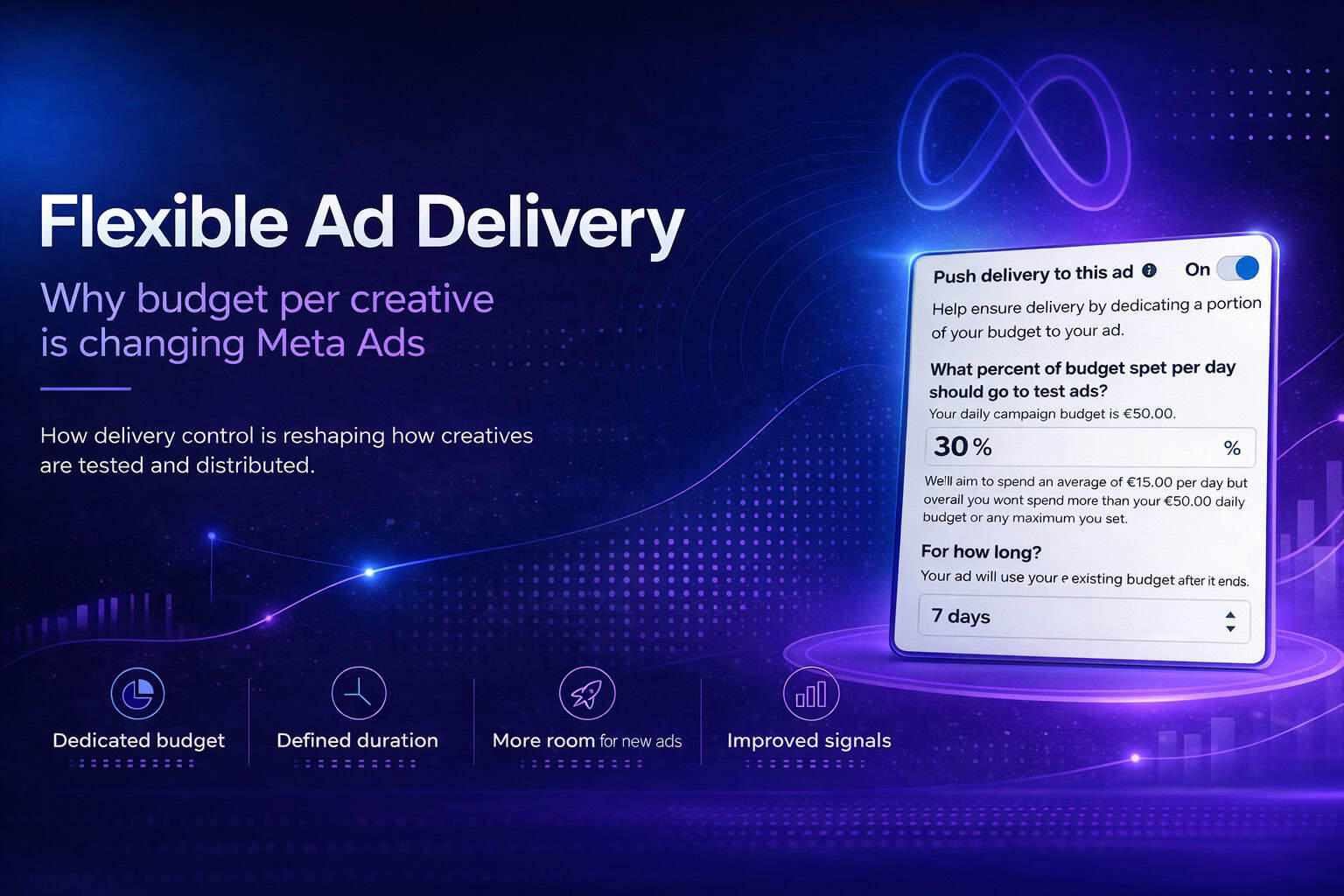
With the introduction of what is commonly referred to as Flexible Ad Delivery, it is now possible to allocate a portion of budget to a single creative and define how long it should remain in distribution, preventing it from being excluded too quickly by the system.
The point, however, is not the ability to “protect” a creative. The real shift is that, for the first time in an explicit way, the advertiser can intervene in how the algorithm learns.
Ad Creative Budget in Meta Ads: What This Feature Actually Enables
Ad creative budget in Meta Ads Manager allows you to assign a percentage of budget to a specific ad, ensuring it maintains a minimum presence in delivery even when, under normal conditions, the system would penalize it.
This introduces a constraint within a model that, until now, has been almost entirely autonomous, where budget allocation was driven by predictive models built on real-time signals.
This is not a return to manual control, but rather a form of guided intervention. The algorithm continues to optimize, but it does so within a framework that is no longer completely unconstrained, because some decisions are influenced upstream.
In other words, you are not choosing which ad performs best.
You are deciding which ad gets the chance to be evaluated.
Why Meta Introduced Ad Creative Budget Control
To understand this evolution, we need to shift from a feature-based perspective to a system-based one.
Meta Platforms advertising platforms do not operate as neutral distribution tools. They function as probabilistic systems that allocate budget based on the likelihood of achieving a result, using signals such as clicks, watch time, interactions, and conversions to continuously update predictions.
This approach has made the system extremely efficient in the short term, but it has also introduced a structural bias. Creatives that enter the learning phase early and generate positive signals tend to receive more and more budget, while new creatives struggle to emerge regardless of their actual potential.
The introduction of ad creative budget control is not about convenience. It is a response to this imbalance, designed to reintroduce a layer of exploration that has gradually diminished over time.
The Core Issue: How Creatives Are Distributed in Meta Ads
When analyzing campaign performance, most people focus on targeting, copy, or format. In practice, the most critical factor is how creatives are distributed.
Meta does not distribute ads evenly. It relies on predictive models that, based on early delivery signals, progressively shift investment toward creatives that show a higher probability of short-term results.
This means distribution is never neutral. It is the result of continuous selection, where every interaction strengthens or weakens an ad’s visibility.
The system quickly enters an optimization loop that reduces creative diversity, concentrating budget on a limited number of ads.
Why New Ads Struggle to Enter Distribution
In this context, new creatives are structurally disadvantaged. They enter the system without historical data and must compete against ads that have already accumulated signals.
The issue is not just creative quality, but timing. In early stages, the algorithm needs fast confirmation and tends to favor what it already “knows.”
If initial signals are insufficient:
- delivery is reduced
- learning is interrupted
- the ad is no longer meaningfully tested
This creates an operational paradox where potentially strong creatives are never truly evaluated.
Spend Control per Ad: The Real Operational Implication
Introducing spend control per ad changes how we interpret advertising budget. It shifts the focus from resource distribution to learning management.
When you allocate budget to a creative, you are not just guaranteeing visibility. You are forcing the system to collect data in an area it would otherwise ignore.
This leads to a different way of understanding budget:
It is no longer just a tool for results. It becomes a lever to generate signals and feed the model.
In this sense, budget implicitly splits into two components:
- a portion dedicated to performance
- a portion dedicated to exploration
Managing this balance becomes central.
The Hidden Risk of Forced Allocation
Intervening in distribution also means accepting a trade-off.
Forcing delivery on unproven creatives can reduce short-term performance, increasing cost per result and lowering overall efficiency.
At the same time, properly managed exploration helps the system avoid saturation and discover new creative combinations that would otherwise never emerge.
The difference lies not in the feature itself, but in the quality of the creative hypotheses being tested.
How to Use Ad Creative Budget Strategically
Effective use of ad creative budget in Meta Ads is not about platform mechanics. It is about designing a testing system.
In creative testing, allocating budget ensures new ads receive a minimum data threshold, preventing premature exclusion from the learning phase.
In scaling phases, it helps maintain creative diversity, reducing the risk that a single ad dominates the campaign and leads to saturation over time.
In more mature setups, it becomes a tool to reactivate exploration without restructuring the entire campaign.
Operationally, this often translates into allocating a portion of budget, typically between 10% and 30%, to signal generation, while the rest focuses on performance.
When It Is Testing and When It Is Waste
Not everything forced into delivery creates value.
Allocating budget to a creative makes sense when there is a clear hypothesis, when testing different angles, or when the system needs new signals to exit stagnation.
It becomes inefficient when used to support weak creatives or compensate for a lack of strategy.
The goal is not to increase the number of tests, but to improve the quality of decisions behind them.
From Targeting to Signals: The Link with The Andromeda Framework
This evolution is part of a broader shift in how advertising campaigns on Meta function.
As explored in The Andromeda Framework, the system is moving from a targeting-based model to one driven by signals.
You are no longer telling the platform who to find through increasingly precise segmentation. You are building content and structures that allow the algorithm to identify the most relevant users autonomously.
In this context, ad creative budget becomes a tool to guide learning, not to control distribution. It represents a point of connection between human logic, based on hypotheses, testing, and design, and algorithmic logic, based on signals and probability.
This balance is exactly what defines The Andromeda Framework.
Ad creative budget in Meta Ads is not just another feature inside Ads Manager. It is a clear signal of the direction digital advertising is moving toward.
The work is no longer about manually managing budget or refining targeting. It is about designing systems capable of generating meaningful signals and guiding algorithmic learning.
In this landscape, the advantage will not belong to those who try to control the platform more, but to those who create better conditions for the system to learn.
And this is where the next competitive edge will be built.