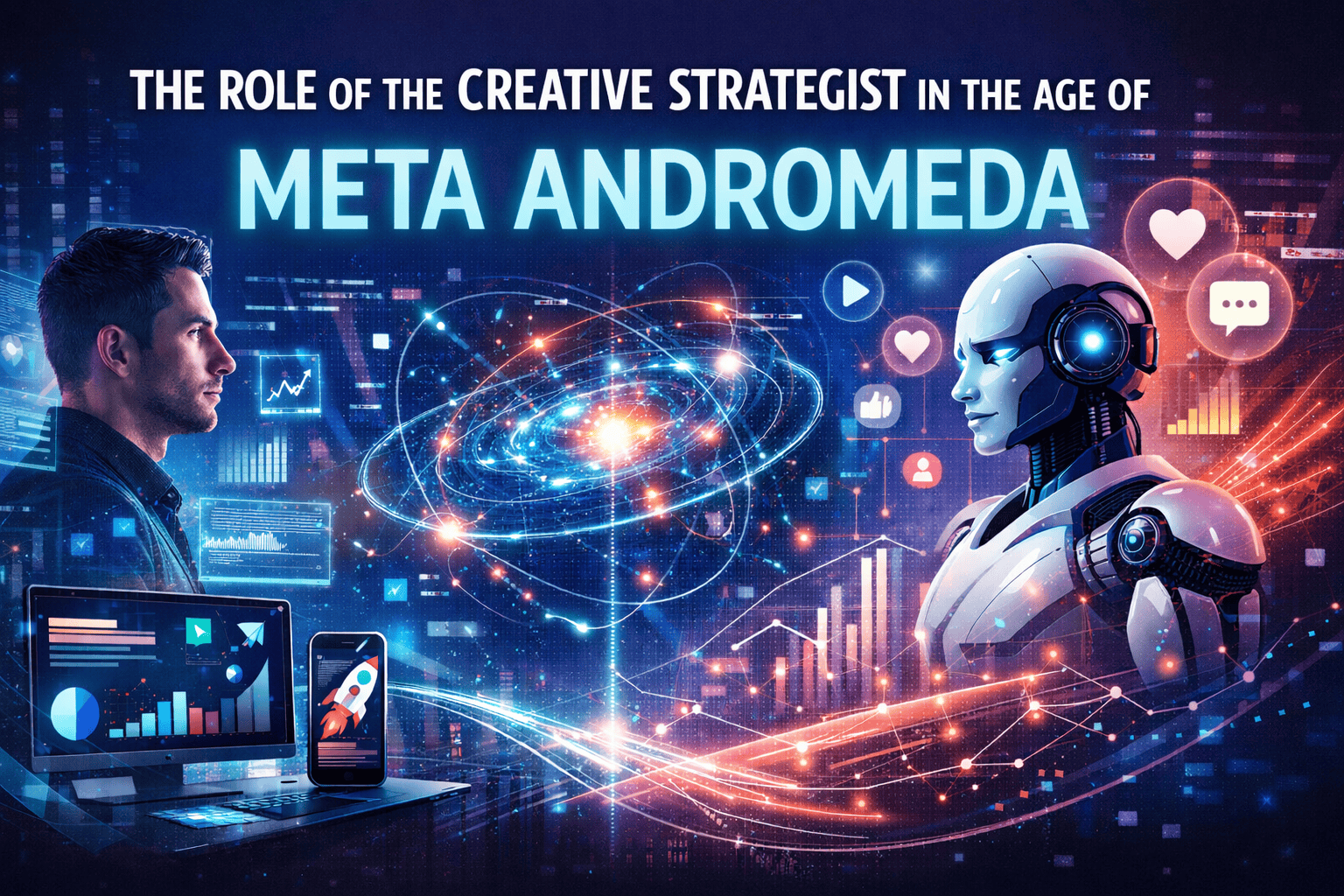
Talking about Meta Andromeda and the creative strategist today means moving beyond an operational view of marketing and entering a systemic dimension, where creativity is no longer an expressive element but a functional component in the algorithmic interpretation of human behavior.
The point is not that creatives have become more important. It is that they have become the primary language through which the system reads, classifies, and distributes attention.
This fundamentally shifts the role of the creative strategist, who no longer works to produce effective content, but to build structures capable of generating coherent and interpretable signals over time.
Meta Andromeda and the Shift from Configuration to Response
This transformation sits at the core of The Andromeda Framework, a model built on observing how advertising systems are evolving toward logics that are increasingly less manually controllable and more driven by behavioral signals.
The book is available in Kindle format and, through a dedicated link, provides access to additional materials including operational content, checklists, and deeper system insights.
If we observe how distribution is evolving across Meta Platforms ecosystems, it becomes clear that the center of gravity has shifted from configuration to response.
This shift is explored in more depth here:
https://giovanniperilli.com/
From Content to System
The most relevant transformation is the shift from a content-based logic to a system-based one.
Individual content loses centrality, while the relationship between content, users, and generated signals becomes the true source of value.
In this context, the creative strategist can no longer think in terms of creative output. Instead, they must design learning environments for the algorithm, where each element contributes to building a readable pattern.
Creativity is no longer a finished object. It becomes a dynamic input that is continuously tested, adapted, and reorganized based on audience response.
The core skill is no longer purely ideational, but interpretative and architectural. It is about understanding how content is read by the system, which signals it produces, and how those signals influence future distribution.
The End of the “Winning Creative” Mindset
One of the most common mistakes is still searching for the best-performing creative as if a stable solution exists.
In a Meta Andromeda context, this logic no longer holds. Performance is not a property of the content itself, but a dynamic relationship between content, context, and audience.
The creative strategist must shift from finding a single winning asset to building an ecosystem of variations that allows the system to learn over time.
This implies working on continuity, coherence, and narrative progression rather than isolated creative ideas.
This approach aligns with how campaign structures are evolving, becoming less dependent on manual control and more oriented toward systemic logic:
https://giovanniperilli.com/
Sequence, Time, and Behavior: The New Creative Levers
The key is no longer the format, but the behavior that the format generates.
The difference between ignored content and distributed content lies not in its form, but in the quality of the signals it produces over time.
Sequence becomes central because it allows the system to read interest progression. Time spent is no longer a secondary metric, but a structural indicator. Returning to a piece of content becomes more informative than many surface-level interactions.
In this scenario, the creative strategist works on behavioral dynamics, designing content that does not just capture attention, but sustains it.
AEO and GAO: The Creative Strategist as a Response Architect
One of the most underestimated shifts is the integration between advertising and Answer Engine Optimization and Generative Answer Optimization.
Meta Andromeda is not an isolated system. It operates within a broader ecosystem where content distribution is increasingly influenced by models that respond, synthesize, and reinterpret information.
In this context, the creative strategist becomes even more strategic. Content must not only perform in feeds, but also be understandable, quotable, and reusable by generative systems.
This requires:
- strong semantic structure
- clear narrative coherence
- sufficient informational density for extraction without loss of meaning
This is exactly the type of content that increases the probability of being selected in automated response systems.
This evolution aligns with the shift from traditional SEO to more advanced models:
https://giovanniperilli.com/
From Distribution to Citability
Content today does not compete only to be seen. It competes to be selected, summarized, and redistributed.
This fundamentally changes how content should be designed.
The creative strategist must think in terms of citability, meaning the ability of content to be reused by generative systems without losing meaning.
This is not about simplification, but about semantic clarity. Every part of the content must contribute to a structure that is readable both by humans and algorithms.
The Convergence of Creative and Media Buying
The distinction between those who create and those who distribute is becoming less relevant.
Both functions now operate on the same signals.
The media buyer can no longer focus only on technical levers, and the creative strategist can no longer ignore distribution logic.
This convergence is giving rise to a hybrid role that integrates behavior, creativity, and system thinking.
This evolution is already visible in the transformation of media buying:
https://giovanniperilli.com/
Operational Implications for Marketing in 2026
For professionals, this means moving beyond execution and developing the ability to read content strategically, understanding not only what works, but why the system distributes it.
For small and medium businesses, competitive advantage is no longer tied only to budget, but to the quality of generated signals. This opens real opportunities for those who can build structured content systems.
For creators, growth no longer depends solely on aesthetic creativity, but on the ability to generate continuity of consumption and produce signals that the system can interpret effectively.
Conclusion: The Creative Strategist as a Semantic Architect
Meta Andromeda does not reduce the role of the creative strategist. It redefines it.
The shift moves from creativity as expression to creativity as system design and semantic structure.
The Andromeda Framework fits directly into this transition, offering a model that goes beyond platforms and addresses how acquisition systems are designed as a whole.
And the fact that the book includes free operational materials is not secondary. It reflects the nature of this shift. Understanding the model is not enough. It must be applied.
The real difference today is not between those who create content and those who do not. It is between those who build isolated assets and those who build systems capable of generating, sustaining, and amplifying signals over time.
In a landscape where platforms do not distribute content but interpret behavior, the creative strategist becomes a semantic architect, designing not only what people see, but what systems understand.