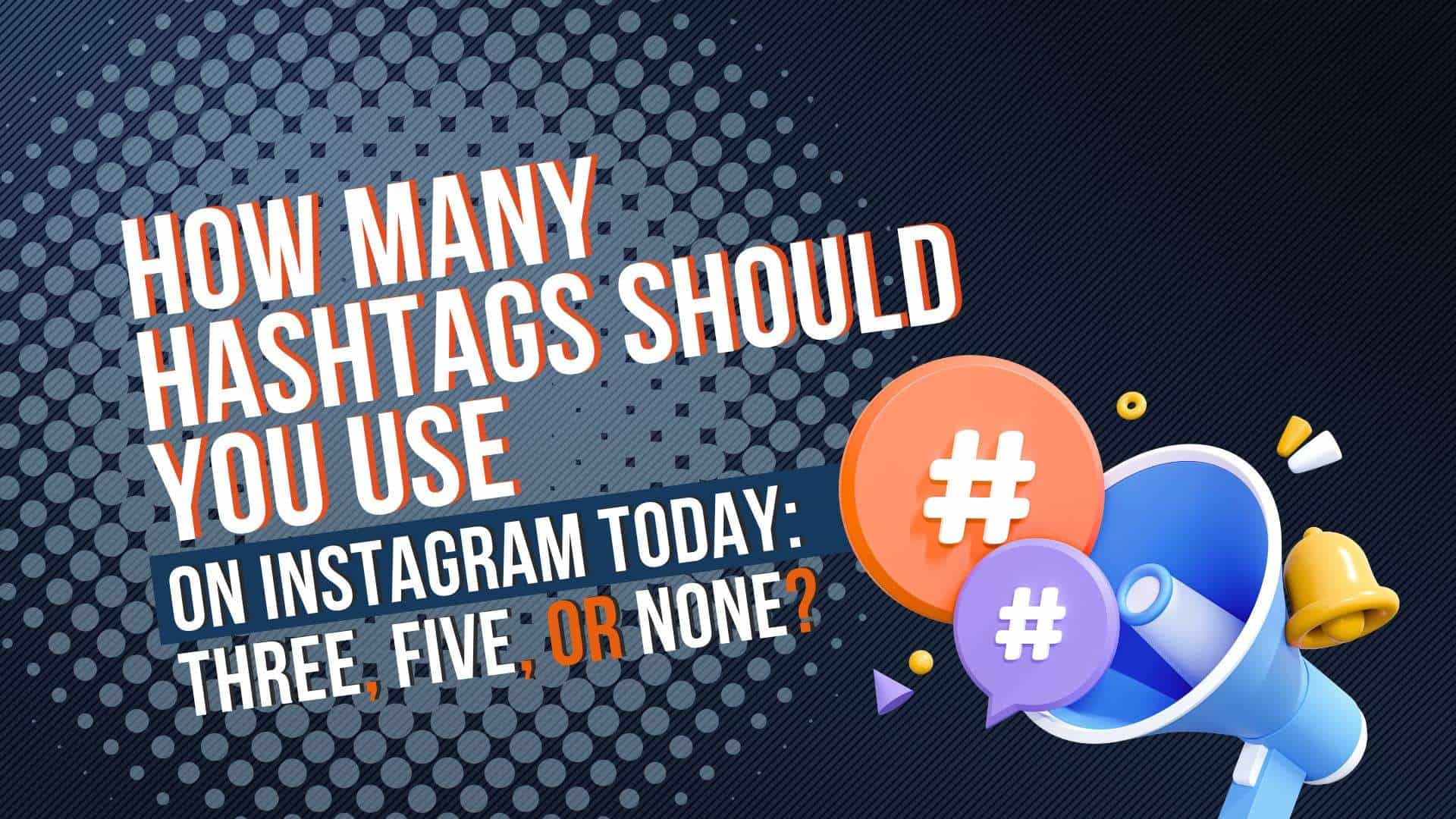
In the past few months, many creators and social media managers have been noticing a new alert inside Instagram while publishing posts. The message suggests using no more than five hashtags. It is not an official Meta announcement, yet its constant appearance reveals a direction the platform is clearly pushing toward: fewer hashtags and more clarity. And what becomes even more interesting is that, based on real performance data, three well-selected hashtags often deliver the best results. In some cases, using none at all performs just as well.
This shift is not accidental. It reflects how Instagram is rethinking content classification in an environment where artificial intelligence can understand what you post with impressive accuracy. The era in which hashtags acted as the primary indexing tool is closing, and a new logic focused on content signals and communication consistency is emerging.
Why Instagram is moving toward fewer hashtags
Instagram today understands content through a combination of factors that go far beyond hashtags. The platform reads visual details, text, tone of voice, recurring themes, viewer behavior, and the overall identity of your profile. These signals create a stronger and more precise interpretation than any list of hashtags ever could.
For this reason, adding a long chain of hashtags does not provide the strategic advantage it once promised. In many cases, it creates noise rather than clarity. Instagram seems to prefer fewer, more meaningful signals that help the algorithm identify the content’s core theme without distractions. This explains why the alert recommending no more than five hashtags keeps appearing and why results with three hashtags often outperform posts overloaded with tags.
When Adam Mosseri said hashtags don’t really boost reach
A few months ago, Adam Mosseri, Head of Instagram, clearly stated in a video that hashtags do not significantly improve reach. According to him, hashtags may help with minimal categorization, but they do not push content further in the algorithm. His message was simple: Instagram already knows exactly what your post is about, thanks to its use of artificial intelligence.
This statement caused a lot of discussion because it challenged years of habits built on the assumption that adding more hashtags automatically meant more visibility. Instead, Mosseri’s explanation confirmed that Instagram’s AI can read and classify content independently, without relying on ten or twenty manually added labels. The recent alerts advising fewer hashtags fit perfectly into the direction he outlined.
Why three hashtags work better than twenty
Recent testing by creators, agencies, and brands shows that three well-targeted hashtags create the ideal balance. They give the algorithm a clean, minimal set of signals without overwhelming it. They also keep the post visually tidy and coherent, helping each hashtag act as a precise anchor rather than part of a confusing list.
This does not mean using five hashtags is harmful. It means that, beyond a certain point, additional tags do not create real value. Instagram no longer relies on the quantity of hashtags to understand a post. It relies on the intrinsic clarity of the content itself.
The real priority today: communication consistency
If we combine Mosseri’s statements, Instagram’s warnings, and the data from real-world performance, a very simple truth emerges. The number of hashtags is no longer the strategic lever it used to be. What truly matters is the consistency of your content across the entire profile.
Instagram evaluates your posts through the identity you build over time. Themes, tone, visuals, topics you repeat, and the type of audience that engages with you all contribute to shaping how the algorithm understands your account. The more consistent your communication is, the more accurately Instagram can match your content to the right viewers.
In this context, hashtags become optional accessories rather than growth engines. They can help with small refinements, but they no longer determine the overall visibility. Reach today comes from clarity, continuity, and identity, not from technical tricks.
The future direction: less labeling, more identity
Looking at everything together, the platform’s direction becomes evident. Instagram is moving toward a model where artificial intelligence reads content at a deeper level, making long hashtag lists unnecessary. A few precise signals are more than enough when the algorithm already understands what you are communicating.
Creators and brands who focus on building a consistent identity—visually, thematically, and narratively—are the ones who benefit the most from today’s algorithm. Hashtags may still have a place, but they no longer define success. What defines success is the coherence of your message over time.
The shift is exactly the one Mosseri hinted at: concentrate on what you communicate, not on how many labels you attach to it.