For ten years, organic communication from candidates was treated as an accessory.
Candidates posted something every day because they needed to have a presence, but the real work was done by paid ads. They were the ones putting the candidate’s face in front of people who did not follow them, growing the page, and filling seats at campaign events.
The profile mainly served as a showcase for people who arrived through advertising.
Today, that model no longer exists, and anyone trying to run a campaign the way they used to will end up with a page that keeps talking to the same few hundred people.
In the guide to online political advertising in Italy, we looked at why political advertising on Facebook, Instagram, Google, and YouTube is no longer available in the European Union.
In the article on the channels that remain open for election advertising, we mapped out what can still be purchased.
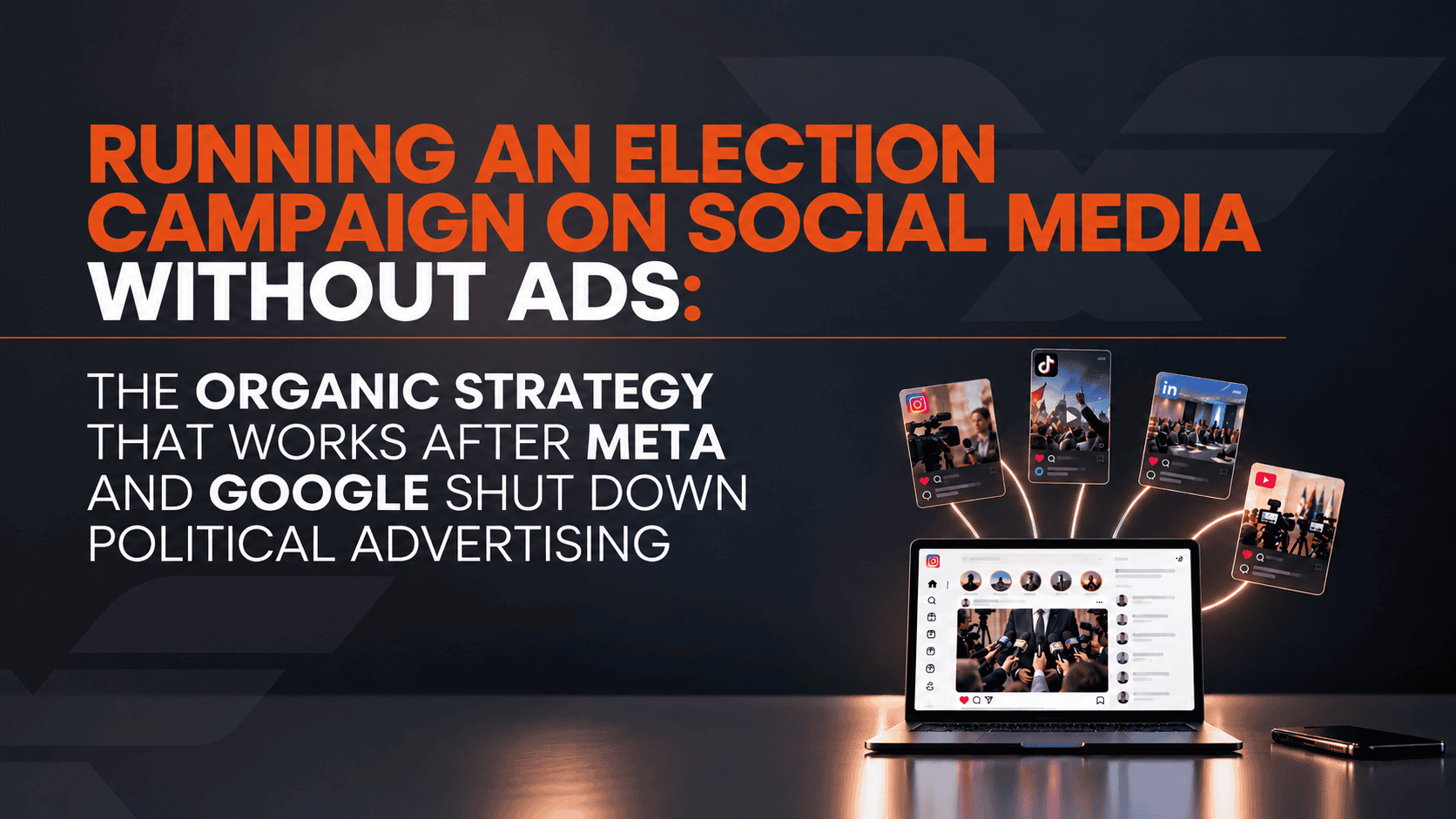
Here, we address the part no budget can replace: how to build visibility, an audience, and relationships without paying the platforms.
What Is Still Allowed, and What Looks Organic But Isn’t
Meta has clarified that the shutdown of political advertising does not prevent politicians and candidates from producing and sharing political content organically.
Profiles, pages, reels, live streams, and stories remain fully available.
But the line needs to be drawn precisely, because some practices that many campaign teams consider organic actually are not.
The “Boost Post” button is an ad, and a political post will be rejected.
A post by a creator who is paid to talk about a candidate is political advertising under the TTPA, with all the obligations that entails.
A seemingly independent issue-focused page managed by campaign staff and supported with paid ads on social issues is not a clever workaround. It is a double risk because ads about social issues are blocked, and because if the connection to the candidate becomes apparent, opponents will be the ones telling the story.
Organic means something simple:
No one pays for distribution.
The Mindset Shift: From Campaign to Programming
Paid advertising made it possible to compress everything into the final weeks.
You could wait until the election was approaching, load up the budget, and visibility would follow.
With organic content, time cannot be compressed.
An audience is built over months, not days, and algorithms reward consistency and audience response, not the candidate’s sense of urgency.
Someone who starts publishing systematically 30 days before the election is talking mostly to people who already know them.
Someone who starts six or nine months earlier arrives at the campaign with a foundation that no opponent can rebuild from scratch.
That is why it helps to think in terms of a programming schedule, as a small publisher would.
A few recurring, recognizable, sustainable formats:
- A weekly segment where the candidate answers questions from residents
- A local series where the candidate visits a place and explains a specific problem
- A short format that explains a municipal resolution, decision, or statistic in one minute
Repetition does not make people bored. It makes you recognizable.
It also frees campaign staff from the daily anxiety of having to invent something new to publish.
What Works on Each Platform
Instagram and Facebook
Short-form video has the greatest potential to reach people who do not already follow the profile.
It works when it tells a specific, local story, with the candidate speaking the way they would at a café rather than like they are reading a press release.
Facebook remains crucial for older age groups and local communities.
Neighborhood and town groups are often where the real local political discussion takes place.
Entering those groups as a candidate requires respecting the rules set by the group and its administrators, and the most effective presence is almost always someone who responds and contributes rather than someone who posts campaign flyers.
TikTok
Political advertising is prohibited, but organic content from politicians is allowed.
It can work for candidates who have a natural presence on camera and want to reach younger voters.
It does not work if you treat it like Instagram in a vertical format. TikTok requires its own timing, rhythm, and tone, and recycled content from other platforms is immediately recognizable.
YouTube
This is where you put the long-form content that no other platform rewards in the same way: the full public meeting, an explanation of the platform, or a discussion with an expert.
It will not generate huge numbers during the campaign, but it is what people who search for the candidate’s name on Google will find.
Without advertising, organic search becomes the first impression.
LinkedIn, X, and Threads
These platforms are useful for communicating with journalists, professional groups, businesses, and other industry stakeholders.
For a candidate running in a general or regional election, they can help establish a position in discussions around areas of expertise.
For a local city council candidate, however, they are usually a time investment with limited returns.
Owned Channels: Where You Actually Build an Audience
The most important lesson from the shutdown of political advertising is that an audience living on a platform belongs to the platform.
Today, advertising is closed. Tomorrow, the distribution of political content could change, as has already happened several times in recent years with Meta’s decisions around recommending political content.
The only audience that truly belongs to the candidate is the one that has chosen to receive their messages.
WhatsApp Channels and Instagram Broadcast Channels
These are the simplest tools for turning a follower into a direct contact.
People who subscribe receive updates as notifications, outside the feed and its competition for attention.
They work well for announcing events, sharing a livestream, or sending a personal message at key moments.
Be Careful With WhatsApp’s Business Platform
There is a limitation that many people do not know about, particularly those coming from conversational marketing.
The WhatsApp Business Messaging Policy prohibits the use of the WhatsApp Business Platform, meaning the APIsused to build chatbots and automated messaging, by political parties, politicians, candidates, and election campaigns, as well as companies providing political strategy and communications services.
So no election chatbots on WhatsApp, and no automated mass messaging.
Beyond violating the policy, these practices can expose the account to being blocked at the worst possible moment.
Newsletters and Contact Lists
Email remains the most underestimated channel in a local campaign.
A weekly newsletter written by the candidate, explaining what they have done and what they have seen in the community, builds a relationship that no feed can guarantee.
The rules are those governing privacy: contacts must be collected with specific consent for political communication, as the Italian Data Protection Authority reiterates before every election.
Every public event, campaign booth, and livestream should provide an easy way for people to leave their contact information with that consent.
The Supporter Network Replaces the Algorithm
Without advertising, people handle the distribution.
A supporter who shares content in their own group of friends or neighborhood reaches people that no campaign page could reach, with a level of credibility that no paid ad has ever had.
This requires organizing that network: giving supporters content that is easy to share, explaining why and when they should share it, and making them feel like part of the campaign rather than simply people repeating its messages.
The line that cannot be crossed is payment.
A volunteer who shares something because they genuinely support the candidate is engaging in organic communication.
A volunteer who is reimbursed for publishing, or a local creator who receives compensation or another benefit, enters the scope of political advertising.
This is a sensitive issue, and we will cover it in a dedicated article about creators in election campaigns.
Being Found: The Candidate’s Name on Google
Someone who has heard about a candidate and wants to know who they are will open Google and search for their name.
Without advertising, what they find depends entirely on what was built beforehand:
- A simple website with a biography, platform, contact information, and event calendar
- Consistent social media profiles
- A YouTube channel with substantive content
- Articles from local publications
If the first result is an old negative article or someone with the same name from another city, that becomes the voter’s first impression.
Working on search visibility months before the election costs little and provides significant protection.
Managing Comments, Crises, and Election Silence
The more organic content grows, the more conversation grows with it, and so does the risk.
You need a clear moderation policy that is applied consistently and distinguishes criticism, which is always legitimate and often deserves a response, from insults and disinformation.
You also need someone who can respond in the candidate’s voice, because in organic communication, comment replies are content too.
And you need to remember the rules that apply on social media as well.
Law No. 28 of 2000 prohibits publishing polls during the 15 days preceding an election, and sharing a poll in a story still counts as publishing it.
Law No. 212 of 1956 prohibits campaigning on the day before the election and on voting days.
Its application to the web has been debated for years, but the cautious approach is not to publish campaign content on those days and not to schedule anything that will be published automatically.
A campaign post accidentally going live on the Saturday before an election is exactly the kind of detail that can become a news story.
The Advantage of Starting Earlier
A campaign without ads is more demanding, slower, and less predictable than the campaigns we had become accustomed to.
But it has one advantage that paid campaigns did not have: it rewards those who work consistently rather than those who arrive with the biggest budget in the final weeks.
A candidate who starts building a programming schedule, contact list, and supporter network today, months before the election, enters the campaign with a structural advantage.
If you want to build the organic strategy for your campaign, from content programming to building owned channels, get in touch.
The earlier you start, the more the work pays off.