Every day, millions of pieces of content are published across social media platforms. While many of them achieve impressive reach, generate engagement, and accumulate thousands of views, that attention does not always translate into inquiries, booked appointments, or sales.
It may seem like a subtle distinction, but it separates those who use content purely as a visibility tool from those who integrate it into a system designed to create real business opportunities.
In an increasingly crowded and competitive digital landscape, attracting attention is only the first step. What determines the true value of a content strategy is not the ability to accumulate views, but the ability to guide people through a journey that transforms initial interest into trust and, ultimately, into action.
This is where the concept of content that generates clients becomes important: content designed not only to be consumed, but to progressively move users toward a meaningful next step.
Why Attention and Conversion Are Not the Same Thing
When analyzing the results of many digital marketing efforts, a recurring pattern emerges.
On one side are profiles capable of generating large amounts of reach and engagement. On the other side, those same profiles often struggle to convert that visibility into real business opportunities.
The reason lies in the difference between attention and conversion.
Attention measures the ability to attract interest, spark curiosity, or generate interaction.
Conversion is the next stage. It requires trust, qualified interest, and a clear understanding of the value being offered.
For this reason, a strategy focused exclusively on visibility often produces incomplete results. The numbers may grow while business opportunities remain unchanged.
When Content Becomes Part of a System
One of the defining characteristics of the most effective strategies is that every piece of content serves a specific purpose.
Some content is designed to attract new people.
Some content builds credibility and authority.
Other content guides users toward a decision or encourages them to reach out.
When these elements work together, communication stops being a series of disconnected posts and becomes a system capable of generating more predictable results.
This is what separates a content strategy from simply publishing content.
The Three Levels of Content That Generates Clients
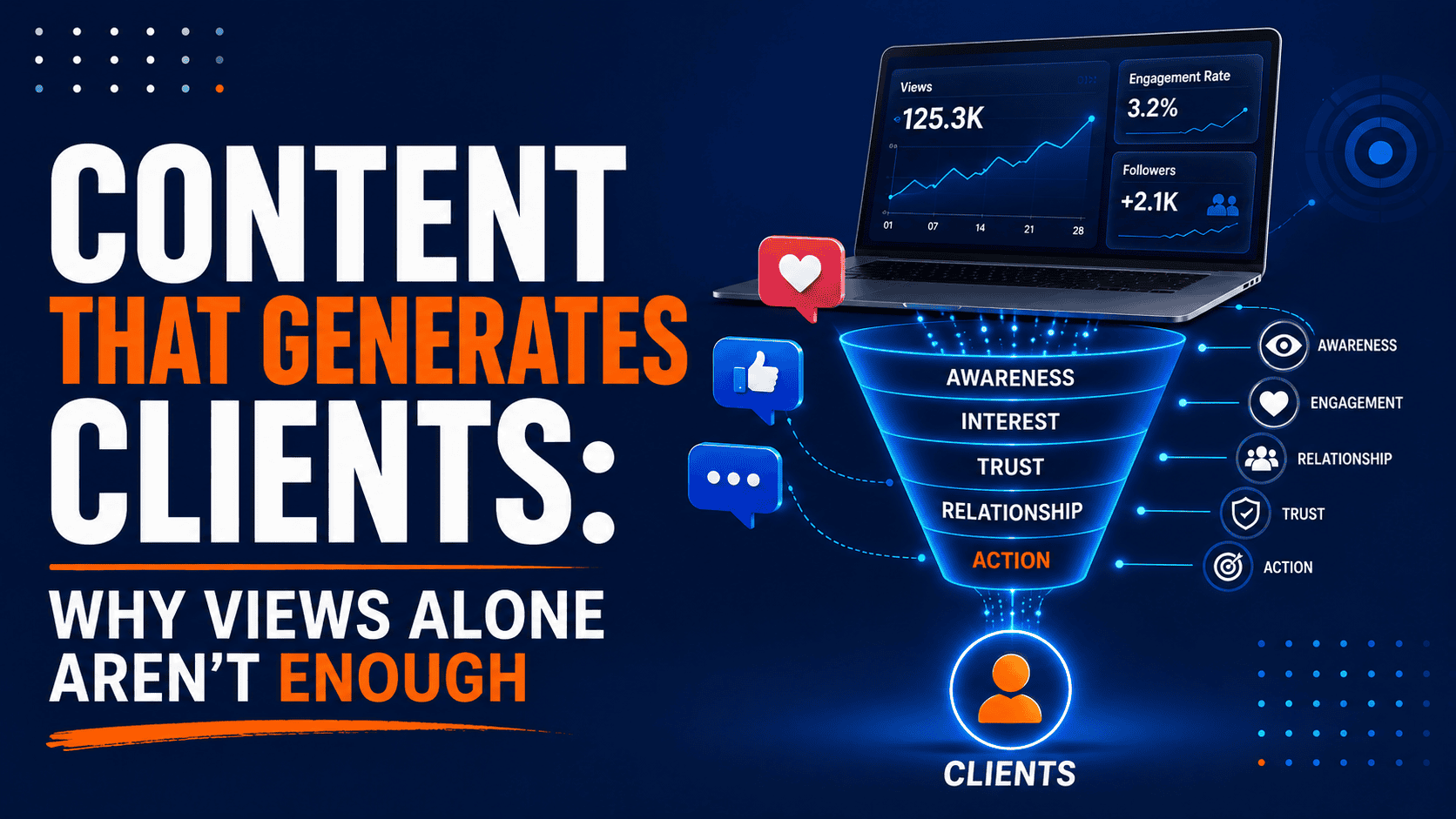
To transform attention into real opportunities, it helps to view content as part of a progressive process.
Attracting the Right People
At this stage, content focuses on identifying problems, goals, needs, and situations that the audience recognizes as their own.
The goal is not immediate persuasion.
The goal is connection.
When people feel that a piece of content accurately reflects their situation, they are more likely to continue engaging.
Building Trust and Authority
Once attention has been captured, the next step is strengthening the relationship.
People rarely make important decisions after consuming a single piece of content.
Before trusting a professional, company, or brand, they usually seek additional confirmation, deeper insights, and proof of expertise.
This is where educational content, case studies, experiences, perspectives, and results become valuable.
Through this process, initial interest gradually evolves into trust.
Guiding People Toward a Decision
The final stage focuses on action.
At this point, the user already understands the problem, has developed a positive perception of the proposed solution, and has enough information to evaluate the next step.
Unfortunately, many strategies stop before reaching this stage, leaving accumulated interest without a clear direction.
Why Many Strategies Stop at Visibility
The constant pursuit of views often pushes businesses to focus only on content that generates immediate attention.
While trending topics, viral formats, and highly shareable content can certainly increase reach, they do not always help build meaningful relationships with the audience.
When an entire strategy revolves around visibility, it becomes more difficult to move people toward deeper levels of engagement.
The result is growth that looks impressive on the surface but fails to translate into commercial outcomes.
The Difference Between Publishing Content and Designing a Journey
The most successful strategies share one common characteristic: every piece of content is designed as part of a larger journey.
Content is not published simply to maintain an online presence.
It is created to move people from one stage to the next.
This approach completely changes the way communication is planned.
The focus shifts away from vanity metrics and toward the role each piece of content plays within the broader system.
This is the point where content becomes a true client acquisition tool.
A Different Perspective on Content Creation
Before asking how to increase views, it may be more useful to ask a different question:
Is this content helping my audience take a meaningful step forward?
When this mindset is applied consistently, content creation becomes significantly more strategic.
Views still matter, but they become a by-product rather than the ultimate objective.
This shift in perspective is what allows an online presence to evolve into a system capable of generating relationships, opportunities, and clients over time.
Conclusion
Content that generates clients is not necessarily the content that receives the most exposure.
It is the content that successfully creates a connection between attention, trust, and decision-making.
In a digital environment characterized by constant content and limited attention, success depends less on being seen and more on guiding people through a coherent journey.
When every piece of content is created with a specific purpose, communication stops chasing visibility alone and becomes a tool capable of generating sustainable, long-term business results.