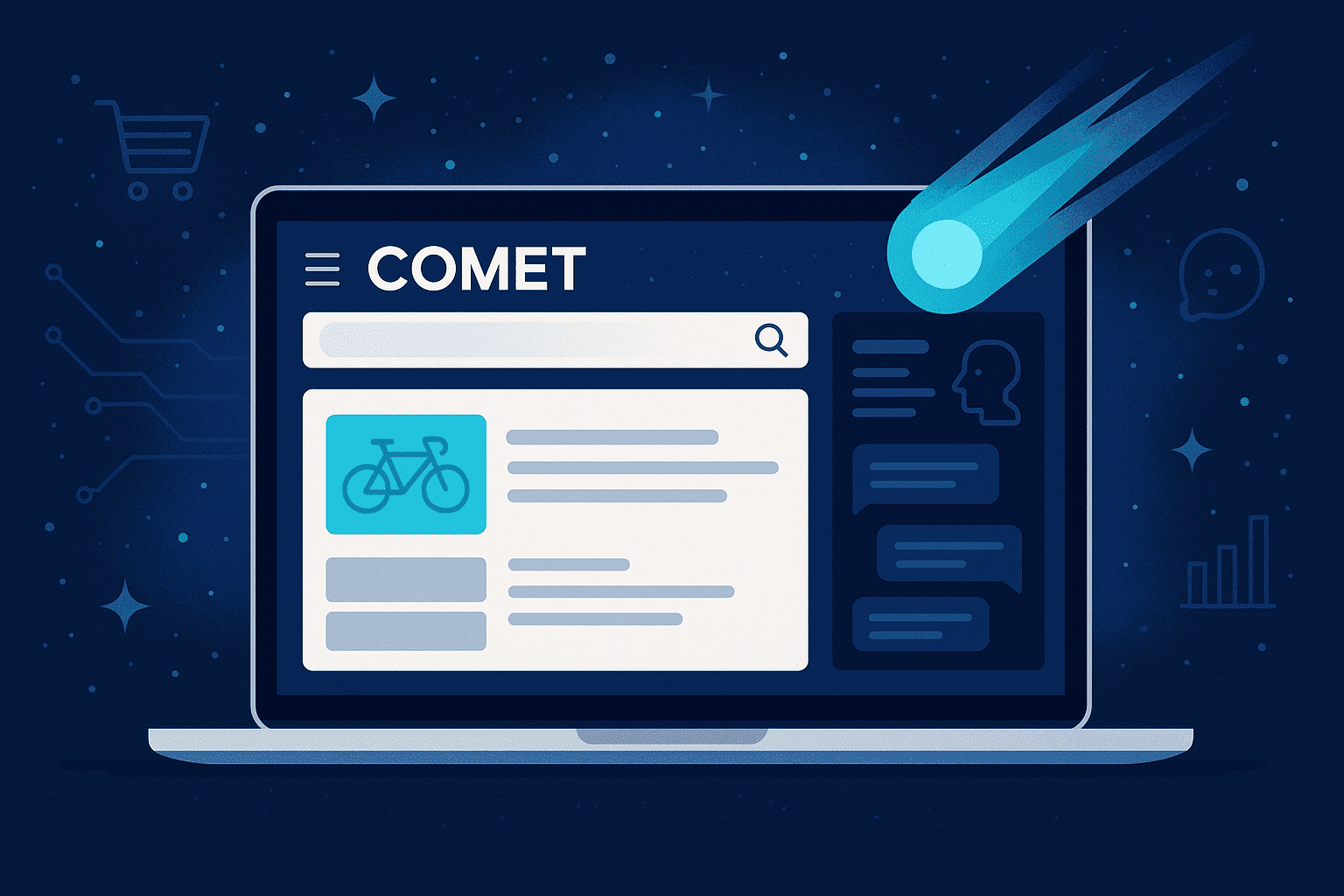
Over the past few months, the name Comet Browser has been everywhere. It’s the latest browser developed by Perplexity AI, the same company that brought a more conversational and intelligent approach to online search.
But this time, the innovation isn’t another search engine—it’s a browser that changes how we browse, shop, and interact with information.
Comet Browser runs on Chromium, just like Chrome and Edge, but the difference is huge. Here, artificial intelligence isn’t a plugin layered on top of the experience—it’s part of the core. Every time you open a page, compare products, or research something, the AI works in the background as a digital assistant that understands the context and helps you move faster.
It goes beyond “asking a question” to an AI tool. It becomes a browsing experience that responds, interprets, and takes action.
If you visit a travel site, the assistant can compare dates and prices.
If you browse an e-commerce store, it can suggest where to find the same item at a better price.
If you land on a long article, it can instantly summarise the main points.
That’s Comet: a browser that doesn’t just show you the web, but navigates it with you.
From traditional browsing to a digital assistant
For more than a decade, browsers have evolved slowly. Sure, we’ve added extensions, synced our accounts, and improved speed, but the basic process hasn’t changed: you search, click, and read.
Comet breaks that pattern. It introduces a browser that understands what you’re doing and tries to simplify the process.
Compared to Chrome, Safari, or Firefox, Comet doesn’t focus only on speed. Its goal is to make online tasks more intelligent, so users avoid repetitive steps and get straight to the outcome: finding information, finishing a task, or completing a purchase.
In other words, Comet aims to become a bridge between information and action. It lets you say, “Show me cheaper alternatives”, “Organise these tabs by priority”, or “Summarise this page for me”, and the AI acts based on what’s on your screen.
The browser reads the page, identifies key elements, and processes them in real time—almost like having a human assistant sitting next to you.
This means fewer tabs, less chaos, and a more natural flow between questions and actions.
The impact on e-commerce: a new era of intelligent comparison
If you work in e-commerce, you can’t ignore Comet Browser.
Its arrival introduces a concept that changes the online shopping experience: built-in AI product comparison.
Until now, comparing products meant opening multiple tabs, checking prices manually, and trying to remember details. With Comet, you can simply ask:
“Is this product cheaper somewhere else?”
“Where can I get faster delivery?”
The browser scans multiple online stores and returns a comparison in real time.
This reduces friction for users—but raises the bar for e-commerce owners. Marketing teams now face a buyer who’s faster, more informed, and less willing to waste time.
And this is where the real opportunities appear:
-
Better offers and better UX
Stores that focus on speed, clarity, and transparency will benefit the most. AI comparison forces brands to be competitive not only in price but also in experience. -
Shorter funnels
When the browser filters and suggests in real time, the journey from “discovery” to “purchase” gets shorter. Conversion rates improve if the offer is clear and the landing experience makes sense. -
Product pages optimised for AI
Pages need to be structured and readable for an AI that analyses, compares, and explains products.
It’s no longer about SEO alone—now it’s about being “AI friendly”.
With Comet, the challenge isn’t only ranking well on Google. It’s appearing inside the conversation between the user and their browser.
Advertising in the age of AI browsers: what changes for marketers
Advertising also enters a new chapter.
Until now, campaigns relied on targeting, data, and algorithms inside platforms like Meta or Google Ads.
With AI browsers, a new player enters the scene: the browser itself.
A user browsing with Comet is no longer a passive viewer. They navigate with an intelligent assistant guiding decisions in real time.
This changes everything for advertisers.
Ads won’t just fight for attention—they’ll need to fit the conversation that the AI assistant is having with the user.
The strongest creatives will be the ones that answer the very questions users—and the AI—are likely to ask:
“Why choose you over your competitor?”
“What’s the real advantage?”
“Is delivery faster?”
Ad copy needs to become more honest, more informative, and much clearer.
The funnel needs to be quick, coherent, and aligned with a world where the AI reduces the time between curiosity and decision.
Marketers will also need to track new signals:
how users behave when assisted by an AI,
how quickly they compare options,
and what happens right after an impression or click.
It’s a more dynamic and more transparent type of marketing, where value matters more than hype, and clarity matters more than big budgets.
A new relationship between users, AI, and brands
Comet Browser introduces a shift: browsing is no longer a solitary, manual action—it becomes a conversation.
Users don’t just “search”; they dialogue with the web.
And brands must learn to enter that dialogue with clarity, substance, and speed.
AI is not the enemy. It’s an interpreter.
It helps users choose, but it also challenges brands to be more direct, more valuable, and more authentic.
The companies that adapt will be the ones that offer real clarity, real benefits, and real experiences.
The others simply won’t show up in the conversation anymore.
In this new landscape, the browser isn’t just a tool.
It becomes an intelligent mediator between what users want and what brands can deliver.
And in that relationship, transparency becomes the real competitive advantage.