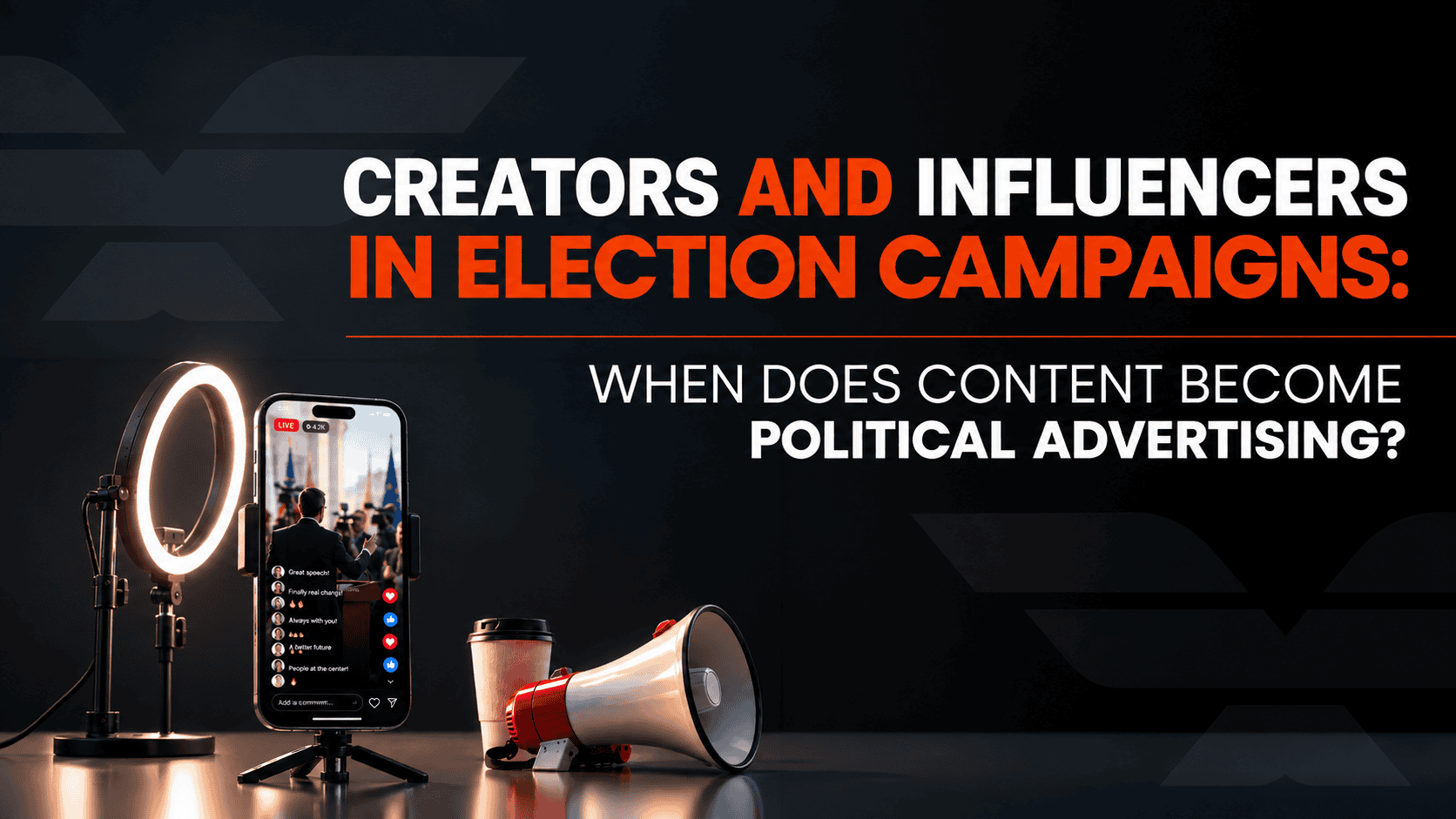
Every time one door closes, someone looks for a window. Since Meta and Google stopped accepting political ads in the European Union, the window many campaign teams have identified is called the creator. The reasoning seems straightforward: if I cannot pay the platform to show my candidate, I can pay someone who already has an audience to talk about them. The content appears as organic, reaches people who do not follow the candidate, and there is no longer any need to run a sponsored ad.
The problem is that the European regulation on political advertising was designed to account for exactly this move. In this in-depth guide from the hub on online political advertising in Italy, we look at where the line falls between a legitimate collaboration and undeclared political advertising, what candidates and creators risk, and how campaigns can work with creators without turning a good idea into a media headache.
The Basic Rule: Payment Matters, Not the Format
Regulation (EU) 2024/900 defines political advertising based on two elements: the message comes from a political actor or is capable of influencing an election, referendum, or legislative process, and it is normally distributed in exchange for compensation or as part of an organized campaign. The medium is irrelevant. A reel posted on a creator’s profile is no different, under the regulation, from a banner on a news website: if someone paid for its distribution, it is political advertising.
The authorities applying the TTPA make this explicit. The Irish Electoral Commission, for example, explains that when an influencer is paid to communicate a political message, they become subject to the regulation’s transparency requirements. At that point, the creator is no longer simply a user expressing an opinion: they are a publisher of political advertising, with all the obligations that the TTPA assigns to those who publish it.
What This Means in Practice
The content must be labeled as political advertising and identify the sponsor. It must link to a transparency notice stating the amount spent, the period during which the ad ran, and the election it relates to. The sponsor, meaning the candidate or committee, must inform the creator that the message is political in nature. The information must also be retained for years. A video with the word “collaboration” written in tiny letters is not enough.
Compensation Is Not Just a Bank Transfer
The question that comes immediately afterward is: what if I do not pay them? This is where many campaign teams fool themselves. Under the logic of the regulation and advertising rules more broadly, compensation is not limited to money. A generous expense reimbursement, a gifted product, a promised position, a consulting contract awarded to the creator’s firm, or a gala dinner provided free of charge can all be benefits that turn spontaneous content into compensated content. The test is simple and blunt: would the creator have published that content, in that form and at that time, if they had received nothing? If the honest answer is no, the content falls within the scope of political advertising.
What the Platforms Say
Beyond the regulation itself, there are the platforms’ policies, which in some cases are stricter than the law.
TikTok
TikTok’s policy on politics does not merely prohibit ads. It also prohibits paid branded content with political purposes. A creator paid by a candidate to publish election-related content violates the platform’s rules, regardless of any label, and risks having the content removed and facing account sanctions.
Instagram and Facebook
Meta no longer accepts political ads in the EU, so creator content cannot be sponsored in any form. For organic branded content, the “paid partnership” tool and branded content policies must be checked on a case-by-case basis before entering into any agreement, because the platform applies specific rules to content involving political and social issues. In any case, the platform’s label does not replace the transparency notice required by the TTPA.
YouTube
Political ads are suspended in the EU. A creator who includes a paid segment supporting a candidate in a video must still disclose the paid promotion under the platform’s rules and, under the TTPA, treat it as political advertising in every respect.
Italian Rules for Influencers
Italy adds another layer of regulation. Through Resolution 197/25/CONS, AGCOM adopted Guidelines and a Code of Conduct for influencers, including transparency requirements for commercial communications and a public register of influencers considered relevant. Those who exceed the established thresholds are treated, in many respects, like media service providers, with editorial responsibility for the content they publish. For a candidate, this has a practical consequence: working with an influencer listed in the register means working with someone who has their own obligations and is generally less willing to take unnecessary risks. During election campaigns, the relevant implementing resolutions on equal access rules, or par condicio, should also be checked to understand how AGCOM treats these individuals in that specific election.
The Most Common Gray Areas
Most real-world cases are neither clearly lawful nor clearly prohibited. Here are the situations that come up most often.
An Interview on a Creator’s Podcast or Channel
If a creator invites a candidate because they consider them interesting for their audience and receives nothing in return, it is editorial content, and the regulation excludes unpaid opinions and editorial content. If the interview was purchased, or is part of a package that includes other services, it becomes political advertising. As a precaution, it is best never to mix the two arrangements with the same creator during the same campaign.
A Supporter With a Large Following
A creator who supports a candidate out of genuine conviction and talks about them spontaneously is exercising their freedom of expression. The risk arises when the campaign team starts providing scripts, schedules, and instructions. The more coordinated the communication becomes, the harder it is to maintain that it is spontaneous.
A Candidate Who Is Also a Creator
A candidate who already has an audience as a creator can continue publishing organically on their own channels. However, they need to be careful with ongoing commercial partnerships: sponsored content from a company in which the candidate also discusses their candidacy mixes commercial and political communication in a way that both the regulation and the platforms may have difficulty accepting.
Ambassador Programs
Asking supporters to share content is one of the most effective levers in an election campaign on social media without ads. Rewarding those who share the most with merchandise, exclusive invitations, or visibility is something else: it moves closer to compensation and can turn a volunteer into an unwitting publisher of political advertising.
How to Work With Creators Without Taking Unnecessary Risks
The safest approach is not to avoid creators, but to choose transparently between two models and not mix them. The first is an editorial collaboration: interviews, debates, and appearances in existing formats, with no compensation or benefit of any kind, and with the creator free to ask whatever questions they want. This is the most credible form and, on platforms where political advertising is closed, the only viable one. The second is a paid collaboration, where platforms allow it: a written contract, sponsor disclosure, labeling and a transparency notice compliant with Implementing Regulation (EU) 2025/1410, and recording the expense as part of the campaign’s election expenses. Everything in between, undeclared compensation, reciprocal favors, inflated reimbursements, is exactly what opponents look for when they start digging.
A practical rule for campaign teams: every relationship with a creator should be documented in writing, even when there is no compensation. A simple exchange of emails clarifying that the participation is unpaid and that the creator has full editorial freedom can protect both parties far better than any explanation offered after the fact.
If you are considering working with creators for your campaign and want to understand which formats make sense and how to structure them correctly, write to me. This is one of those areas where getting the setup right from the start can prevent the most costly problems later.