For years, budget-limited campaigns have quietly given advertisers an unexpected advantage.
You could set a Target CPA of €20 and the campaign would generate conversions at €11. You could set a Target ROAS of 3x and the account would deliver 5.8x. Nobody complained. The number entered in the “target” field remained there, untouched, for months. In some accounts, for years.
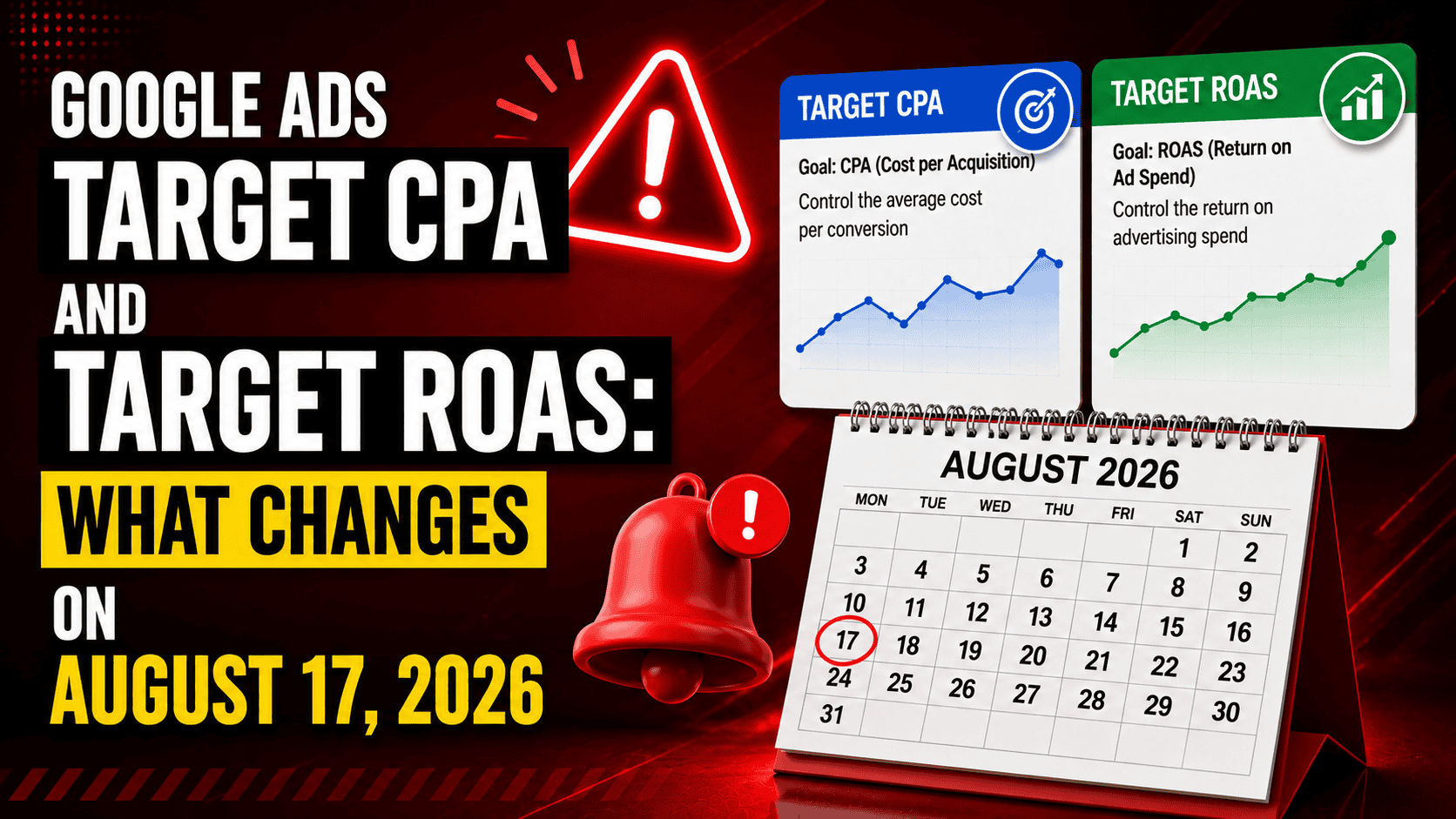
On August 17, 2026, that advantage comes to an end.
Google has announced a change to its bidding system affecting campaigns with a “Limited by budget” status that use target-based bidding strategies: Target CPA, Target ROAS and, for Demand Gen, Target CPC. After that date, campaigns will be steered more closely toward the target declared by the advertiser, rather than the level of performance the algorithm had discovered it could achieve.
Google’s official communication describes this as delivering more consistent and predictable performance. That is true. But it is an uncomfortable truth, because in this case, predictability comes at a cost.
What Actually Changes, in One Sentence
The following example comes directly from Google, rather than being my interpretation.
If your campaign has a Target CPA of €10 but has been generating conversions at €5 over the past few months, from August 17 onward that campaign will begin delivering results closer to the €10 target you entered. Twice the cost, with the same budget.
The same principle applies in reverse to ecommerce. A Target ROAS of 300% that currently produces 600% will gradually be brought closer to 300%.
Google will not automatically change anything in your account. It will not adjust your budgets or rewrite your targets. It will simply begin taking the number you entered more literally. The problem is that, across a huge number of accounts, that number has never been updated.
Why This Change Does Not Only Affect Advertisers Who Were Not Paying Attention
The mechanism that is about to be discontinued was not a bug. It was a consequence of how the system operated.
When a campaign is limited by budget, Smart Bidding enters only the most promising auctions because it does not have enough budget to participate in everything else. The result is an apparent level of efficiency that exceeds the target. Google has clarified that this behavior was not intentional and that it created performance fluctuations that were difficult to explain whenever the budget changed.
This is why increasing the budget of a high-performing campaign by 30% could often lead to a seemingly inexplicable deterioration in CPA.
From August onward, that variable will be removed. Budget and target will return to performing two separate functions: the budget controls spending, while the target controls efficiency. Anyone who has effectively used budget as an implicit efficiency lever, which includes a large number of advertisers, often without realizing it, will lose that lever.
Which Campaigns Are Affected
The update affects Search, Shopping, Performance Max, Demand Gen, Display, Hotel, and Travel campaigns, both in Google Ads and Search Ads 360. Manual CPC and Target Impression Share are excluded.
Notifications are being sent to accounts that have had at least one campaign with a “Limited by budget” status and a target-based bidding strategy during the past twelve months. Twelve months is an extremely broad window. This means that even a campaign that was limited by budget for only two weeks last year could place the entire account within the scope of the update.
If you manage multiple clients, there is one filter you should use: “Limited by budget” status combined with a target-based bidding strategy. Do not rely exclusively on notifications.
The Tool Is Already Available
Since July 6, the Bid Target Adjustment Tool has been available within the platform.
It displays affected campaigns, shows their actual performance over recent periods, and presents three possible options: align the target with actual performance, enter a custom target consistent with business objectives, or do nothing and accept that the campaign will move toward the original target.
When a platform creates a dedicated tool to manage a change, it is communicating something important. It expects the change to have a tangible impact on advertisers’ accounts.
The Real Risk Is Not a Target CPA That Is Too Low
There is a misconception circulating around this update that needs to be corrected.
The risk is not having set a target that is too aggressive. The real risk is the opposite: having set a target that is too generous and then never reviewing it.
A Target CPA left at €80 because it seemed like a prudent figure during the testing phase, while the account has been generating conversions at €45 for months, is exactly the type of campaign that could become significantly more expensive after August 17. Not because Google will simply increase bids, but because the system will stop holding itself back in the same way.
The paradox is clear: the campaigns most exposed to this change may be precisely those currently performing better than expected.
Brand Campaigns Are the Extreme Case
There is one category that deserves particular attention and that very few people are discussing.
Brand campaigns structurally tend to overperform. They capture warm traffic with extremely high intent and often generate conversions at costs far below almost any reasonable target. If you have a budget-limited brand campaign using a Target CPA inherited from the rest of the account, it could be among the first campaigns to experience a decline in efficiency.
Because brand campaigns can have a disproportionate influence on the account’s overall average CPA, the impact may not remain confined to that individual campaign. It can affect the broader performance figures reported to the client at the end of the month.
What Changes for Lead Generation
Advertisers using Search and Demand Gen to generate leads now face a decision that can no longer be postponed.
If the actual CPA over the past ninety days is significantly better than the target currently set, there are two sensible options. You can lower the target to reflect current performance and attempt to preserve that level of efficiency going into the autumn. Alternatively, you can leave the target where it is, knowing that you are effectively allowing the algorithm to spend more per lead in exchange for potentially greater volume.
The second option is not inherently wrong. If your real bottleneck is the number of appointments rather than the cost per appointment, a higher CPA combined with greater volume may make business sense. But it should be a deliberate decision, not an accident.
There is also a third option: remove the target and switch to Maximize Conversions. This can help recover volume, but it means giving up direct efficiency controls and becoming more exposed to CPA fluctuations when budgets change. It is a reasonable choice only when budget is genuinely the primary constraint and cost per lead is secondary.
Ecommerce: Target ROAS and Seasonality
For ecommerce businesses, the issue is less theoretical than it might appear because the update arrives shortly before the most important commercial season of the year.
If a Shopping or Performance Max campaign consistently performs above its current Target ROAS, that additional margin could disappear in the weeks leading up to Black Friday and Cyber Monday. This is precisely the worst moment to discover the impact, because it is also when advertisers typically increase their budgets.
There is, however, another side to the change. Once campaigns have stabilized, scaling could become more predictable. If the target is respected more consistently, increasing the budget should theoretically produce fewer of the unexpected side effects advertisers have become accustomed to. In principle, greater predictability may replace some of the hidden efficiency that is being lost.
For Performance Max, there is an additional consideration: advertisers may see shifts in how spending is distributed across the campaign’s internal channels, as the algorithm optimizes more strictly toward the stated target rather than independently pursuing the most efficient available path.
What to Do in the Coming Weeks
Google says that no action is required. Technically, that is true. In practice, it is a statement that should be interpreted carefully.
The first step is extremely simple, yet often overlooked: compare the target set for each campaign with its actual CPA or ROAS over the past sixty to ninety days. Wherever there is a significant gap between those two figures, you have identified a campaign that may be exposed to the change.
The second step is to verify that your tracking is reliable. Every Smart Bidding strategy is only as good as the data it receives. With a system that will now follow targets more literally, poor tracking does not merely create tolerable inefficiency. It can generate an incorrect decision that is then repeated thousands of times. Duplicate conversions, missing server-side events, unimported offline conversions, and attribution models left unexamined can all distort the signals guiding the system.
The third consideration is timing. Google recommends completing the review by August 17, but making changes on August 16 leaves virtually no room for campaigns to stabilize. Campaigns generally need one or two conversion cycles to adjust. Advertisers managing significant volumes should therefore aim to complete this work within the first few days of August.
What This Update Really Tells Us
There is a broader interpretation of this change that extends beyond bidding.
The implicit message is clear: I am no longer asking you to optimize. I am asking you to tell me the truth about what you actually want.
And this is where the real problem begins, because many advertising accounts cannot answer that question accurately. They do not know their true margins, the actual value of a lead across the entire sales pipeline, or the difference between a desirable CPA and a genuinely sustainable one. For years, many businesses could operate without this clarity because the algorithm partially compensated for it. Now, the system is increasingly taking the number provided and acting on it.
August 17 is therefore not merely a technical deadline. It is the day Google will stop correcting poorly defined targets on your behalf.