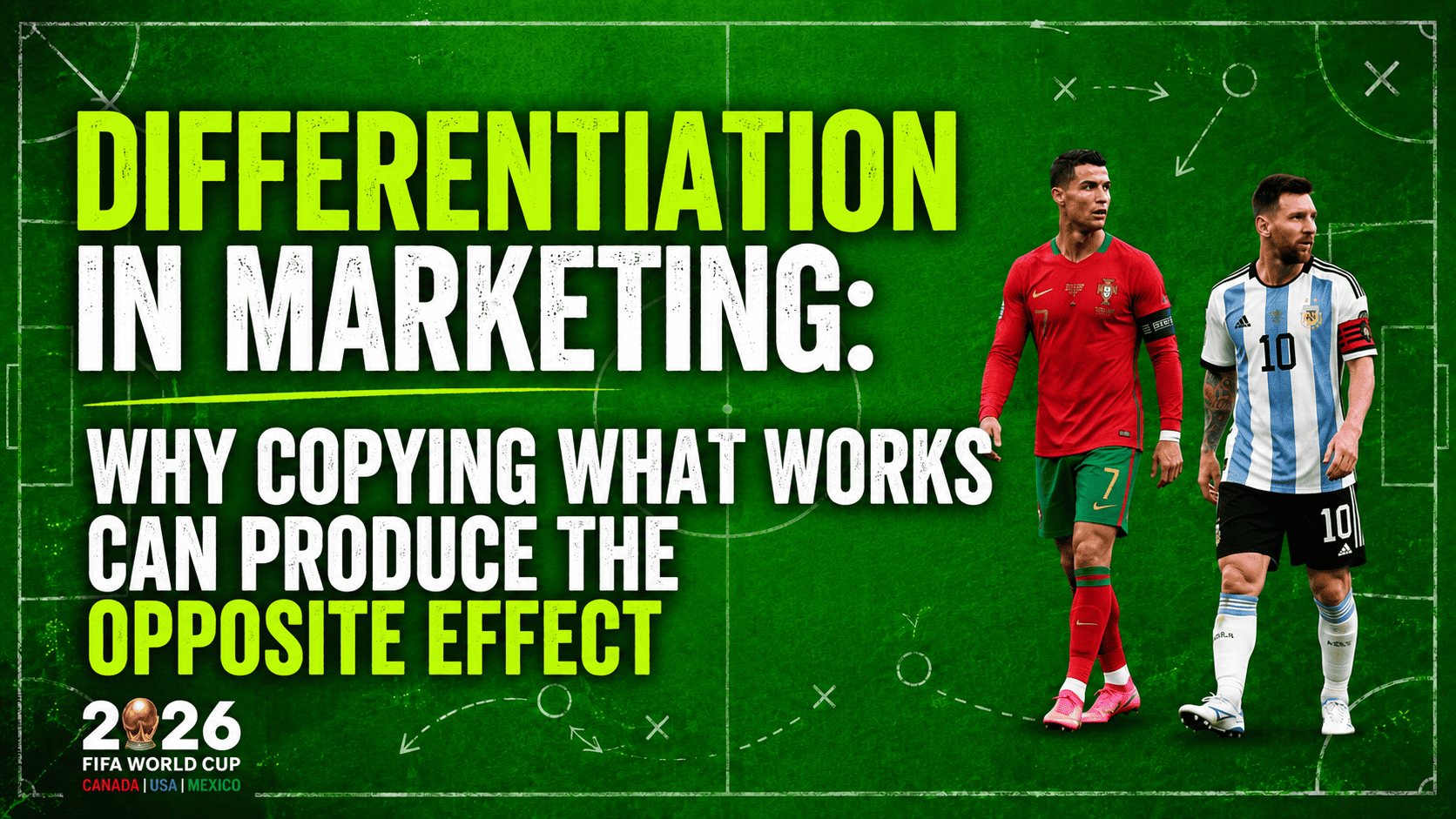
Among the many recurring dynamics that shape marketing and its underlying logic, there is one that deserves particular attention: an idea works, delivers clear results, and within a short time is adopted by an increasing number of companies, eventually transforming from a distinctive advantage into an industry standard. It follows a kind of downward curve in which the original idea is gradually weakened and stripped of some of its greatest strengths, above all its ability to spark curiosity and encourage its target audience to learn more.
This process is not limited to communication or advertising. It can also be seen in products, design, content, and even sports. Recognizing it means understanding a fundamental principle: differentiation is not an absolute characteristic but a condition that always depends on the competitive landscape.
When What Works Stops Making You Stand Out
During major sporting events, such as the current FIFA World Cup, it is common to notice trends that spread remarkably fast. A fascinating example can be found in football boots.
From the opening matches, a significant number of players have taken the field in Canada, the United States, and Mexico wearing bright pink boots. The choice is not purely aesthetic. Against the green of the pitch, pink creates a striking contrast, making the boots instantly recognizable to both spectators and television cameras.
For a brand, this kind of decision offers an obvious advantage that can be summarized in a simple equation: greater visibility equals greater product exposure.
As both sport and life constantly remind us, however, every advantage has another side. Powerful ideas tend to be imitated, for better or for worse.
Imitation Reduces the Value of Novelty
In marketing, successful ideas are analyzed and replicated with remarkable speed. This is entirely natural.
When a strategy delivers strong results, it quickly becomes a benchmark for the market. Other brands begin adopting similar language, comparable visual solutions, and almost identical communication techniques. This is exactly what has happened among brands such as Nike, Adidas, Puma, and New Balance.
Although this process may initially seem beneficial, it ultimately produces a very different outcome.
The more companies adopt the same approach, the less capable it becomes of interrupting attention. What was once distinctive becomes familiar, and the element of surprise gradually disappears.
Real Differentiation Begins When You Break the Pattern
This is where an interesting dynamic emerges.
If most players are wearing pink football boots, those wearing completely different colors naturally attract attention. During the World Cup, for example, the white and blue boots worn by Lionel Messi, perfectly matching Argentina’s colors, immediately stand out. Not because they are necessarily better, but because they break a pattern that has become predictable.
The same principle applies to marketing.
When an entire industry relies on the same formats, the same hooks, the same visual styles, or the same communication techniques, standing out no longer means refining the existing formula. It means changing direction, sometimes radically.
The ability to break an established pattern becomes a differentiator in itself.
For this reason, true originality does not always come from inventing something completely new. More often, it comes from doing something different from what the market has begun to accept as normal.
Why Following the Market Is Not Always the Best Strategy
There is a specific reason why so many companies end up looking alike.
Watching what works for competitors reduces the perception of risk. If a particular strategy appears successful, following it feels like the safer choice.
This mindset, however, often produces a paradoxical effect.
In trying to reduce uncertainty, companies gradually give up their own identity, creating communication that becomes increasingly similar to everyone else’s.
The result is a marketplace where everyone tries to stand out using exactly the same tools. As the overall noise increases, memorability inevitably declines.
Differentiation Is an Ongoing Process
One of the most common mistakes is treating differentiation as a destination that can be reached once and for all.
In reality, it works very differently.
Every distinctive element is eventually imitated. As a result, what makes a brand recognizable today may no longer have the same impact just a few months later.
That is why differentiation requires continuous observation.
You must monitor how the market evolves, recognize when a particular approach has become too widespread, and have the vision and confidence to adjust your communication before it loses its effectiveness.
Differentiation is therefore not an endpoint but a dynamic process that evolves alongside the competitive environment.
Observing the Context Matters More Than Following Trends
Every marketing decision should be evaluated not only on its intrinsic quality but also on the context in which it exists.
An excellent idea can lose much of its effectiveness if dozens of competitors adopt it at the same time.
Conversely, an apparently simple decision can become extremely powerful precisely because it introduces a point of contrast with what audiences encounter every day.
For this reason, before asking what the best strategy might be, it is often more useful to ask a different question: does this choice genuinely differentiate the brand, or is it simply following a path that is already overcrowded?
Differentiation Does Not Always Mean Doing More. It Often Means Doing Something Different
More often, it means recognizing when an idea has stopped being distinctive and having the courage to take a different path, even an unconventional one.
This is the same principle that can be observed both in sports and in communication: something stands out because it creates contrast. Once everyone copies that contrast, it inevitably loses much of its power.
Perhaps, then, the most valuable question is not, “What are my competitors doing?” but rather, “What can I do today that nobody expects?”
More often than not, that is where true differentiation begins.