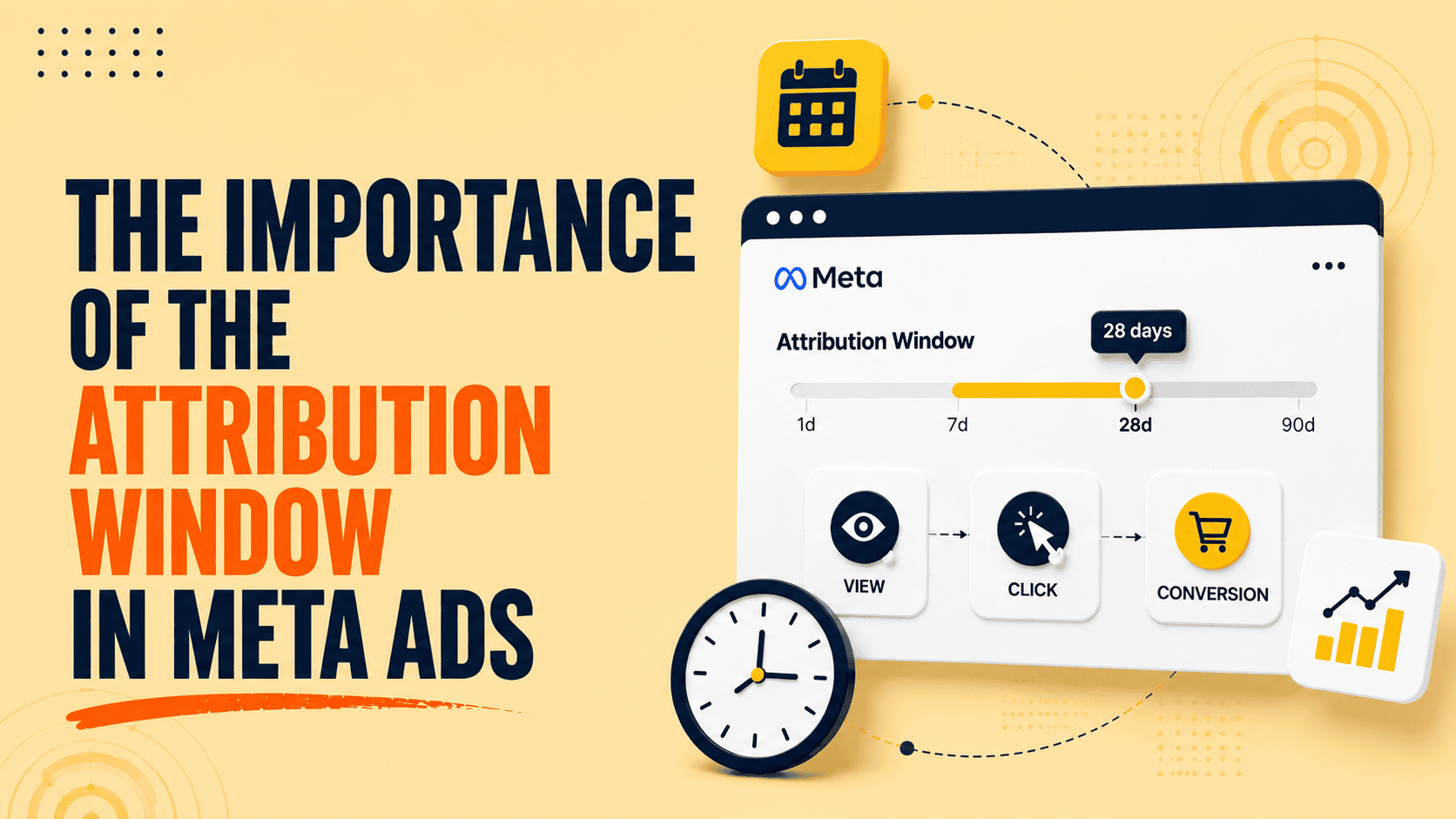
Among the most overlooked settings in Meta Ads, the attribution window is one of the most important. Yet this single setting directly affects how campaign performance is interpreted, how conversions are evaluated, and how advertisers make decisions about budgets, creatives, and optimization.
Many advertisers simply leave the default setting in place without asking whether it actually reflects how their customers make purchasing decisions. The problem is that when the attribution window doesn’t align with real customer behavior, performance data can become misleading.
When that happens, effective campaigns may be paused too early, while successful offers may be mistakenly considered underperforming.
What Is the Attribution Window in Meta Ads?
The attribution window is the period of time during which a conversion is credited to an ad after a user interacts with it.
This setting does not change user behavior.
It changes how performance is recorded and reported inside the platform, making it a critical factor in reporting accuracy and strategic decision-making.
Why This Setting Is Often Overlooked
The reason is simple: many advertisers analyze numbers without considering the context behind them.
If you only look at attributed conversions without understanding the customer’s actual buying timeline, it’s easy to misjudge campaign performance.
This can lead to conclusions such as:
- Assuming a campaign isn’t generating results when conversions simply take longer.
- Believing an ad performs poorly even though it significantly influences purchasing decisions.
- Cutting budgets on campaigns that are actually driving sales.
- Judging a product or service as ineffective when it simply requires a longer buying cycle.
The goal isn’t to find the universally “best” attribution window.
The goal is to choose the one that most accurately reflects how your customers actually buy.
When a Short Attribution Window Makes More Sense
A shorter attribution window, such as one day, is generally more appropriate when purchasing decisions happen quickly.
This is common with lower-priced products, such as items costing $20 or $30, where buying behavior is often impulsive.
The customer journey typically looks like this:
- The user sees the ad.
- They click.
- They purchase almost immediately.
When this reflects average customer behavior, a one-day attribution window provides a more accurate picture of campaign performance.
The same principle can apply to campaigns focused on generating immediate leads, such as booking a phone call or requesting a quick consultation.
Why Short Windows Work Well for Low-Cost Products
With simple and affordable offers, conversions often happen as a direct response to advertising.
In these situations, extending the attribution window too far can make it harder to understand which campaigns are actually driving immediate purchases.
A shorter window provides a clearer view of direct advertising impact when decisions happen with minimal friction.
When a Longer Attribution Window Is More Appropriate
The situation changes dramatically when selling consulting services, education programs, B2B software, real estate, or other high-ticket offers.
In these industries, purchasing decisions are rarely immediate.
Instead, potential customers often follow a longer journey:
- They encounter the advertisement.
- They visit the website.
- They review additional information.
- They return one or more times.
- They carefully evaluate the offer.
- Only after several days do they convert.
In these cases, a seven-day attribution window often provides a far more realistic representation of the customer’s decision-making process.
Not because it’s inherently better, but because it aligns with longer buying cycles.
Industries With Longer Decision Cycles
Some categories naturally require more trust and evaluation before a purchase is made, including:
- Professional services, where credibility plays a major role.
- Consulting businesses, where value must be carefully assessed.
- Educational programs, where buyers compare multiple options.
- B2B software, where several stakeholders may be involved.
- Real estate, where purchasing decisions naturally take longer.
- High-ticket products that are rarely bought impulsively.
In these scenarios, using an attribution window that is too short can artificially reduce reported conversions, making campaigns appear less effective than they actually are.
The Right Question to Ask
Choosing an attribution window should begin with customer behavior, not platform defaults.
The real question isn’t:
“Which setting produces better reports?”
Instead, it should be:
“Which setting most accurately reflects how long my customers take to make a decision?”
This perspective changes how campaigns are evaluated.
Rather than applying the same configuration to every account, businesses should consider:
- The type of offer.
- Product or service pricing.
- Decision complexity.
- The number of touchpoints before conversion.
- How quickly prospects move from interest to action.
The Most Expensive Attribution Mistakes
Choosing the wrong attribution window can become extremely costly.
If data is interpreted incorrectly, strategic decisions will also be incorrect.
Common mistakes include:
- Turning off effective campaigns because they appear weak under a short attribution window.
- Underestimating how ads contribute throughout the customer journey.
- Judging a valuable offer too harshly simply because conversions take longer.
- Optimizing campaigns based on incomplete data, reducing visibility into true advertising performance.
When this happens, it is no longer just a reporting issue.
It directly affects revenue, budget allocation, and long-term campaign growth.
How to Correctly Interpret Attribution, Conversions, and Performance
To evaluate Meta Ads accurately, it helps to follow a structured process.
First, analyze your customer’s decision-making timeline to determine whether conversions happen within hours or after several days.
Then, align the attribution window with the nature of your offer instead of applying a universal default.
Always interpret conversion numbers within context, remembering that fewer attributed conversions under a short window do not necessarily indicate weaker performance.
Evaluate campaigns realistically by considering the time customers need to reach a decision.
Finally, make optimization decisions only after interpreting the data within that broader context to avoid shutting down campaigns that are actually working.
This approach helps prevent rushed conclusions and creates performance analysis that better reflects commercial reality.
There Is No Perfect Attribution Window
Perhaps the most important takeaway is that there is no universally correct attribution window.
The right choice always depends on the business model.
An e-commerce store selling inexpensive products requires a very different reporting framework than a consulting business, educational provider, or premium service company.
Treating every business the same inevitably produces distorted insights.
The attribution window is not merely a technical setting.
It is an analytical tool.
Like any analytical tool, it should be calibrated to accurately reflect the reality you are trying to measure.
Conclusion
The attribution window directly shapes that interpretation and deserves far more attention than it typically receives.
When it accurately reflects customer behavior, reporting becomes more meaningful, campaigns are evaluated more fairly, and costly mistakes become less likely.
The objective is not to chase a default configuration.
It is to build a reporting framework that matches the way people actually make purchasing decisions.