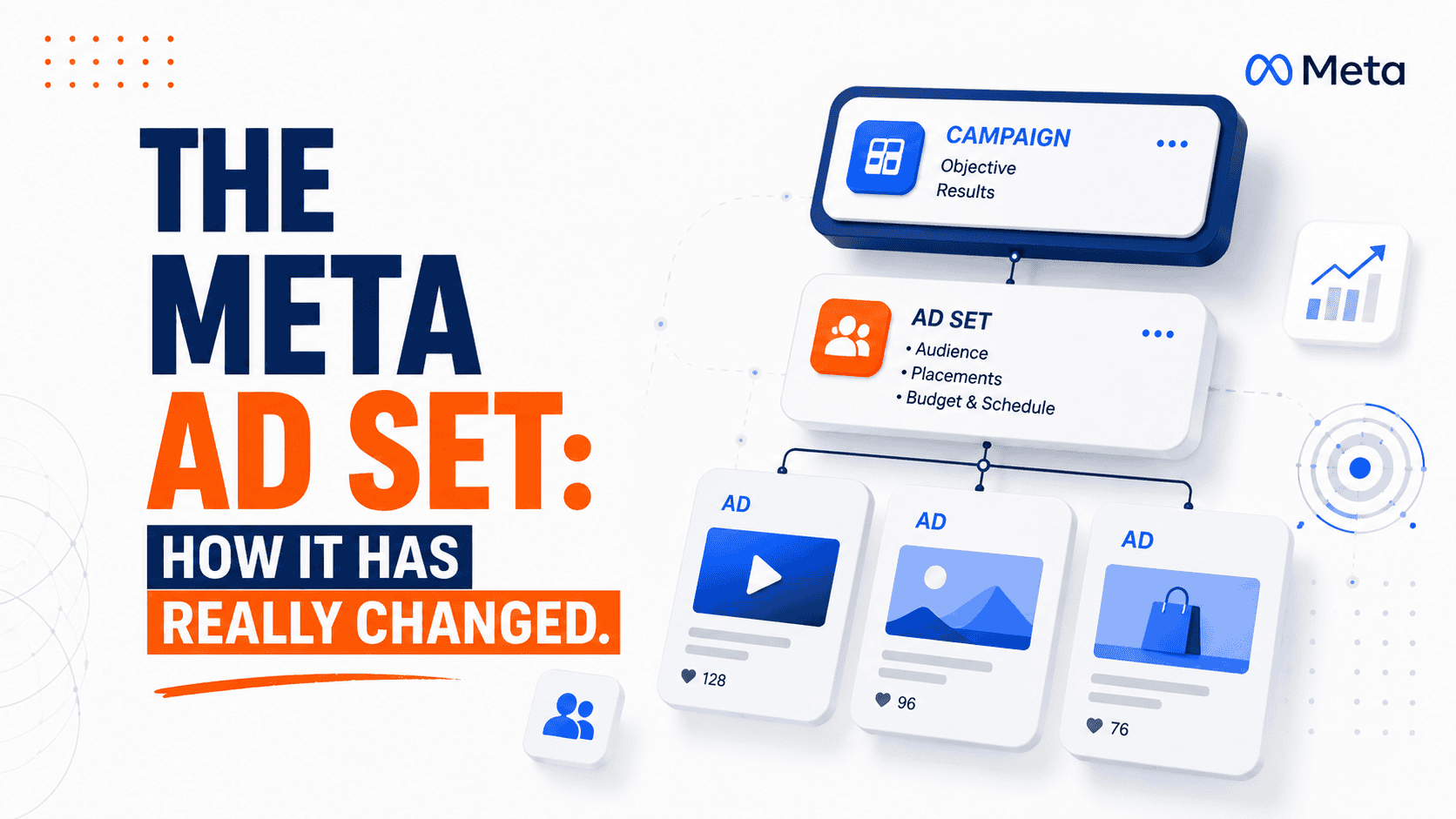
For many years, the ad set in Meta Ads was the operational center of targeting. It was where advertisers defined interests, behaviors, lookalike audiences, exclusions, and detailed audience segments. The goal was simple: identify the ideal customer profile and instruct the platform to find those people.
Today, that logic is no longer enough.
With the evolution of Meta’s machine learning systems and increasingly predictive algorithms, the role of the ad set has changed dramatically. Continuing to manage it the way marketers did a few years ago is one of the most common mistakes in Facebook Ads and Meta Ads campaigns.
From Manual Targeting to Predictive Targeting
In the traditional model, the ad set was used to build audiences with surgical precision. Advertisers selected numerous signals, including:
- Specific interests
- Purchase and browsing behaviors
- Lookalike audiences
- Audience exclusions
- Highly detailed segmentations
For a long time, this approach worked well. The platform relied heavily on manual instructions, and advertisers attempted to define the perfect audience before the campaign even launched.
Over time, however, Meta began changing both its structure and operational logic.
The algorithm became increasingly capable of interpreting real-time signals, automatically expanding audiences, and identifying users likely to convert without depending on rigid segmentation rules.
Why the Ad Set Is No Longer the Core of Targeting
The most important shift is this:
The ad set is no longer a strict control mechanism. It is now an initial direction for the algorithm.
Rather than defining a fixed path, it provides a starting point from which the system can optimize delivery.
This means many campaigns struggle not because the algorithm is ineffective, but because they are still built using outdated principles. When advertisers force narrow audiences, tiny segments, and long lists of interests, they often restrict a system specifically designed to discover high-potential users independently.
The Impact of Artificial Intelligence on Meta Ads
Artificial intelligence has shifted the center of gravity of campaign optimization.
Meta now interprets how users interact with content, click on ads, watch videos, and complete conversions. These signals become the foundation of optimization.
As a result, the platform no longer relies solely on the settings chosen during campaign setup. It operates dynamically and predictively.
This is why, in many cases, only a few basic ad set settings are necessary, such as:
- Country
- Age
- Language
Once these essential parameters are defined, Meta can use behavioral data to identify people most likely to respond to the advertising message.
The Real Targeting Happens in the Creative
If the ad set plays a smaller role as a rigid filter, where does targeting happen today?
The answer is in the creative itself.
Modern targeting is driven primarily by what the ad communicates. The wording, positioning, opening hook, video format, and creative angle all influence who engages with the campaign.
Particularly important elements include:
- Copy, because it clarifies who the message is for
- The hook, because it captures the attention of the right audience
- The creative format, because it influences the quality of signals sent to the platform
- Offer clarity, because it helps the algorithm identify the users who respond best
When a creative explicitly speaks to a specific audience, such as founders, entrepreneurs, or accountants, Meta begins identifying the types of people who engage with that content and expands distribution toward similar profiles.
The Signals That Drive Campaign Delivery
Campaign delivery depends on more than the initial setup.
It is heavily influenced by the signals generated during delivery.
Every interaction helps define audience quality. Some of the most important signals include:
- Watch time
- Clicks
- Engagement
- Conversions
When the message is clear and attracts the right people, the algorithm receives stronger and cleaner signals. The more consistent these signals become, the easier it is for Meta to identify users similar to those who have already demonstrated interest or purchase intent.
This is why, in lead generation and digital marketing campaigns, creative quality often matters more than complex audience segmentation.
The Most Common Meta Ads Mistake
The most common mistake is continuing to think as if it were still 2018.
Many advertisers try to manually control every targeting detail, believing that tighter segmentation automatically leads to better results.
In reality, this often creates the opposite effect:
- It reduces the algorithm’s ability to explore
- It limits campaign scalability
- It makes discovering new converting users more difficult
- It shifts attention toward technical settings rather than messaging
Additionally, many detailed targeting options no longer carry the same importance they once did. Certain interests have been reduced or removed, while the platform increasingly relies on audience expansion and machine learning.
How to Structure an Effective Ad Set Today
An effective ad set no longer needs to be complex.
Instead, it should provide enough flexibility for the algorithm to work while maintaining only the constraints that are genuinely necessary.
A strong setup generally includes:
- Defining geographic area, age, and language when required
- Avoiding extremely small audiences
- Not creating dozens of nearly identical audience segments
- Focusing strategic efforts on creative and messaging
- Monitoring audience response signals to evaluate message alignment
This does not mean targeting has disappeared.
It means targeting has moved to a different level.
Today, the system learns primarily from what the ad communicates and how people respond to it.
Where Your Time and Attention Should Go
If advertisers once spent most of their time building the perfect audience, it now makes more sense to focus on building stronger messages.
Today’s priorities include:
- Writing clear and compelling copy
- Creating relevant and immediate hooks
- Developing creatives that clearly speak to the intended audience
- Producing content capable of generating strong and consistent signals
When these elements are executed effectively, Meta has a far better chance of finding the right audience than a campaign built around dozens of audiences but supported by weak or generic ads.
Conclusion
The Meta ad set has not become less important—it has simply changed function.
It is no longer the place where all targeting decisions are made manually. It is a starting point rather than the primary source of precision.
Today, the real competitive advantage comes from creating ads that are clear, relevant, and highly specific. Targeting still exists, but it increasingly happens inside the ad itself: within the copy, the hook, the creative, and the signals generated by audience interactions.
Advertisers who continue relying exclusively on interests, narrow audience segments, and restrictive targeting are often working against the platform’s current logic.