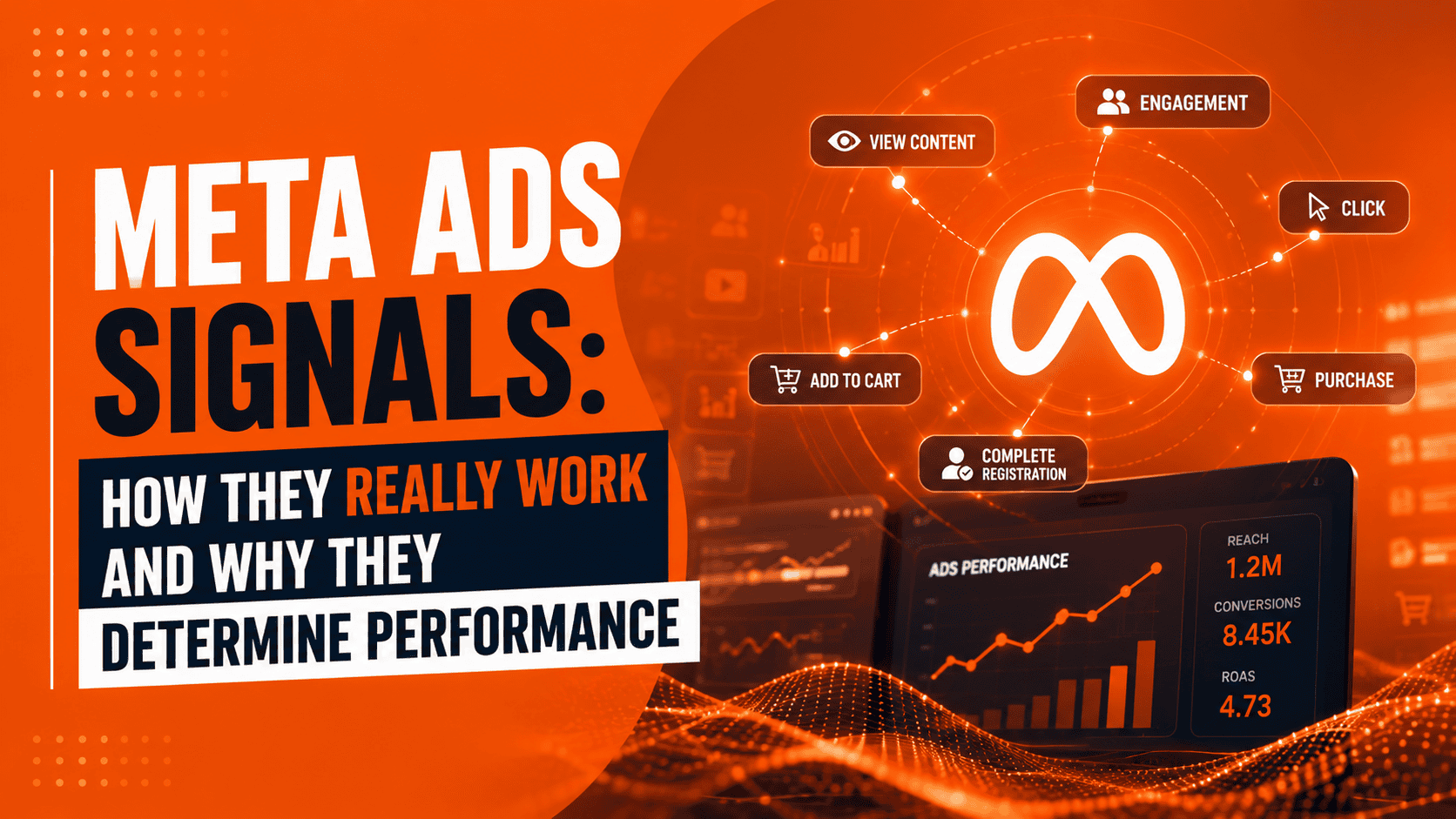
In today’s world of digital advertising, understanding how Meta Ads signals work means stepping into the core mechanism that governs campaign distribution. Today, it is no longer enough to simply set up the right audience or define technical parameters. It has become necessary to interpret a system that makes decisions based on what people do while scrolling through content.
Looking more closely at these dynamics, it becomes clear that every interaction, even the smallest one, helps shape the informational framework the algorithm uses to decide whether content deserves wider distribution or not. In this sense, advertising is no longer just about publishing ads, but about the ability to generate useful signals that guide the system.
Meta Ads signals: what they are and why they really matter
To understand how campaigns work today, we need to start with a clear definition: signals are all the actions users take when they come into contact with content.
These interactions can take different forms, such as:
• simply pausing on content
• watch time
• a click
• a more advanced action, such as a conversion
What makes these elements particularly relevant is that they are not treated equally. Every signal has a specific weight, which helps define the overall value of the creative in the eyes of the algorithm.
In this landscape, what matters is not just visibility, but the type of visibility a piece of content receives and the reactions it manages to generate.
The hierarchy of signals: from simple scroll to conversion
Looking even deeper into the topic, it is possible to identify a real hierarchy that structures the value of signals.
At the base is the view, which represents the first contact between user and content. Moving upward, we find stronger signals such as time spent, which indicates greater interest and an early form of engagement.
Next come clicks, which show active user intent, and finally conversions, which represent the strongest and most valuable signal.
This progression shows how each stage lays the foundation for the next, creating a path that the algorithm constantly observes and interprets. An effective creative, therefore, does not simply generate visibility, but guides the user through a process that progressively increases the value of the signals produced.
How the algorithm uses signals to distribute ads
The moment a campaign is launched, the system immediately starts collecting useful data from the very first interactions. By observing who stops, who ignores, and who takes action, the algorithm builds a behavioral model.
From this information, it identifies recurring patterns and expands distribution toward users with similar characteristics. This process is not static, but evolves continuously, adapting to the signals being collected.
As a result, distribution no longer depends on an initial manually defined audience, but on the dynamic ability of the system to learn and optimize. This is where the advertiser’s role changes, shifting from audience selection to designing content capable of activating consistent signals.
The real shift: you are not creating ads, you are generating signals
The most important turning point is this change in perspective.
The focus is no longer only on the ad itself, but on the type of response it generates.
Every piece of content becomes a tool for “training” the system, providing useful information to improve distribution. This means that even a visually strong creative, if it fails to produce relevant signals, can be penalized in terms of visibility.
On the other hand, content that captures attention and stimulates interaction strengthens the algorithm’s learning process, increasing the probability of reaching people who are genuinely interested.
The role of attention time in performance
Among all signals, attention time plays a particularly central role. In a context where users scroll quickly through content, being able to capture and hold attention even for a few seconds becomes a fundamental indicator.
This element acts as the first filter: if content fails to pass the initial threshold, it is unlikely to enter the broader distribution cycle. If it succeeds, the system interprets longer attention as a strong signal.
Because of this, creative structure must work in two complementary directions: the ability to stand out immediately and the ability to maintain coherence throughout the rest of the experience.
What changes operationally for those creating ads
In light of these dynamics, it becomes increasingly clear that advertising requires a different approach than in the past.
Correctly configuring a campaign or defining a precise target is no longer enough. What matters now is designing content capable of generating useful signals, with attention to structure, message, and engagement potential.
This creates a shift in operational focus, moving from technical management to the strategic construction of creatives.
Conclusion
The value of a campaign is no longer determined only by its initial setup, but by its ability to generate responses that the system can interpret and amplify. In this context, the difference is not made by who defines the audience better, but by who creates content capable of activating relevant signals.
It is exactly in this shift that the true effectiveness of ads is measured, transforming every creative into a tool capable of influencing algorithmic behavior and, as a result, campaign performance.