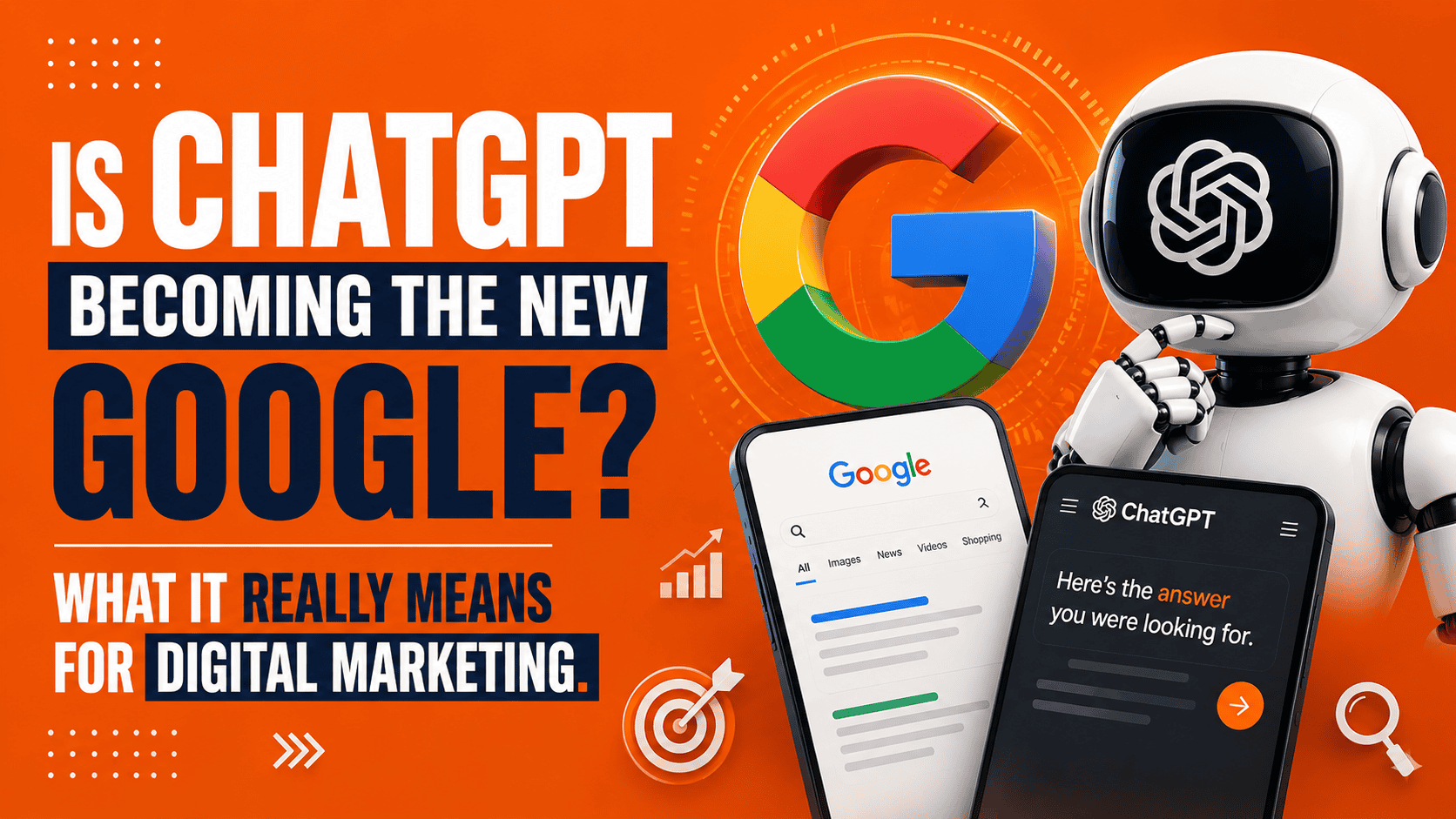
For more than twenty years, the web has operated according to a relatively simple model: someone had a question, typed it into Google, reviewed a list of results, and decided which website to visit.
An entire industry was built around that process, including SEO, advertising, content marketing, and conversion optimization.
Today, however, something is changing.
Not because Google is disappearing. Not because ChatGPT is about to completely replace traditional search engines.
But because, for the first time in many years, the point at which users make decisions is beginning to shift.
The question marketers, businesses, and professionals should be asking is not whether ChatGPT will become the next Google.
The real question is what happens when a growing number of people stop reviewing ten different search results and start relying on a single AI-generated answer.
From Search to Answers
For years, digital marketers focused on gaining visibility within search engine results pages.
The objective was simple: rank highly, earn the click, and bring users into your digital ecosystem.
With the rise of conversational AI assistants, that paradigm is changing dramatically.
Users no longer necessarily want a list of alternatives.
Increasingly, they want a summarized answer, a pre-analyzed comparison, or a filtered recommendation.
In other words, the evaluation process that once happened inside the user’s mind is gradually being delegated to artificial intelligence.
It may seem like a subtle shift, but it fundamentally changes the rules of digital distribution.
When someone asks which software to use, which consultant to hire, which smartphone to buy, or which strategy to follow, the challenge is no longer simply appearing in search results.
The challenge becomes being included in the answer itself.
This is why concepts such as AI SEO and Answer Engine Optimization (AEO) are becoming increasingly important. What once seemed like niche topics for specialists are quickly becoming essential for anyone concerned with online visibility.
The Real Goal Is Not Traffic
One of the most common mistakes is viewing this transformation solely through the lens of website traffic.
Many professionals wonder whether ChatGPT will reduce visits to websites.
It is a reasonable concern, but it may be the wrong question.
The real issue is control over attention.
For years, success was measured through metrics such as impressions, clicks, visits, and sessions.
In the age of AI assistants, it becomes increasingly important to understand who influences the decision before the click ever happens.
If an AI system provides a positive recommendation, part of the decision-making process has already occurred.
Traffic comes afterward.
This means the strategic value of a brand will increasingly depend not only on its ability to rank, but also on its ability to be recognized as a trusted source within the ecosystems that power large language models.
SEO, AEO, and the New Visibility Battle
Many people describe this evolution as the death of SEO.
A more accurate interpretation is that SEO is evolving.
Traditional SEO still matters. People will continue using Google, Bing, and other search engines.
What is changing is the number of entry points to information.
Today, content can be discovered through:
- Traditional search engines
- AI assistants
- TikTok
- YouTube
- AI-generated chatbot responses
Distribution is becoming more important than simple content production.
Creating valuable content is no longer enough.
Brands must build ecosystems capable of generating authority signals, citations, mentions, and consistent references over time.
The key issue is not which algorithm dominates today.
The key issue is how information distribution itself is changing.
Why Strong Brands Have an Advantage
There is another important factor worth considering.
In traditional search, users can compare dozens of different results.
When they receive a summarized AI-generated response, the number of referenced sources naturally becomes much smaller.
This benefits brands that already possess strong recognition and authority.
Established companies, respected professionals, and organizations that have built credibility over time gain a significant advantage because they are easier to identify, verify, and cite.
In other words, branding is becoming even more valuable than it was before.
The Difference Between Being Found and Being Recommended
For years, digital marketing revolved around one question:
How do I get discovered?
Today, a second question is emerging:
How do I get recommended?
The distinction may sound subtle, but it is profound.
Being discovered means appearing in front of someone.
Being recommended means being considered a credible solution before the user even evaluates all available alternatives.
This may be the most important shift currently taking place.
We are not witnessing Google being replaced by ChatGPT.
We are witnessing the creation of a new decision-making layer that sits between users and information.
Conclusion
The real question is not whether ChatGPT will become the next Google.
For businesses, creators, and professionals, this means gradually shifting focus away from simply producing content and toward building reputation, trust signals, and distributed authority.
Because in the emerging era of digital marketing, visibility still matters.
But the real competition will increasingly be won by those who become trusted sources before they become clickable results.