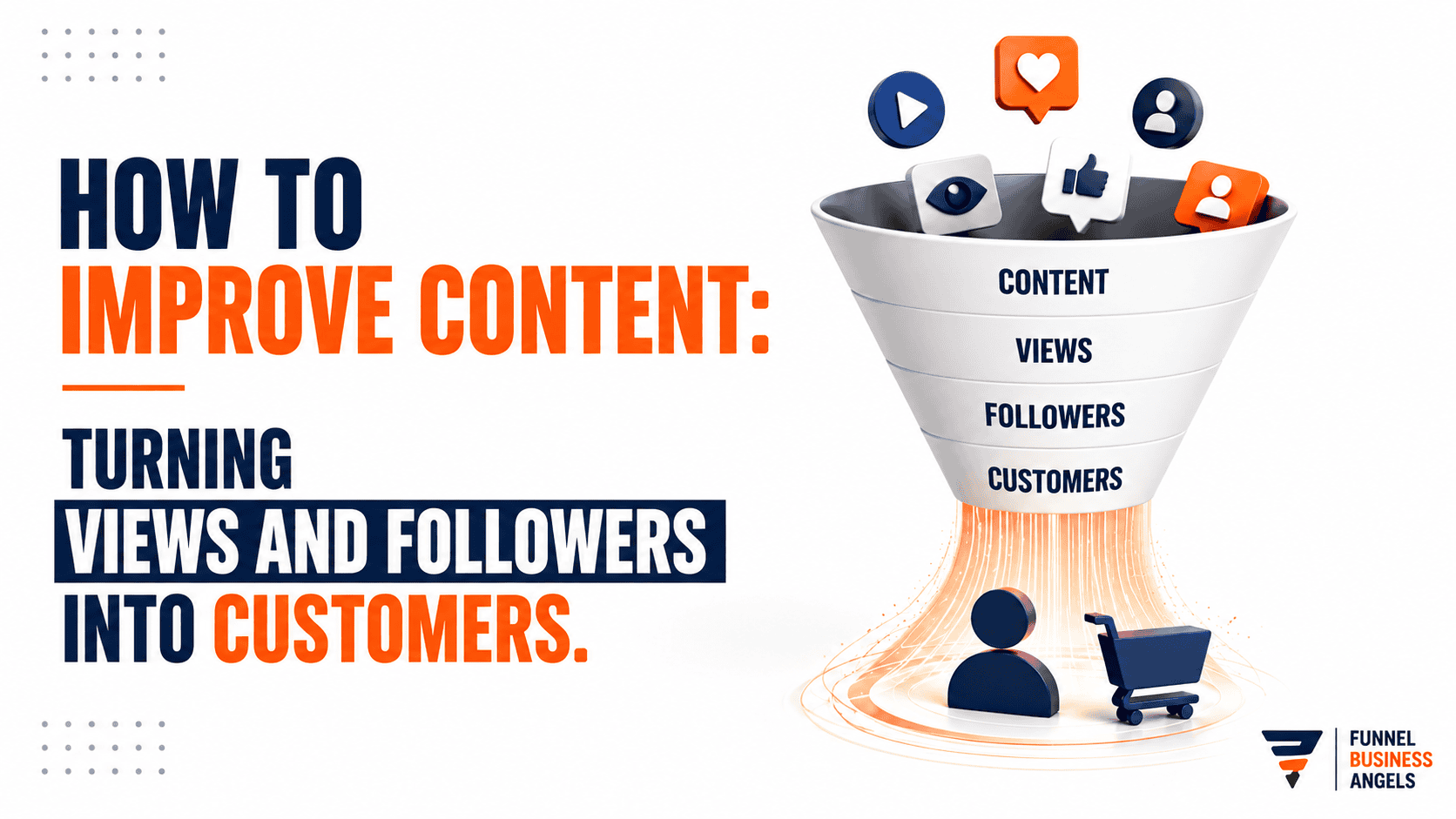
Many pieces of content generate views, likes, and new followers but fail to generate customers. In most cases, the problem is not the ability to create interesting content. The real limitation is the lack of a clear structure that guides people toward a specific action.
When a content strategy produces attention but not conversions, marketing remains incomplete. Views alone do not build a sustainable business. What is needed is a journey—a sequence of content designed to attract the right audience, qualify them, and guide them toward a consultation, lead magnet, call, or offer.
Why Content Gets Views but Doesn’t Generate Customers
A common mistake is publishing without a clear direction.
One piece of content today, a tip tomorrow, a trend the next day.
Each individual post may perform well in terms of reach, but if it is not part of a system, the attention generated becomes scattered.
This is the core issue: the difference between attracting followers and generating customers lies in the journey.
If someone consumes a piece of content but does not understand the next step, the outcome is simple. The platform keeps the attention, but the business captures little real value.
In practice, traffic is being handed to the social platform without creating any progression toward conversion.
That is why every piece of content should have a clear destination. It cannot be left to chance.
Every Piece of Content Needs a Clear Direction
Effective content does more than educate or entertain.
It should guide people toward something specific.
Possible destinations include:
- A lead magnet
- A consultation
- A discovery call
- An offer
- A more structured customer acquisition system
This completely changes how marketing is designed.
Instead of publishing content and hoping followers figure out what to do next, businesses intentionally build a path where every piece of content serves a specific purpose within the funnel.
In other words, content should not exist as isolated episodes.
It should function as part of a coherent customer acquisition system.
The Framework That Makes Content More Effective: The 3-Level Model
One of the most effective ways to improve content is by organizing it across three levels.
Although this framework is commonly used in advertising campaigns and lead generation strategies, the principle also applies to organic content whenever a clear funnel exists.
1. Content That Attracts the Right Audience
The first level is designed to capture the attention of the right people.
The objective is not broad visibility. The goal is to connect with an audience that aligns with the product, service, or offer.
At this stage, content should create initial interest while highlighting a recognizable problem, need, or goal.
Being relevant matters more than being viral.
This step is critical because attracting the wrong audience may improve vanity metrics while producing weak business outcomes.
2. Content That Qualifies
Once attention has been captured, the next stage is qualification.
Here, content helps identify people who are genuinely a good fit by clarifying the problem, context, and value of the solution.
Qualification creates clarity.
It helps potential customers understand whether the solution is relevant to their situation.
This reduces wasted conversations and improves lead quality.
Many businesses stop at visibility.
Without qualification content, marketing creates broad interest but generates few meaningful commercial opportunities.
3. Content That Drives Purchase Decisions
The third level focuses on conversion.
At this stage, content should not simply educate or attract attention.
It should help the audience move toward a concrete decision.
This can happen through:
- A clear call to action
- A contact request
- A consultation
- Access to a lead magnet
- A structured offer
Clarity becomes essential.
If content creates interest but provides no path forward, the process stops.
If it clearly guides people toward action, attention can become a real business opportunity.
Why a Clear Funnel Improves Results
When content is organized within a funnel, the metrics begin to change.
The objective is no longer simply increasing visibility. The focus becomes making customer acquisition more efficient and predictable.
Some of the most important benefits include:
- Lower cost per lead because messaging is better aligned with the right audience
- More stable ROAS thanks to a less random conversion process
- Higher-quality customers rather than casual followers or curious visitors
- Greater predictability in business growth
Predictability is the key advantage.
Without a system, marketing depends on hope.
With a system, marketing becomes a controllable growth lever.
Stop Hoping Followers Will Buy on Their Own
One of the most important mindset shifts involves abandoning the assumption that followers will eventually figure out the value of an offer and purchase independently.
That rarely produces consistent results.
Effective marketing does not rely on hope.
It relies on designing a customer journey.
When this approach is implemented correctly, content stops being isolated social media posts and becomes a strategic business asset.
How to Build a More Effective Content Strategy
To improve content performance, every publication should answer several important questions:
- Who is this content meant to attract?
- Is it attracting the right audience or simply generating attention?
- Does it help qualify potential customers?
- Does it provide a clear next step?
- Does it lead toward a consultation, discovery call, lead magnet, or offer?
If the answers are unclear, the content may perform well on the platform while underperforming for the business.
Following the three-level framework ensures that every piece of content contributes to a measurable outcome.
From Content to System
Improving content is not only about creativity, copywriting, or format.
It is primarily about placing content within a coherent system.
This is often what separates businesses that accumulate attention from businesses that generate customers.
Views can be useful, but they are not the destination.
They are simply the first stage of a process that should be intentionally designed all the way to conversion.
When the journey is clear, content stops being merely an editorial asset and becomes an active component of the marketing strategy, lead generation system, and business growth engine.
Conclusion
Improving content is not about publishing more often or chasing engagement.
It is about creating direction.
Every piece of content should guide people toward a specific next step within a structured funnel.
The most effective approach is to build content across three levels:
- Attract the right audience
- Qualify prospects
- Guide them toward purchase
When this framework is applied consistently, cost per lead tends to decrease, ROAS becomes more stable, and qualified customers begin arriving more predictably.
Ultimately, the real breakthrough is not creating content that people like.
It is creating content that takes people somewhere.