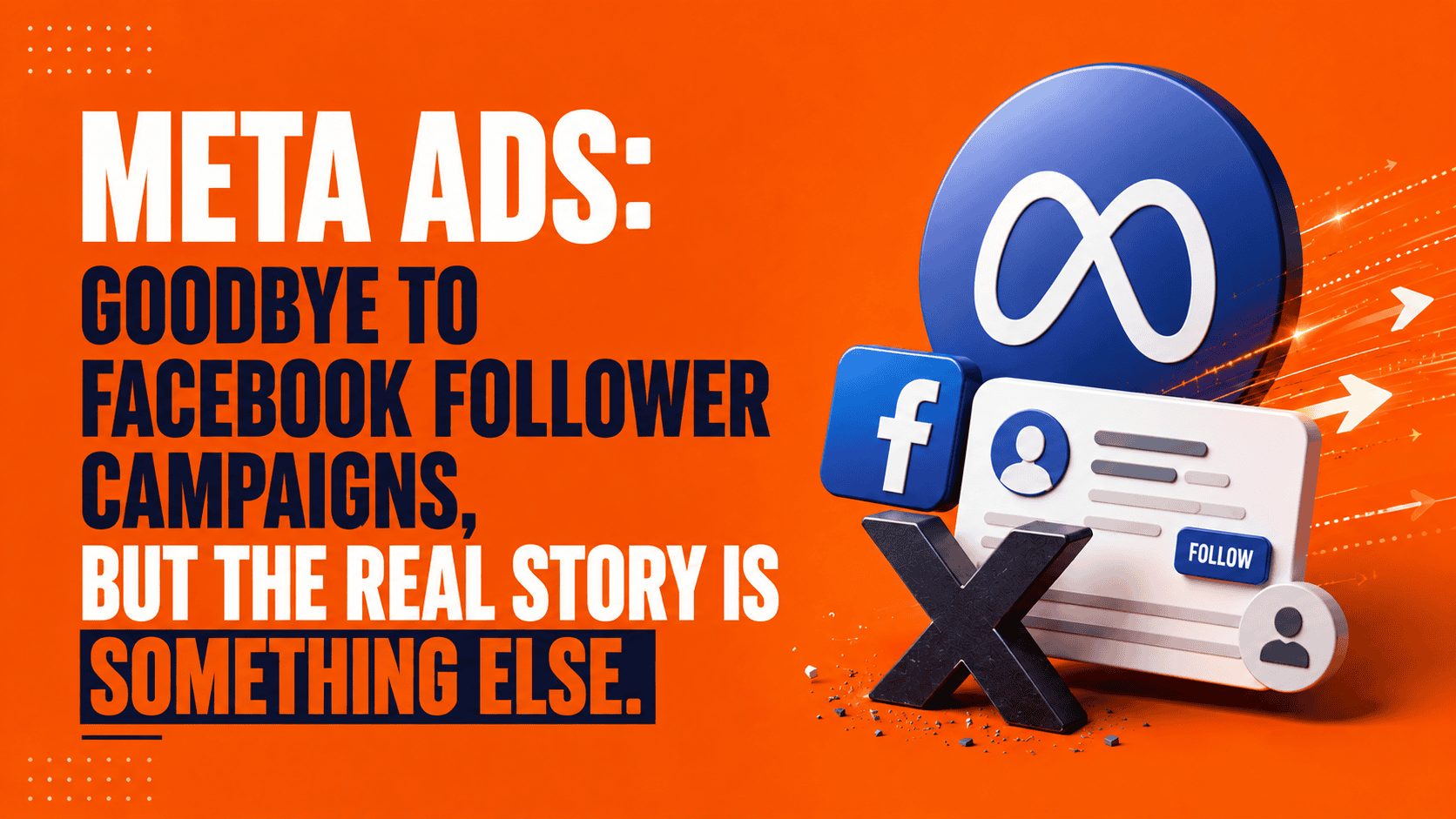
Over the past few days, a piece of news has been spreading quickly among marketers, social media managers, and advertisers: Meta appears to be removing Facebook follower campaigns.
As often happens when a platform introduces a major change, reactions have been polarized. Some see it as the end of Facebook Page growth, while others dismiss it as nothing more than another Ads Manager update.
As usual, the reality sits somewhere in the middle.
The removal of the dedicated Page Likes objective is not simply an interface change. It is a signal that reveals much more about where Meta is heading and how Facebook and Instagram continue to evolve.
Facebook Follower Campaigns: What Is Actually Changing?
For many years, growing a Facebook Page was considered one of the most important indicators of social media success.
More followers meant greater distribution potential. Every new fan represented a person who, at least in theory, would see the content published by the Page.
That model no longer exists.
Over the past several years, Facebook has steadily weakened the relationship between follower count and actual content visibility. At the same time, Instagram has followed a similar path, moving closer and closer to the recommendation-driven model that helped make TikTok one of the world’s most influential platforms.
Today’s algorithms no longer distribute content primarily based on existing connections.
They distribute content based on the probability that a user will find it interesting.
This is a cultural shift before it is a technological one.
From Social Graph to Interest Graph
To understand this evolution, we need to look at how modern feeds work.
For years, Facebook was built around the concept of the social graph. You followed people, brands, or Pages, and most of your feed came from those relationships.
Today, the dominant model is the interest graph.
In other words, platforms attempt to understand what topics capture your attention and use that information to determine what content you see, regardless of whether you follow the creator.
This explains why a Reel published by a relatively small account can reach hundreds of thousands of people, while a Page with tens of thousands of followers can generate modest results.
Distribution no longer depends on audience size.
It depends on the quality of the signals a piece of content generates.
Viewed through this lens, the removal of follower campaigns becomes far more logical than it initially appears.
Why Meta Is Moving Away from Followers
The real question is not whether followers still matter.
The real question is whether they still play the central role they did ten years ago.
The answer is no.
From an advertising perspective, follower growth and business outcomes are not necessarily connected.
Many companies have spent significant budgets over the years acquiring Page followers without seeing meaningful improvements in leads, website traffic, or sales.
A profile can accumulate thousands of followers while generating very few business results.
Meta understands this dynamic perfectly and is increasingly prioritizing objectives tied directly to user behavior and measurable actions.
The Facebook Page Is Not Dead, but Its Role Is Changing
Another common misconception is that Meta is signaling the end of business Pages.
That is not the case.
Facebook Pages still play an important role within the Meta ecosystem.
They serve as credibility assets, official brand hubs, and spaces where businesses can collect reviews, information, content, and community interactions.
What changes is their importance as a distribution mechanism.
Today, content discovery increasingly happens through Reels, recommendations, suggested content, and AI-driven interest-based distribution systems.
The Page becomes an identity hub.
Distribution is handled by the platform’s artificial intelligence.
What This Means for Businesses and Advertisers
For companies investing in marketing and advertising, this update should trigger an important reflection.
Measuring success exclusively through followers and likes is becoming less meaningful every year.
The metrics that increasingly reflect business impact are different:
- Watch time
- Shares
- Saves
- Profile visits
- Meaningful engagement
- Conversion-oriented actions
This does not mean followers and likes have become irrelevant.
It means they can no longer be treated as the ultimate objective.
They are the outcome of a strong strategy, not the strategy itself.
The Real Lesson Behind This Update
The removal of follower campaigns is not simply another Ads Manager update.
It reflects a much larger transformation taking place across the entire social media ecosystem.
For years, growth was measured through highly visible metrics: followers, fans, and likes.
Today, platforms are rewarding something different.
They reward the ability to capture attention, maintain interest, and influence behavior.
That is why the real story is not that Meta is removing follower campaigns.
The real story is that Meta is officially confirming a shift that began years ago:
In modern digital marketing, it matters less who follows you and far more who chooses to stop and pay attention.