Launching Meta Ads today is no longer as simple as creating an ad and assigning a budget. The real challenge is providing the algorithm with enough accurate signals to optimize toward meaningful business outcomes.
In today’s advertising environment, shaped by iOS privacy updates, ad blockers, and the growing loss of browser-side data, many campaigns fail not because of weak offers or poor ad creatives, but because the technical and strategic foundations were never properly prepared. When tracking, conversion events, ad creatives, and audiences are not configured correctly, Meta ends up spending budget without truly learning who converts.
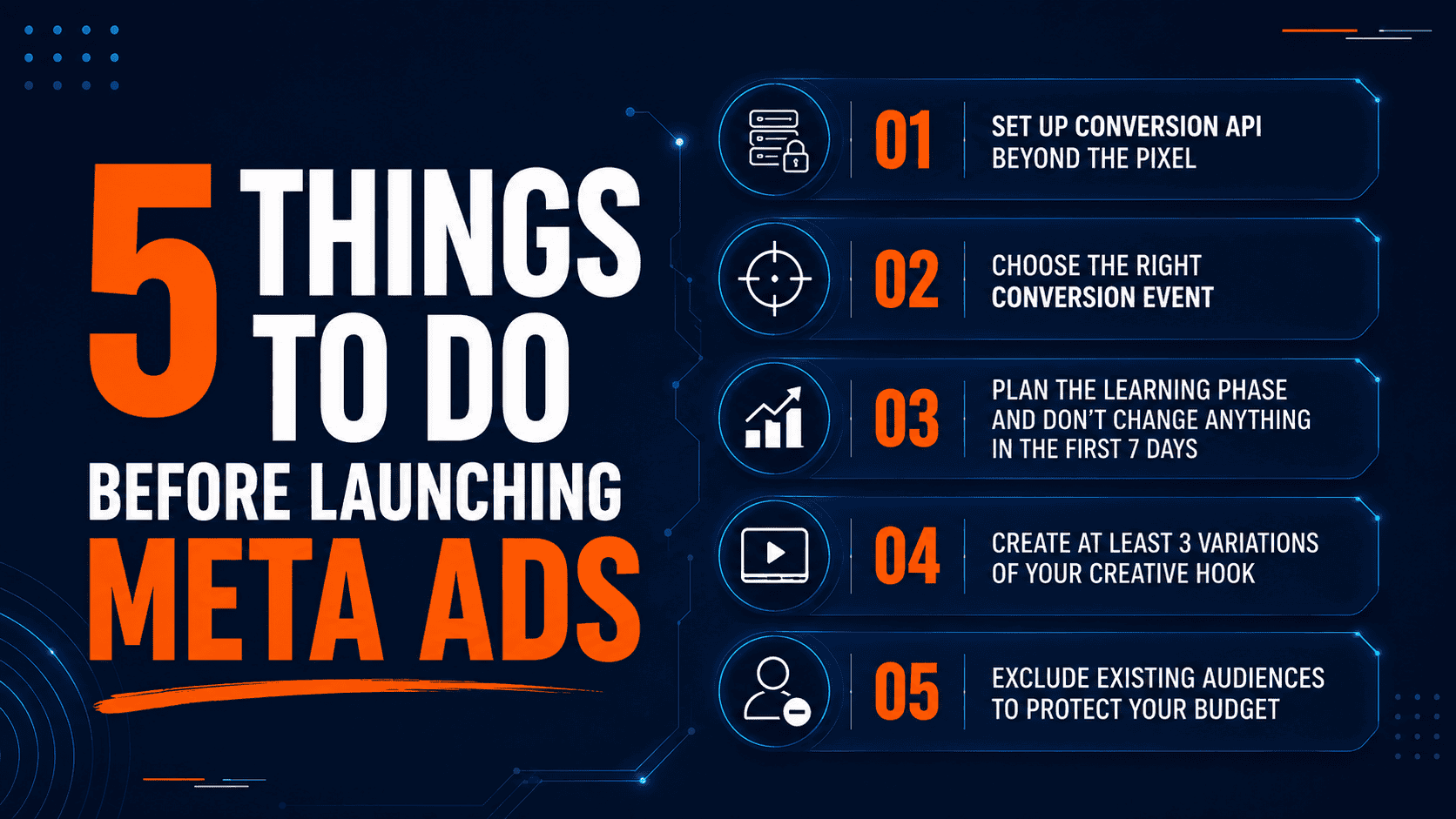
Before launching a new campaign, there are five essential actions that can make the difference between a campaign that scales and one that simply burns through budget.
Why Pre-Launch Matters More Than the Launch Itself
One of the most common misconceptions in digital marketing is that results depend primarily on what happens after ads go live. In reality, a large percentage of campaign performance is determined before launch.
Meta Ads performs best when it receives clear inputs. If the platform has reliable data, a properly configured conversion event, enough volume to exit the learning phase, and well-tested ad creatives, optimization improves significantly. If these elements are missing, the algorithm works with incomplete signals and distributes budget inefficiently.
The following five actions are designed to reduce that inefficiency.
1. Enable Conversion API, Not Just the Pixel
Relying solely on the Meta Pixel is no longer enough. Browser-side tracking alone misses a significant percentage of conversions due to operating system restrictions and ad blockers.
The consequence is simple: when a meaningful portion of conversions goes untracked, Meta receives an incomplete picture of campaign performance and optimizes less effectively. The system may prioritize less profitable audiences simply because it cannot see the full set of results being generated.
In practical terms, using only the Pixel can result in the loss of 20–40% of conversion data. That gap is too large to make reliable decisions regarding budgets, ad creatives, and targeting.
Why Conversion API Is Critical
Conversion API adds server-side tracking and helps recover signals that would otherwise be lost. It does not necessarily replace the Pixel—it complements it.
The benefit is not just technical. It is strategic. More accurate data enables the algorithm to:
- Better identify users most likely to convert
- Optimize budget allocation more effectively
- Reduce the risk of misinterpreting campaign performance
- Improve long-term stability and consistency
Businesses launching Meta Ads without this setup start at a disadvantage. Before spending a single dollar, tracking should be reliable.
2. Choose the Right Conversion Event
Not all metrics carry the same value. A common mistake is optimizing for superficial signals such as link clicks or views, assuming they will automatically translate into business results.
Meta finds what it is instructed to find. If the objective is clicks, it will find people who click. If the objective is real business outcomes, the campaign must be optimized accordingly.
The Right Event Is the One That Creates Business Value
The conversion event should align with the action that matters most to the business. For example:
- Lead, if the goal is acquiring qualified prospects
- Purchase, for e-commerce businesses
- Booking, for appointment-based businesses and consultations
The principle is straightforward: optimize for what matters, not for what is easiest to obtain.
Tracking Matters as Much as Event Selection
Choosing the right event is only useful if that event is accurately tracked. Campaigns may generate clicks and activity, but if conversion data is incomplete or inaccurate, the algorithm learns the wrong lessons.
That is why event verification should happen before any significant advertising investment is made.
3. Plan for the Learning Phase
Meta campaigns do not immediately operate at peak efficiency. Every campaign enters a learning phase where the system gathers signals and determines which users are most likely to convert.
This phase should be planned, not left to chance.
The Operational Benchmark: 50 Conversions
To exit the learning phase, Meta generally requires around 50 conversion events per week. This benchmark has important practical implications. If the budget is too low relative to the expected cost per conversion, the campaign may never generate enough signals to optimize effectively.
Why Many Campaigns Waste Budget Here
The learning phase is often the most expensive and unstable part of the campaign lifecycle. Problems occur when:
- The budget does not match the campaign objective
- The selected event occurs too infrequently
- Targeting, ad creatives, or campaign structure are changed too early
- Learning is interrupted before enough data is collected
The Seven-Day Rule
One of the most common mistakes is making changes too soon. Editing campaigns during the first few days resets or destabilizes the learning process, preventing the algorithm from collecting sufficient data.
As a rule of thumb, avoid making changes during the first seven days unless there is a clear technical issue. Patience during this phase is not passive—it is strategic discipline.
4. Create at Least Three Ad Creative Hooks
On Meta platforms, attention is won within seconds. The first three seconds of an ad often determine whether someone continues watching or scrolls away.
For this reason, a single ad creative is rarely enough. Launching one variation and expecting consistent performance is one of the most common causes of weak campaigns.
The First Three Seconds Matter Most
The hook is the element that stops the scroll and captures attention. It can be:
- A compelling statement
- A strong promise
- A thought-provoking question
- A clearly articulated problem
- A visual opening that immediately attracts interest
If the hook fails, the rest of the ad rarely gets a chance.
Test at Least Three Different Hooks
At launch, create at least three versions of your ad creative, each featuring a different hook. The goal is not to predict the winner in advance but to allow the data to reveal it.
This approach:
- Reduces dependence on a single creative concept
- Shifts targeting toward ad creatives and behavioral signals, which aligns with the direction Meta Ads continues to evolve
In a platform environment where traditional targeting plays a smaller role than it once did, ad creatives have become one of the most important targeting mechanisms available.
5. Exclude People Who Already Know Your Brand
Another critical pre-launch step involves audience exclusions. Without them, campaigns may spend budget targeting people who have already converted or are already familiar with the brand.
Paying repeatedly to reach existing customers is one of the most overlooked inefficiencies in Meta advertising.
Who Should Be Excluded
Before launching a campaign, create exclusion audiences for:
- Existing customers
- Previously acquired leads
- Website visitors
- People who already know the brand and do not need prospecting messages
This helps protect budget and provides cleaner performance data.
Doesn’t Meta Handle This Automatically?
To some extent, yes. Modern Meta automation can make intelligent decisions. However, automation performs best when it receives clear instructions.
If exclusions are not configured correctly, the platform can only work with the information it has been given. The quality of the output still depends heavily on the quality of the setup.
The Principle Behind All Five Actions
These five actions are not separate tactics. They are components of the same operating system. Meta Ads performs best when it receives signals that are accurate, sufficient, and aligned with business goals.
That means:
- Reliable tracking through Pixel and Conversion API
- A conversion event aligned with business outcomes
- Sufficient budget and volume for the learning phase
- Multiple ad creative hooks for testing
- Clean audiences through strategic exclusions
The challenge is not simply running ads. The challenge is structuring campaigns so the algorithm can accurately identify who is most likely to convert.
Final Meta Ads Pre-Launch Checklist
- Enable Conversion API alongside the Pixel
- Select the correct conversion event and verify tracking accuracy
- Plan for the learning phase and avoid making changes during the first seven days
- Create at least three ad creative hook variations
- Build exclusion audiences for customers, leads, and existing visitors
Conclusion
Meta Ads in 2026 no longer rewards advertisers who operate with the same strategies that worked in 2021. Competitive advantage comes from the quality of the signals you provide to the platform.
When tracking, conversion events, learning, ad creatives, and audience exclusions are configured correctly, the algorithm has the conditions it needs to optimize effectively. When these elements are neglected, campaigns may appear active while simply consuming budget.
A strong pre-launch process creates the foundation for better performance, more reliable decision-making, and sustainable campaign growth.