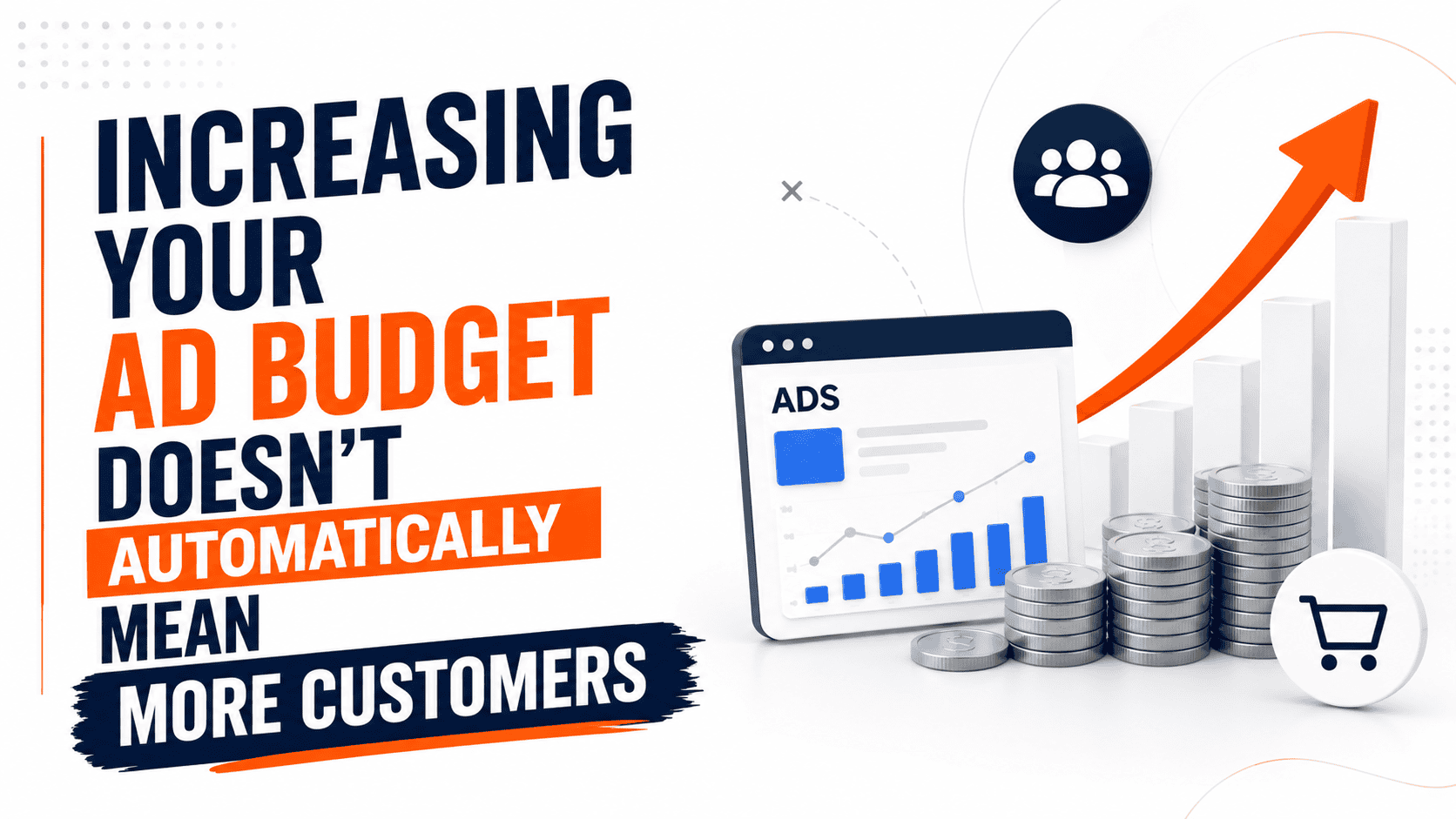
One of the most common beliefs in digital marketing is that increasing ad spend automatically leads to more customers.
In reality, this logic only works on the surface. In most cases, when a campaign underperforms, the problem is not how much money is being spent — it is what the campaign is actually communicating.
If the message is weak, generic or irrelevant to the right audience, increasing the budget does not solve the issue. Very often, it amplifies it.
The result is simple:
The Real Problem Is Not the Budget — It Is the Message
Many marketers instinctively focus on the financial side first.
If a campaign is not generating leads, sales or inquiries, the immediate reaction is often to increase spending. But this approach ignores one critical factor:
the quality of the copy and the precision of the message.
An advertising campaign does not work simply because it receives more funding.
It works when it creates a strong and clear signal for both the platform and the person seeing the ad.
If the signal is weak, the algorithm interprets the ad as less relevant.
The principle is simple:
when copy tries to speak to everyone, it resonates with no one.
And when it resonates with no one, metrics begin to deteriorate.
What Happens When the Copy Is Too Generic
Generic messaging creates a very predictable chain reaction.
The first metric that usually suffers is CTR — the click-through rate.
If the ad does not directly speak to a specific type of person, it captures less attention and generates fewer clicks.
At that point, the advertising algorithm steps in.
A low CTR is interpreted as a sign of low relevance.
The platform therefore considers the ad less interesting compared to competing content fighting for the same advertising space.
The result is worse distribution, often toward broader but less qualified audiences.
In practical terms, the campaign loses precision.
And when precision disappears, costs increase.
The Typical Sequence Looks Like This
- The copy does not speak to a precise target audience
- CTR decreases
- The algorithm interprets the ad as low relevance
- Distribution becomes less efficient
- The campaign reaches broader and less qualified audiences
- Costs increase while results worsen
In this situation, increasing the budget does not fix the structural issue.
It simply pushes a weak message harder.
Why More Budget Does Not Guarantee More Customers
Budget acts as an accelerator, not as a cure.
If a campaign already has strong foundations, additional investment can help scale results.
But if the messaging is flawed, extra budget only spreads ineffective communication faster.
This is one of the most overlooked aspects of Meta Ads and digital advertising in general:
spending does not replace strategy.
When an ad fails to connect with the real problem of the ideal customer, it does not matter how much money supports it.
The audience will not identify with the message.
The offer will not feel relevant.
And conversions will remain weak.
The Turning Point: Copy That Speaks to the Right Customer
Performance changes when copy stops being vague and becomes specific.
The breakthrough happens when the message:
- identifies a precise problem
- speaks to a clearly defined ideal customer
- immediately explains why the solution is the correct one
This is the foundation of effective communication in digital marketing.
The goal is not writing “more creative” or “more aggressive” ads.
The goal is building a message that instantly clarifies three things:
- who the ad is for
- what concrete problem exists
- why the proposed solution is credible
When these elements become clear, the message becomes more relevant.
And relevance improves both human response and algorithmic interpretation.
The Role of the Algorithm: Rewarding Clear Signals
Advertising platforms like Meta operate through signals.
They do not understand ads emotionally like people do.
Instead, they analyze behavioral reactions:
- clicks
- engagement
- attention
- interaction quality
- perceived relevance
If the message is clear and aligned with the correct audience, the signal becomes stronger.
The algorithm understands more easily:
- who should see the ad
- which users are more likely to respond
- how distribution should be optimized
This makes campaign delivery more efficient and often helps reduce costs.
A strong piece of copy improves not only human perception, but also algorithmic performance.
How to Recognize Weak Messaging
Weak advertising messages often share the same characteristics.
They usually:
- speak too broadly
- fail to identify a specific person
- describe generic benefits instead of concrete problems
- fail to differentiate the offer
- try to appeal to everyone and end up sounding anonymous
These elements make it harder to capture the attention of the ideal customer.
And if attention is weak from the start, the campaign already loses momentum in its earliest stage.
How to Build Stronger Ad Copy
Improving campaign performance starts with improving the message itself.
The copy should be designed to create immediate relevance.
An effective structure begins with three strategic questions.
What Specific Problem Are You Naming?
The more concrete the problem is, the easier it becomes for the right person to recognize themselves in it.
Precision increases relevance.
And relevance improves response.
Who Are You Actually Talking To?
Not “anyone who might be interested.”
A clearly defined ideal customer.
The right customer is not simply someone who clicks.
It is someone who genuinely matches the offer.
Why Is This Solution the Right One?
The message must immediately explain why the product, service or brand represents a credible solution.
When these elements become clear, the copy naturally becomes more selective.
And that selectivity is exactly what makes it more effective.
You do not need everyone to respond.
You need the right people to respond.
Better Performance Comes From Better Communication
Reducing marketing to a budget discussion is a strategic mistake.
The campaigns generating the strongest results are not necessarily the campaigns spending the most money.
They are the campaigns communicating with clarity, precision and relevance.
When copy:
- identifies a specific problem
- speaks to the correct ideal customer
- clearly explains the value of the solution
three things usually happen:
- the right audience responds better
- the algorithm distributes more efficiently
- costs decrease while results improve
That is the difference between campaigns that simply consume budget and campaigns that generate sustainable performance.
Conclusion
Increasing your ad budget does not automatically mean more customers.
If the message lacks relevance, spending more money will not fix the problem.
It will amplify it.
The real breakthrough happens when communication stops being generic and becomes strategic.
Effective copy does not try to appeal to everyone.
It tries to become deeply relevant to the people who matter most.
In modern digital marketing — especially within Meta Ads — message quality is not just a creative detail.
It is a direct performance lever.