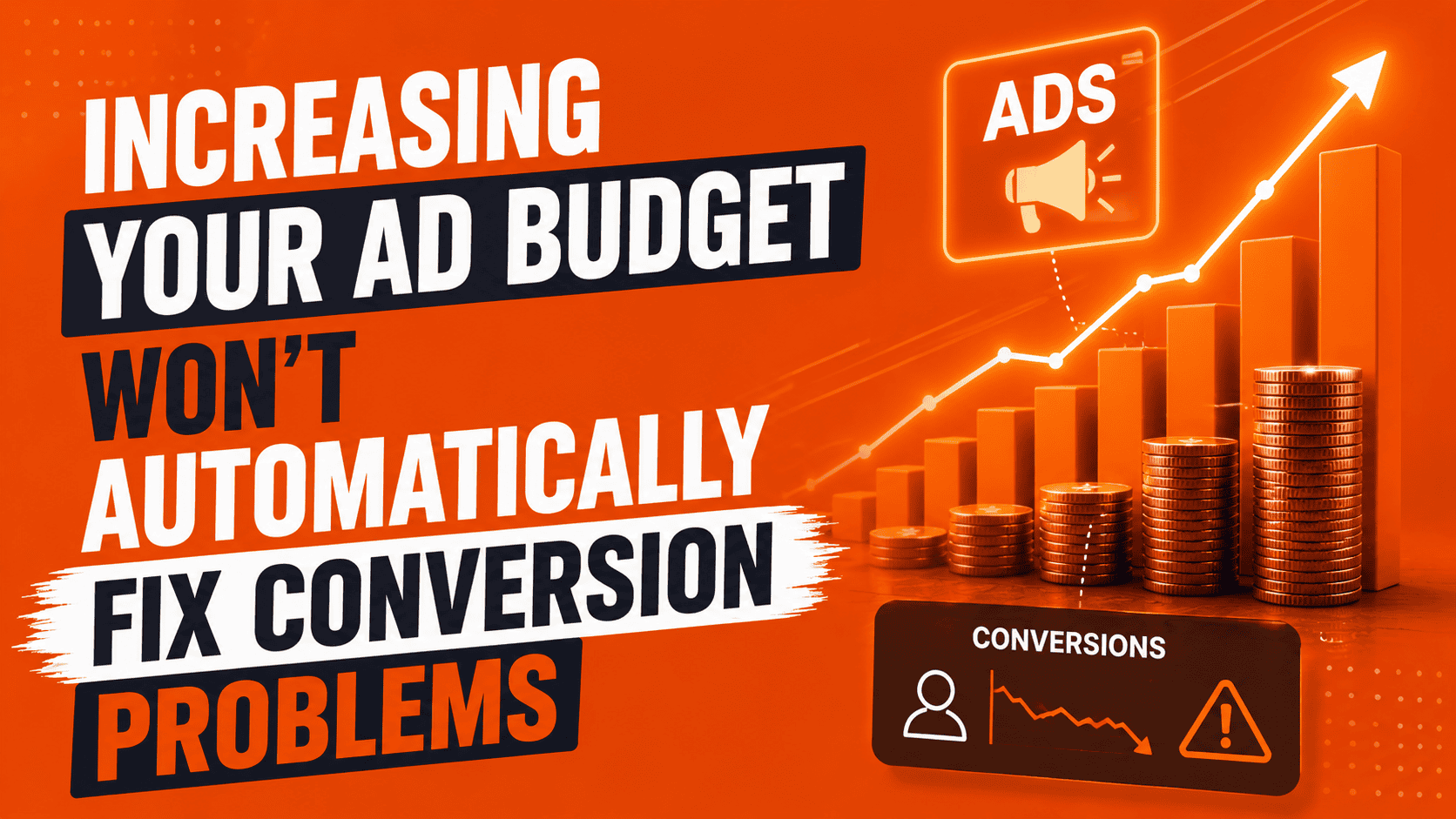
Many companies react the same way when a campaign underperforms: they increase the budget.
It’s an understandable decision, but very often the wrong one. In most cases, the real issue is not how much is being spent on Meta Ads or Facebook Ads. The problem is what the ad is actually communicating.
If the message is unclear, generic or irrelevant to the right audience, increasing the budget can actually make the situation worse instead of improving it.
More budget, without strategy, does not automatically mean more customers.
The False Myth: More Budget Equals More Results
The idea that spending more on advertising automatically leads to more conversions is one of the most common misunderstandings in digital marketing.
This approach ignores a fundamental principle:
When a campaign is not converting, budget is rarely the first variable that should be adjusted.
If the copy, creative or messaging fail to resonate with the correct audience, the system lacks the necessary signals to distribute the ad efficiently.
In other words, increasing the budget behind a weak message simply amplifies an existing problem.
Why the Real Problem Is Often the Message
An ad performs when it creates an immediate connection with a specific person.
But when the copy is generic, vague or written for everyone, it usually ends up speaking to no one.
This has a direct impact on performance.
When the ad fails to identify a clear problem or communicate a compelling value proposition, audience response weakens. One of the first signals to deteriorate is CTR — the click-through rate.
And a low CTR sends a very specific message to the platform:
“This content is not relevant enough.”
That is when the real performance problems begin.
What Happens When CTR Drops
When CTR decreases, the algorithm interprets the content as less interesting or less relevant.
This affects campaign distribution in very concrete ways:
- the ad gets distributed less efficiently
- it reaches broader and less qualified audiences
- perceived relevance decreases
- costs begin to rise
- results worsen despite higher spending
This is where many businesses make a second mistake:
They interpret declining performance as a volume problem instead of a relevance problem.
So they increase the budget again without fixing the actual cause.
The Role of the Algorithm: It Does Not Only Read Targeting
Modern campaigns no longer operate exclusively through targeting settings.
The system also evaluates the signals generated by user behavior and communication quality.
If the message is confusing, people react less.
If people react less, the algorithm concludes the ad is weak.
And once the ad is considered weak, distribution deteriorates.
On the other hand, when signals are clear, the platform understands:
- who should receive the ad
- which users are more likely to respond
- how to optimize delivery more efficiently
This is why in modern Meta Ads, copywriting, creatives and behavioral interpretation are often just as important — if not more important — than traditional targeting.
The Turning Point: Building Copy That Sends a Clear Signal
Campaigns start working when the message stops being generic and becomes specific.
Effective copy does not try to appeal to everyone.
It tries to become instantly relevant to the correct ideal customer.
A strong ad typically does three things very clearly.
Identify a Specific Problem
The message must begin with a concrete and recognizable problem.
Not an abstract promise.
The clearer the problem, the more likely the right person feels directly addressed.
An effective ad does not simply promote a product or service.
It demonstrates understanding of the exact difficulty the customer is experiencing.
Speak to the Correct Ideal Customer
Reaching a broad audience is not enough.
The objective is reaching the right audience — the people most likely to care and convert.
This requires communication that makes the recipient feel recognized.
When copy becomes too universal, it loses intensity.
But when it feels tailored to a specific person, perceived relevance increases dramatically.
Make the Solution Immediately Clear
The ad must communicate very quickly why the brand or offer represents a credible solution.
Complicated messaging is rarely effective.
Clarity is.
The user should immediately understand:
- what problem is being addressed
- who the offer is for
- why the solution deserves attention
When Signals Become Clear, Costs Can Decrease
Well-structured copy does not only improve audience perception.
It also improves communication with the algorithm itself.
When the system receives strong and coherent signals, it tends to distribute the ad more effectively.
This can improve campaign efficiency and positively impact metrics such as CTR and overall acquisition costs.
The principle is simple:
The clearer the message, the better the algorithm understands it.
The better it understands it, the better it distributes it.
And when distribution improves, results become far more sustainable.
How to Understand Whether the Problem Is Budget or Copy
Before increasing ad spend, it is essential to evaluate the quality of the message itself.
A few questions help reveal whether the bottleneck is financial or strategic:
- Does the copy speak to a specific person or to everyone?
- Is the problem described clearly or vaguely?
- Does the ad immediately communicate the value of the solution?
- Does the CTR indicate genuine interest or irrelevance?
- Is the campaign attracting the correct type of audience?
If the answers reveal ambiguity, budget is not the first variable to change.
The message needs to be clarified first.
The Key Lesson for Anyone Running Meta Ads
Campaign performance does not depend only on spending levels.
It depends on the ad’s ability to send clear, relevant and coherent signals.
Businesses that still think only in terms of targeting and budget often overlook what matters most today:
communication quality.
A piece of copy that speaks precisely to the ideal customer, identifies a real problem and clearly communicates the solution is not simply a creative detail.
It is a strategic lever that directly affects distribution, costs and conversions.
Conclusion
Increasing ad budget without a clear strategy will not automatically generate more customers.
In most situations, when conversions are weak, the real issue is not spending level — it is communication quality.
If the message lacks relevance, CTR drops.
If CTR drops, the algorithm interprets the signal negatively.
From there, distribution worsens, audiences become less qualified and costs rise.
The solution is not simply increasing spend.
The solution is building messaging that immediately makes sense to the right people.
That is what allows the algorithm to distribute more effectively and campaigns to generate sustainable results.