Over the past few months, one question has started circulating more and more among creators, companies, professionals, and social media managers: are social networks beginning to penalize AI-generated content?
The question mainly comes from a series of very specific signals. LinkedIn has openly started talking about content quality and reduced visibility for posts perceived as generic or inauthentic. Instagram continues to push the concept of originality. TikTok has strengthened policies around labeling artificially generated content. Meta, meanwhile, is progressively shifting focus from technical optimization toward creative quality and real behavioral signals.
What’s interesting, however, is that almost no platform is actually saying: “we ban AI.”
What’s happening is far more sophisticated — and much more important for anyone working in digital marketing.
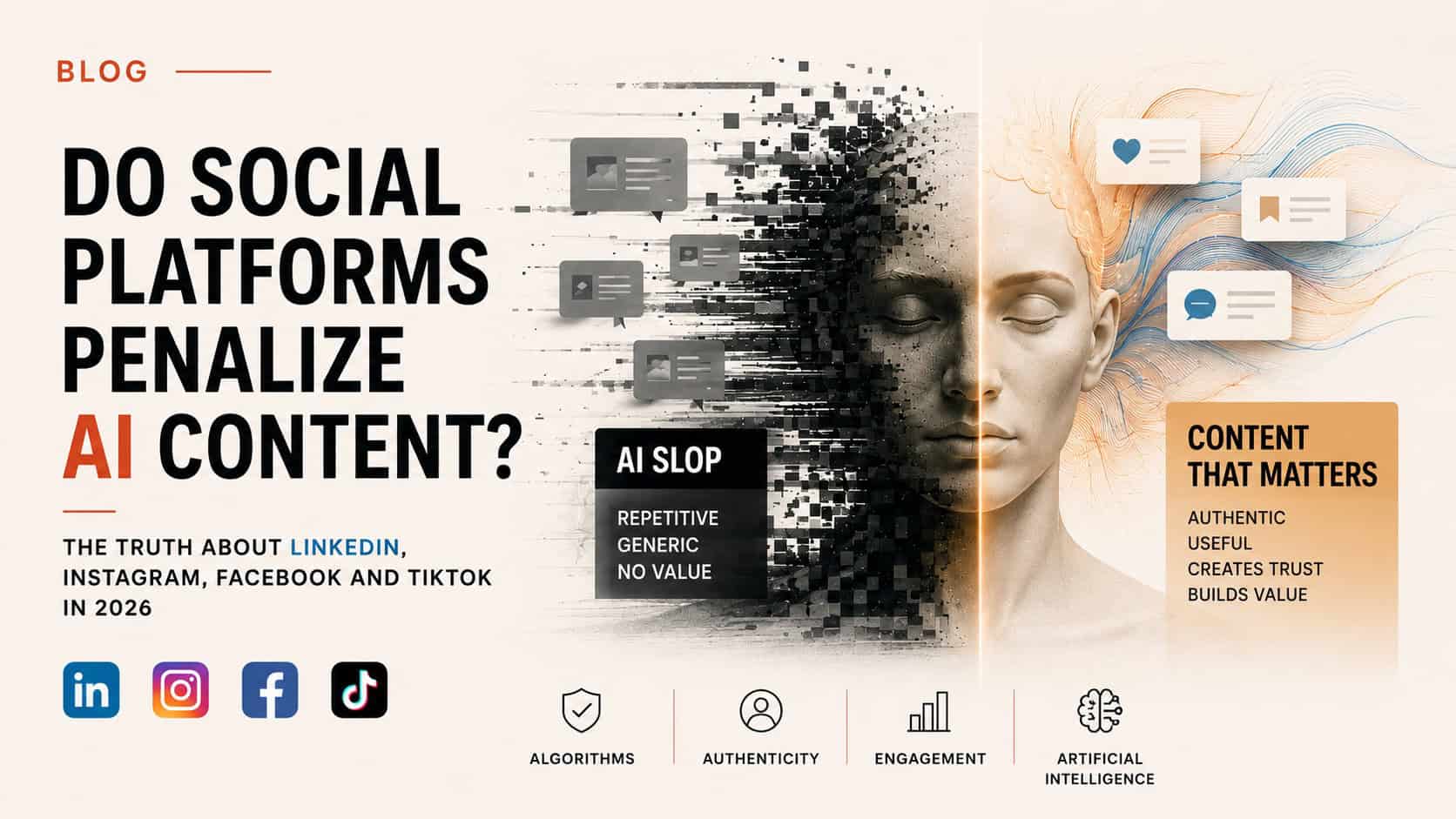
The real target of today’s algorithms does not seem to be artificial intelligence itself, but rather the industrial-scale production of mediocre, repetitive, indistinguishable content. What is increasingly referred to as “AI slop”: content that is technically correct, but lacks real experience, depth, perspective, or practical value.
And this is where the topic becomes strategically interesting.
AI Content on Social Media: The Problem Is Not the Technology, but Saturation
For years, social networks mainly rewarded frequency, volume, and the ability to generate fast interactions. If you understood the right format, replicated it quickly, and published consistently, distribution followed naturally.
The arrival of generative AI pushed this dynamic to the extreme.
Today, it’s possible to produce dozens of captions, carousels, articles, video scripts, and LinkedIn posts in just minutes. This dramatically lowered the cost of content production, but also massively increased the amount of content published every single day.
And when volume grows too much, algorithms inevitably become more selective.
Not because they “hate AI,” but because platforms need to protect user retention. If feeds become saturated with content that feels repetitive and interchangeable, users spend less time on the platform, trust decreases, and even the advertising value of the platform weakens.
This is exactly where the shift is happening.
LinkedIn Is Sending the Strongest Signal
Among all platforms, LinkedIn is probably showing the clearest signs of a strategic shift.
In recent algorithm updates, the platform has increasingly prioritized:
- real reading time
- depth of comments
- saves
- private shares
- perceived authority
- vertical expertise
At the same time, many professionals have started noticing weaker performance from posts that feel overly “perfect,” excessively standardized, or written with the typical neutral tone associated with AI-generated text.
This is not accidental.
LinkedIn is evolving into a professional environment with higher informational density, and that inevitably requires more aggressive filtering of superficial content.
In practice, the issue is not whether a post was written with ChatGPT. The issue arises when the post feels like it was written by nobody.
And that difference is enormous.
Because AI-assisted content enriched with real experience, data, case studies, personal observations, and strategic interpretation still performs very well. Generic content, on the other hand, increasingly loses momentum quickly.
LinkedIn today rewards content capable of generating authentic conversations and meaningful time spent, not just shallow engagement.
In other words, the platform is beginning to distinguish between content designed to “appear competent” and content that is genuinely useful.
Instagram and Facebook Don’t Penalize AI — They Penalize Low-Effort Content
On Instagram and Facebook, the situation is slightly different, but the direction is remarkably similar.
Meta has never openly declared systematic penalties against AI-generated content. In fact, the company is investing billions into artificial intelligence itself.
What clearly emerges, however, is that the algorithm is becoming increasingly sensitive to real engagement signals.
Today Instagram increasingly evaluates:
- watch time
- saves
- DM shares
- return visits to content
- depth of interaction
- ability to retain attention
This means generic, quickly produced, easily replicable content naturally loses distribution power.
And this distinction matters.
If someone uses AI to improve creative workflows, organize ideas, build structures, or speed up production, there is essentially no problem.
But if an entire online presence becomes an assembly line of soulless content, then the risk of declining reach increases significantly.
Even Adam Mosseri has repeatedly emphasized originality and authenticity, especially within the Reels ecosystem.
This connects directly to another major trend emerging in 2026: the return of “human” content.
Less polished, more believable videos.
More vertical expertise.
More real experience.
Less sterile aesthetics.
More interpretation.
Paradoxically, while AI makes content easier to produce, algorithms are simultaneously increasing the value of human recognizability.
And that may be one of the most fascinating paradoxes of this era.
TikTok and Transparency Around AI Content
TikTok is approaching the issue differently.
The platform has introduced clearer policies regarding the labeling of AI-generated content, especially for realistic images, audio, and video.
Here, the focus is less about editorial quality and more about transparency.
TikTok understands perfectly well that generative AI will become increasingly central to content creation. That is why it is building systems where users can understand what is real, synthetic, or manipulated.
But once again, a very clear pattern emerges: the content performing best still tends to feel authentic, recognizable, and credible — even when supported by AI.
The real question is not “AI or no AI.”
The real question is: does the content feel alive?
The Real Trend of 2026: Authenticity Becomes a Competitive Advantage
The most interesting part of this entire shift is probably this:
For years, people believed technology would replace human creativity. What is actually happening is something different: technology is increasing the value of authentic creativity.
When everyone can mass-produce content, what becomes rare is no longer content itself, but perspective.
Experience.
Interpretation.
Analysis.
Context.
Strategic vision.
The ability to understand trends before everyone else.
These are the elements algorithms are beginning to reward indirectly.
And this is also why many creators publishing fewer, more thoughtful, more personal pieces are outperforming accounts pushing enormous quantities of standardized material.
At the center of this transformation is another critical concept in today’s attention economy: trust.
When users feel content exists only to occupy space in their feed, they ignore it almost instantly. When they perceive real experience or original thinking, behavior changes completely.
They save.
Share.
Comment.
Return to the profile.
Follow.
And that is exactly what algorithms are trying to detect.
How to Use AI Without Losing Quality or Reach
The smartest conclusion is probably not “stop using AI.”
That would be unrealistic — and strategically naive.
Artificial intelligence is now an extraordinary productivity accelerator. The problem only begins when it fully replaces thinking.
The people succeeding today use AI to:
- organize information
- accelerate brainstorming
- improve structures
- synthesize data
- create variations
- optimize workflows
- adapt formats across platforms
But the core of the content remains human.
And this is where a huge part of marketing will be decided over the next few years.
The difference will not be between people who use AI and people who do not.
The difference will be between those who use AI to amplify real expertise and those who use it to simulate expertise they do not actually possess.
And that is a distinction users — and increasingly algorithms — are beginning to recognize very quickly.
Ultimately, the real question is not whether social platforms penalize AI content.
The real question is something deeper:
In an era where everyone can publish anything in seconds, what still manages to feel genuinely human?