If we look at the evolution of recent years individually — from Instagram subscriptions to services like Meta Verified, to the growing automation of Meta Ads — the risk is interpreting them as disconnected updates, simple features introduced to improve user experience or open new revenue streams.
The problem with this interpretation is that it ignores the bigger picture. What is emerging is not a sum of new features, but a structural transformation in how social networks function, organize themselves, and distribute value.
We are not moving toward more advanced platforms. We are moving toward layered platforms.
The Historical Model: Uniform Access and Distributed Attention
For years, social media has been perceived as a relatively uniform environment, where all users had access to the same features and, at least in theory, the same opportunities for visibility, with differences mainly driven by content quality, consistency, and the ability to build a community.
This model was based on an implicit assumption: attention was an abundant resource, widely available and relatively evenly distributed, while advertising served as the primary tool to amplify visibility in a controlled way.
With the exponential growth of content and the massive integration of artificial intelligence into distribution systems, this balance has started to break.
Signals of Change: Not Features, but Direction
If we analyze the main platform developments, a coherent direction emerges across different layers of the system.
On one side, direct monetization models are developing, such as creator subscriptions and premium services for users, introducing a first distinction between content accessible to everyone and content reserved for part of the audience.
On the other side, in advertising, platforms are evolving toward increasingly automated systems driven by artificial intelligence, where distribution is no longer directly controlled but mediated by behavioral signals and predictive models.
These two phenomena, often analyzed separately, are actually part of the same process.
They are not features. They are signals of a deeper transformation.
The Narrative Friction: What People Think vs What Is Happening
The dominant narrative tends to describe this evolution as a gradual improvement of platforms, where new opportunities, more advanced tools, and greater accessibility are being introduced.
This interpretation is incomplete.
What is happening is not simply an expansion of possibilities, but a redefinition of how access to attention works.
Not everyone operates in the same space anymore. And more importantly, not everyone operates at the same level.
The Layered Model: How Social Platforms Are Changing
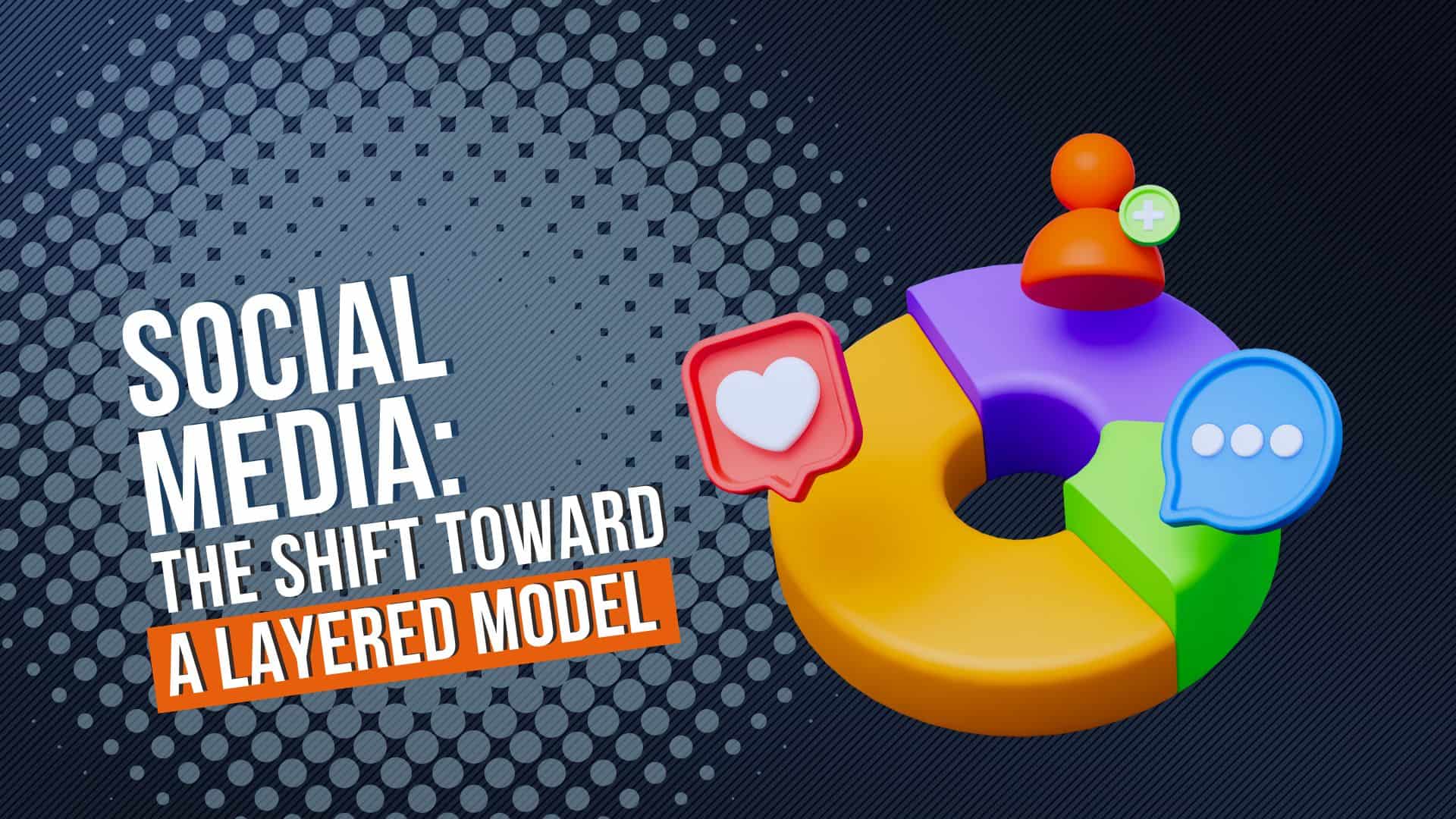
Platforms are progressively taking on a layered structure, where different modes of access and usage coexist.
A first level consists of users operating within the free environment, where visibility is heavily filtered by algorithms and competition for attention is high.
A second level involves creators and professionals who build deeper relationships with their audience, often through exclusive content or direct monetization models.
A third level includes advertisers and companies, who use advanced tools to influence distribution, working with data, creatives, and signals in an increasingly AI-driven environment.
The difference between these levels is not simply economic.
It is structural. It concerns how access to distribution works and the degree of control, direct or indirect, that users have over the system.
The Attention Economy: From Abundant Resource to Filtered Resource
At the core of this transformation lies a fundamental shift: attention is no longer a relatively evenly distributed resource, but a scarce, filtered, and allocated resource managed through increasingly complex systems.
This means that visibility is no longer a direct consequence of publishing content, but the result of a multi-layered selection process.
Artificial intelligence plays a central role in this process, determining which content is shown, to whom, and how often, based on signals that are not always explicit or directly controllable.
In this context, access to attention becomes progressively differentiated.
Why This Is Happening: Saturation, AI, and Monetization
The reasons behind this evolution are multiple and interconnected.
On one side, content saturation makes it impossible to maintain a uniform distribution model, as the volume of information far exceeds users’ capacity to consume it.
On the other side, artificial intelligence allows platforms to manage this complexity, selecting and distributing content more efficiently.
Additionally, platforms are developing more sophisticated monetization models that do not rely solely on advertising, but integrate direct payments and deeper relationships between users and creators.
The result is a system where access, distribution, and monetization are increasingly interconnected.
What Changes for Marketers
For those working in digital marketing, this shift requires a deep revision of how platforms are interpreted.
It is no longer enough to simply be present, publish content, or invest in advertising, nor is it enough to replicate strategies that worked in the past.
It becomes necessary to understand the level at which you operate and build strategies aligned with that level.
For professionals, this means developing a system-level understanding beyond tools. For companies, it means integrating content, distribution, and relationships into a unified ecosystem. For creators, it means building a direct relationship with the audience that does not depend solely on organic visibility.
Conclusion
Social media is not simply becoming more complex or more advanced.
The shift from a uniform model to a layered model redefines how attention is distributed, how value is created, and how competition works within platforms.
In this scenario, the difference is not between those who use social media and those who do not. It is between those who continue to interpret it as a linear environment and those who begin to understand it as a stratified system, where each level requires different logic, tools, and skills.
And it is precisely this ability to interpret the system that will define competitive advantage in the coming years.