In recent years, discussions about artificial intelligence have mostly focused on chatbots. For many users, tools such as OpenAI’s ChatGPT, Anthropic’s Claude, or Perplexity AI seem like simple variations of the same product.
In reality, the AI landscape is evolving into very different technological models. Some systems are designed to assist with writing and reasoning, others aim to replace traditional search engines, while some focus on analyzing large volumes of information or even executing operational tasks autonomously.
Understanding these differences has become essential for professionals, companies, and marketers. The question is no longer which AI tool is the best, but which architecture of artificial intelligence is best suited for a specific digital task.
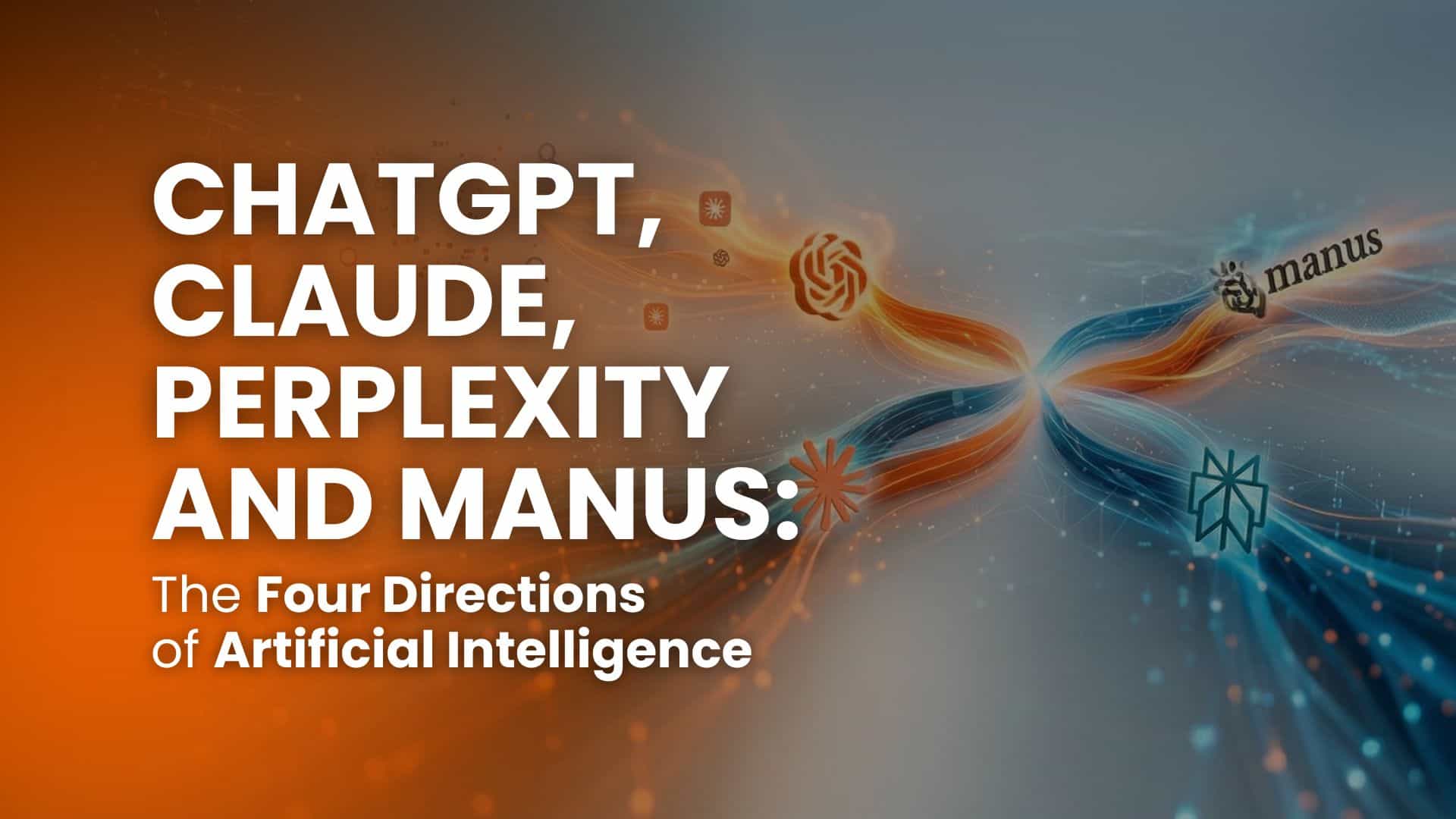
In this context, four tools represent four distinct directions in the evolution of AI: ChatGPT, Perplexity, Claude, and Manus.
ChatGPT, Claude, Perplexity and Manus: Four AI Architectures
The most important differences between these tools are not just visible features but their architectural logic.
Each of them represents a different category of artificial intelligence.
ChatGPT: The Universal AI Assistant
ChatGPT, released publicly in November 2022, represents the most widely used general-purpose AI assistant.
It is designed to perform a wide range of tasks using large language models based on the GPT (Generative Pre-trained Transformer) architecture.
Common applications include:
- writing and editing content
- coding support
- strategic brainstorming
- document analysis
- image generation
- workflow automation through APIs
The main strength of ChatGPT is versatility. It adapts to many contexts, including marketing, software development, education, research, and content creation.
This flexibility has led to a massive ecosystem of integrations and third-party tools built on GPT models.
Its main limitation is access to real-time information. ChatGPT is not fundamentally designed as a search engine and often relies on integrations to retrieve updated data.
Perplexity: AI Reinventing Search
Perplexity was built with a completely different goal: rethinking the concept of online search.
Founded in 2022, the platform combines large language models with web retrieval systems that analyze information across the internet in real time.
Unlike traditional chatbots, Perplexity is designed to:
- search the web
- aggregate sources
- summarize information
- cite original articles
Instead of showing a list of links, it delivers a synthesized answer supported by verifiable sources.
This represents a broader shift in online search behavior, where traditional SEO is evolving toward Answer Engine Optimization (AEO).
Perplexity’s limitation lies in creativity: because it prioritizes factual retrieval and citations, it is generally less effective for brainstorming or creative writing.
Claude: The Analytical AI
Claude was developed with a different philosophy.
Anthropic, founded by former OpenAI researchers, focuses on three core principles:
- safety
- reasoning quality
- long-context understanding
One of Claude’s most distinctive features is its very large context window, allowing it to analyze hundreds of pages of text within a single conversation.
Because of this capability, Claude is frequently used for:
- contract review
- legal analysis
- summarizing complex documents
- producing long-form content
Claude models are also built around Constitutional AI, an approach that guides system behavior through structured ethical and safety principles.
This makes Claude particularly valuable in professional environments where precision and reasoning quality are essential.
Manus: AI That Executes Tasks
Manus represents a completely different category: autonomous AI agents.
Rather than functioning only as a conversational assistant, Manus is designed to perform real operational tasks.
AI agents typically operate through a multi-step process:
- analyzing a problem
- planning the necessary actions
- using digital tools
- producing an operational result
This means AI no longer only generates answers but can interact directly with software, data, and digital platforms.
For example, AI agents can:
- collect data from the web
- generate analytical reports
- automate workflows
- build dashboards
This shift represents the evolution from conversational AI to operational AI.
However, the main limitation today is reliability: AI agents are still an emerging technology and often less stable than traditional language models.
Structural Differences Between These AI Systems
The differences between these platforms can be summarized into four categories:
- ChatGPT → general conversational assistant
- Perplexity → AI-powered search engine
- Claude → analytical reasoning system
- Manus → autonomous AI agent
These also represent four stages in the evolution of artificial intelligence:
- conversational assistance
- intelligent information retrieval
- deep cognitive analysis
- operational automation
When to Use Each AI Tool
Each system becomes especially effective in specific contexts.
ChatGPT works best for:
- creative writing
- marketing strategies
- brainstorming ideas
- content creation
Perplexity is ideal for:
- research
- fact checking
- news analysis
Claude excels at:
- complex document analysis
- reviewing long texts
- producing detailed reports
Manus and AI agents are suited for:
- automation workflows
- operational tasks
- data-driven processes
The Direction of the AI Market
The AI sector is moving toward three major strategic directions:
- AI copilots integrated into everyday software
- conversational search engines replacing traditional search behavior
- autonomous AI agents capable of executing tasks
These trends are converging toward a new generation of tools combining:
- advanced language models
- web access
- operational automation
- multimodal capabilities
The Future of Artificial Intelligence
It is unlikely that one single platform will dominate the future of AI.
Instead, the emerging trend is integration between different AI architectures.
The most advanced platforms are already combining:
- linguistic reasoning
- access to online information
- task execution
- multimodal interaction
In this scenario, artificial intelligence evolves from a simple answering tool into a collaborative operational system working alongside humans.
Conclusion
For professionals and businesses, the key question is no longer which AI tool is the best.
A more useful question is: which AI should be used for each type of digital task?
Today a practical combination might look like this:
- ChatGPT for creativity and strategy
- Perplexity for research
- Claude for deep analysis
- Manus for operational automation