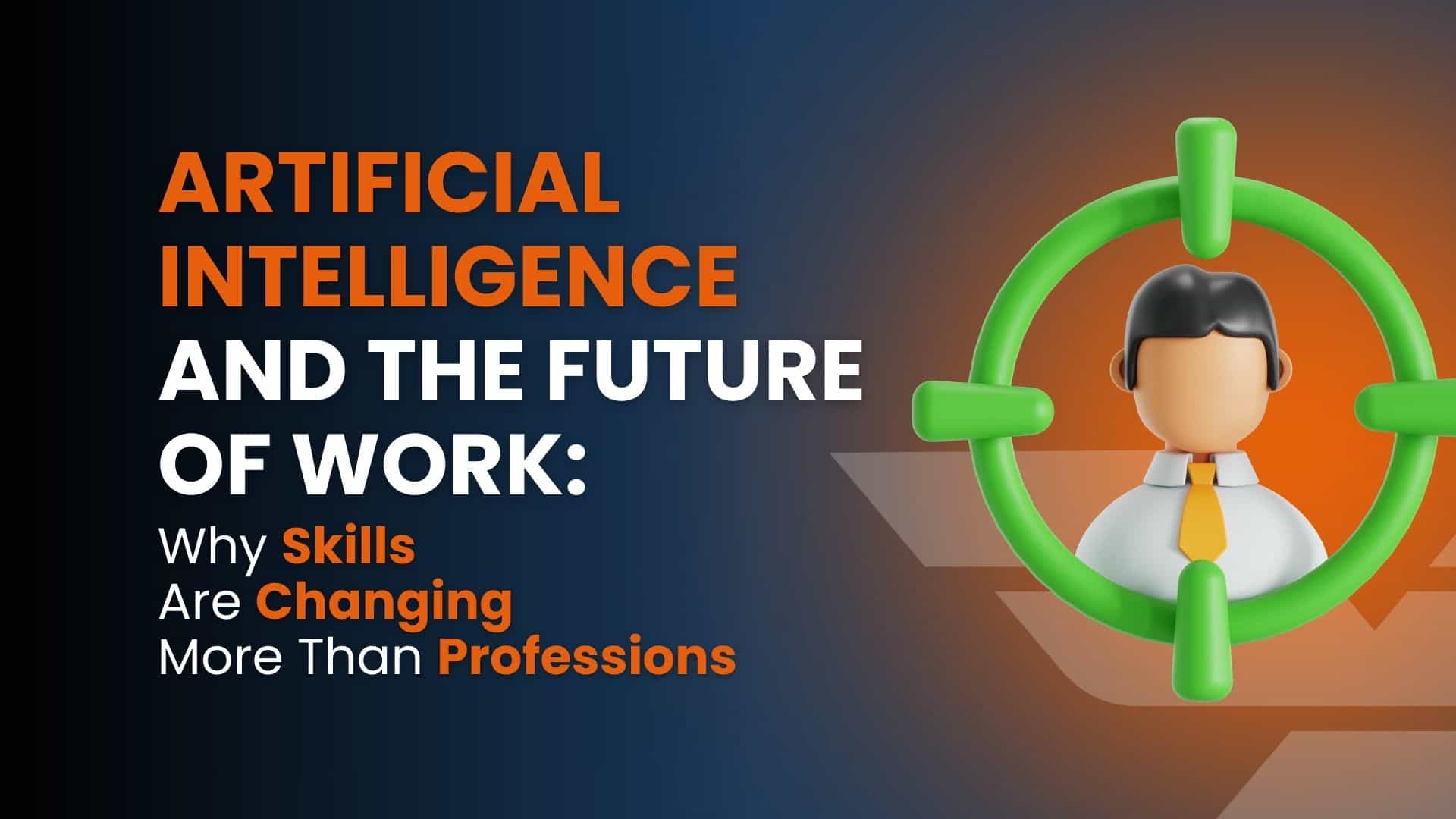
In recent months, the debate around artificial intelligence and work has been dominated by a rather simple question: will AI replace people?
The reality emerging from labor market analyses is much less linear. The real change does not concern the disappearance of professions as much as the transformation of the tasks that make them up.
One of the most interesting perspectives on this phenomenon comes from the data observed by LinkedIn, one of the platforms with access to the largest global map of professional skills.
The platform’s CEO, Ryan Roslansky, has addressed this topic several times in recent interviews and public talks. His position is quite clear: the future of work is not something that will arrive in ten years — it has already begun.
According to Roslansky, the real question is not what technology can do, but how humans will choose to use it.
And it is precisely this shift in perspective that helps explain what is happening in the labor market.
Artificial Intelligence Does Not Eliminate Jobs: It Changes What We Do Every Day
One of the most widespread narratives about artificial intelligence is that it will drastically reduce employment.
In reality, available data tells a different story.
Many technologies do not eliminate entire professions. Instead, they automate specific tasks within existing jobs. This means that a profession does not disappear; rather, its internal composition changes.
A marketing consultant uses AI tools to analyze data or generate creative drafts.
A lawyer relies on automated document analysis systems.
An entrepreneur integrates predictive models into strategic decision-making.
The result is not total replacement, but a model of work that is increasingly augmented by technology.
Roslansky himself has explained that artificial intelligence is beginning to take over the most repetitive or less creative tasks of everyday work, freeing up space for strategic decisions and human interpretation.
The Real Change Concerns Skills
If we examine job posting data from recent years, a much deeper phenomenon emerges.
Professions change slowly. Skills change quickly.
LinkedIn analyzed millions of profiles and job listings, showing that a significant portion of required skills has already changed in recent years.
This means that professional stability no longer depends primarily on a degree or on the profession itself, but on the ability to continuously update one’s skills.
This is where an increasingly important concept comes into play: learning agility.
In other words, the ability to learn quickly becomes more important than any single technical skill.
Why Companies Are Moving Toward Skills-Based Hiring
Another important shift concerns recruitment criteria.
More and more companies are adopting a skills-based hiring model — meaning they select candidates based on actual capabilities rather than academic qualifications.
Roslansky has explained that the future of work does not necessarily belong to those with the most prestigious degrees, but to those who demonstrate:
- adaptability
- curiosity
- the ability to learn new technologies
This shift is particularly evident in sectors related to technology, digital marketing, and data management.
The traditional résumé is gradually losing centrality. Demonstrable skills are becoming more valuable.
Why the Five-Year Career Plan Is Becoming Obsolete
Another interesting point from Roslansky’s interviews concerns career planning.
For decades, one of the most common pieces of advice in the professional world was to have a five-year career plan.
Today this approach risks becoming quickly outdated.
According to the LinkedIn CEO, planning a career over very long horizons may be unrealistic given how quickly technology is transforming the labor market.
The reason is simple.
Many professions will change significantly in the coming years. Some roles did not exist ten years ago, and others will emerge in the next five.
As a result, the traditional linear career model — education, entry into a company, growth within the same organization — is gradually giving way to more dynamic professional paths.
AI Literacy Is Becoming a Cross-Functional Skill
Another important trend concerns the growing demand for AI-related skills.
This does not mean that everyone needs to become an AI engineer.
It means that more and more professions require a basic ability to interact with intelligent systems.
Being able to use AI tools to:
- analyze data
- generate content
- automate processes
is becoming a cross-disciplinary skill, similar to how computer literacy functioned in the 1990s.
For many professionals, the real risk will not be artificial intelligence itself, but the inability to use it.
The AI Paradox: Human Skills Are Also Becoming More Valuable
One of the less discussed effects of artificial intelligence is the renewed importance of human skills.
As technological automation increases, skills that are harder to replicate with algorithms become more valuable.
These include:
- communication skills
- critical thinking
- creativity
- leadership
- relationship management
The future of work will not simply be technological.
It will increasingly be a combination of human capabilities and digital tools.
The Real Competitive Advantage in the Future of Work
If we look at all these signals together, a fairly clear conclusion emerges.
The transformation of work does not concern artificial intelligence alone. It concerns how people build their professional paths.
For decades, the dominant paradigm was based on:
- stability
- academic credentials
- linear career progression
The emerging model looks very different:
- dynamic skills
- adaptability
- continuous learning
In this scenario, the real competitive advantage is not possessing a single technical skill, but developing the ability to learn faster than others.
And it is precisely this ability — even more than technology itself — that will define the work of the coming years.