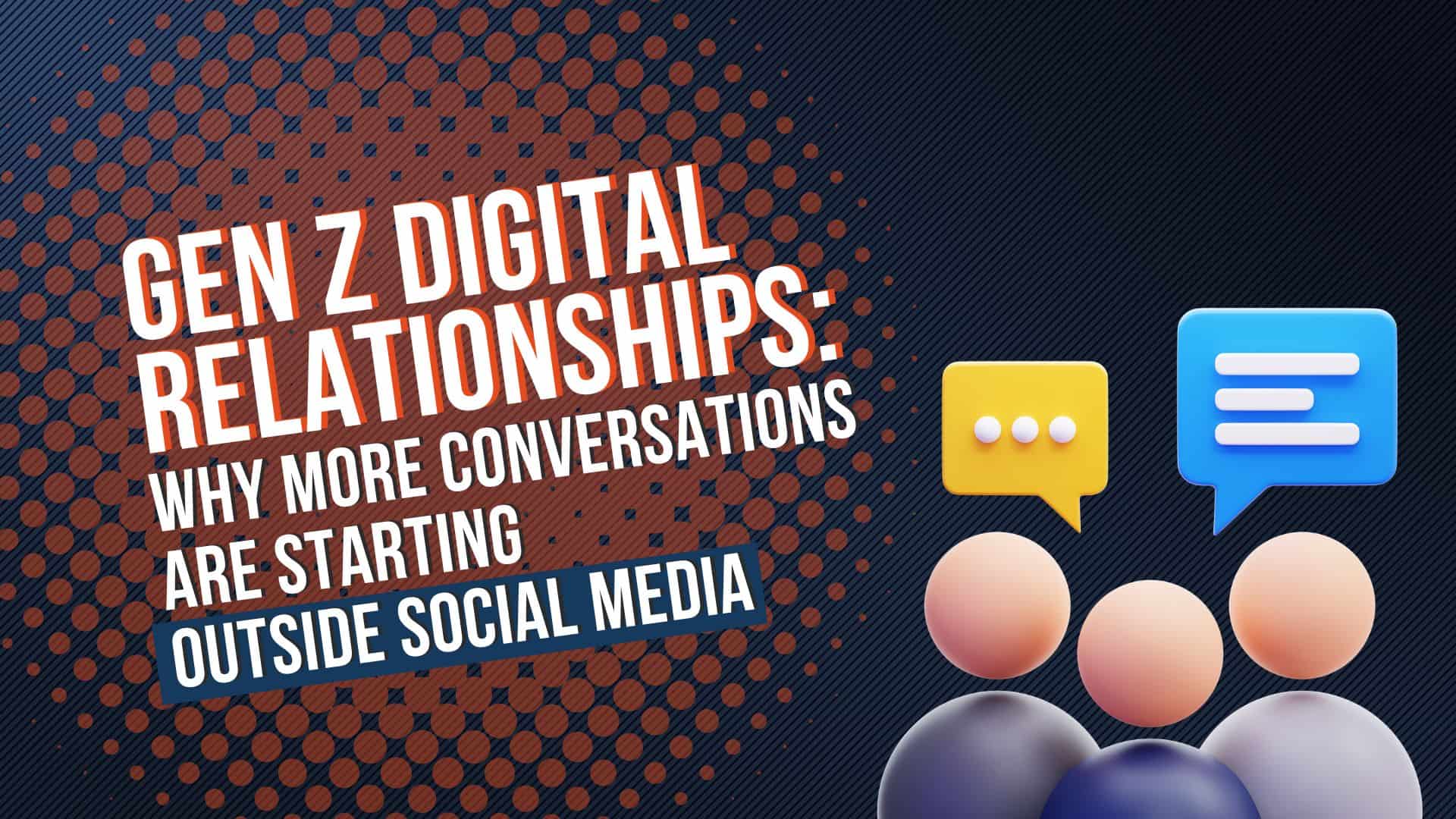
In recent years, something subtle but significant has been changing in the way Gen Z and Gen Alpha digital relationships develop and evolve online.
For a long time, the dynamics of digital social interaction were fairly linear: first people followed each other on Instagram, then they started chatting in direct messages, and only later—if the conversation became more personal—did they exchange phone numbers.
Today, the opposite is increasingly happening.
The first contact is often no longer the follow.
It is the phone number.
“Here’s my number” is becoming a more common phrase, while Instagram often stays in the background, almost like a secondary personal showcase.
This does not mean social media is losing importance. Instead, its role is changing.
More and more profiles are private, curated, and carefully managed. They are not necessarily the place where conversations begin anymore. Instead, they function more like a visual business card for personal identity.
The real relationship happens somewhere else.
From Public Visibility to Private Conversations
The numbers help explain why.
More than 70% of Gen Z prefer messaging apps over public social platforms, and every day more than 140 billion messages are sent across platforms owned by Meta Platforms.
Digital communication is not decreasing—it is simply becoming more private, more direct, and more selective.
This shift is closely linked to a sociological concept widely discussed in social media studies: context collapse.
On public social platforms, multiple audiences coexist—friends, colleagues, family members, acquaintances, and strangers. This makes authentic self-expression increasingly difficult.
As a result, many people prefer smaller and more controlled spaces, such as:
- Private chats
- Small group conversations
- One-to-one messaging
The result is a new balance between public space and relational space.
Social media becomes the place of identity and observation, while messaging platforms become the place of actual relationships.
What This Change Means for Digital Marketing
For professionals working in digital marketing, this shift has significant implications.
For years, most lead generation strategies focused on public visibility and open interaction:
- Content creation
- Comments
- Direct messages
- Public communities
Now a different model is emerging—one based more on private conversations.
It is no coincidence that many platforms have heavily invested in messaging features in recent years. Apps such as WhatsApp, Telegram, and Messenger are increasingly becoming spaces not only for communication but also for conversion and customer relationships.
This means the user journey may change structure.
Instead of the traditional sequence:
content → follower → direct message
it may increasingly look like:
content → curiosity → private conversation
or
content → discovery → entry into a private channel such as a chat or group.
Final Thoughts
From a marketing perspective, this trend opens interesting opportunities.
Relationship-building may increasingly move into closed environments where attention is higher and communication is less noisy.
Examples include:
- WhatsApp communities
- Telegram channels
- Broadcast messaging lists
- Automated chatbot conversations
These tools align perfectly with the new communication behavior: less public noise, more direct interaction.
In this context, social media does not disappear at all. It remains essential for discovery, positioning, and brand image.
However, the most delicate part of the process—trust, dialogue, and decision-making—is increasingly moving into more intimate and controlled spaces.
If this trend continues in the coming years, we may see a significant transformation of the digital landscape:
- Social media becoming more public and performative
- Gen Z digital relationships becoming more private and conversational
For marketers, understanding how to connect these two worlds—public visibility and private conversation—may become one of the most important skills of the coming years.