When observing the evolution of digital marketing, it is easy to focus on the tools. Social networks, advertising platforms, artificial intelligence, and marketing automation systems all seem to change constantly.
In reality, one constant runs through the entire history of digital marketing: the objective.
In 2000 as in 2026, marketing has the same fundamental goal: to attract customers, generate demand, and build relationships with the market.
What changes is not the objective, but the system through which that objective is achieved. Platforms evolve, distribution models change, and the way people discover companies and content online continues to transform.
Digital Marketing in 2000: The Web as an Informational Space
In the early 2000s, the internet was primarily an informational environment.
Companies built websites that functioned essentially as digital brochures. The main goal was simply to be present online and allow users to find information about the company.
Digital marketing activities revolved around a small set of tools:
- Websites
- Email marketing
- Early search engine optimization (SEO)
SEO already existed, but it was far simpler than it is today. The amount of online content was limited and competition for traffic was relatively low.
At that time, digital marketers often had technical skills related to web development. Knowing HTML or being able to manage a website was already a competitive advantage.
Digital Marketing in 2010: The Rise of Social Marketing
The following decade marked a major transformation.
With the growth of social networks, the internet stopped being just an informational space and became a social environment.
Platforms like Facebook, YouTube, and Twitter changed how people consumed content and interacted with brands.
Companies began building audiences and communities. Digital marketing became increasingly connected to content production and user engagement.
New professional roles appeared, including:
- Social media manager
- Content strategist
Marketing shifted from simply publishing information to managing relationships with audiences.
Digital Marketing in 2020: The Era of Performance
Around 2020, digital marketing entered a phase strongly dominated by data and performance measurement.
Advertising platforms made it possible to reach highly specific audiences with remarkable precision. Campaign management became a highly specialized discipline.
New roles emerged, including:
- Media buyers
- Performance marketers
- Growth marketers
Marketing teams focused on building scalable customer acquisition systems.
Key tools included:
- Landing pages
- Marketing funnels
- Tracking systems
These tools allowed companies to measure and optimize campaign performance in a precise and systematic way.
Digital Marketing in 2023: The Artificial Intelligence Revolution
In 2023, generative artificial intelligence introduced another major shift.
Content production became dramatically faster. Texts, images, and videos could now be generated using AI-based tools.
This changed the balance within digital marketing.
If content creation becomes easier, distribution becomes the real challenge.
Platform algorithms increasingly determine which content users will see, creating a new competitive landscape where visibility is heavily influenced by automated recommendation systems.
Digital Marketing in 2026: Distribution and Algorithms
By 2026, digital marketing is increasingly guided by algorithmic systems.
Advertising platforms rely on predictive models to identify the most relevant audiences for content. Social networks automatically select posts that are most likely to generate engagement.
At the same time, new visibility models are emerging around AI-powered response systems, as discussed in the framework of SEO, AEO, and GAO strategies.
In this environment, online visibility no longer depends solely on search engine rankings or advertising campaigns. It increasingly depends on a content’s ability to be selected and distributed by algorithms.
The 2020 Mindset vs the 2026 Mindset
The difference between these periods becomes clear when looking at how marketing professionals interpret digital strategy.
The 2020 mindset is tied to the logic of performance advertising:
- Detailed segmentation
- Direct campaign control
- Manual management of parameters
- Continuous funnel optimization
The 2026 mindset is different.
Algorithms now make more decisions autonomously. The marketer’s role increasingly shifts toward designing distribution systems rather than controlling every individual variable.
This change can sometimes create misunderstandings within teams. Two professionals may analyze the same problem but propose completely different solutions because they interpret the context through different mental models.
The point is not about who is right. It is about recognizing that digital marketing evolves alongside the technological ecosystem in which it operates.
Why a Gap Between Professionals Is Emerging
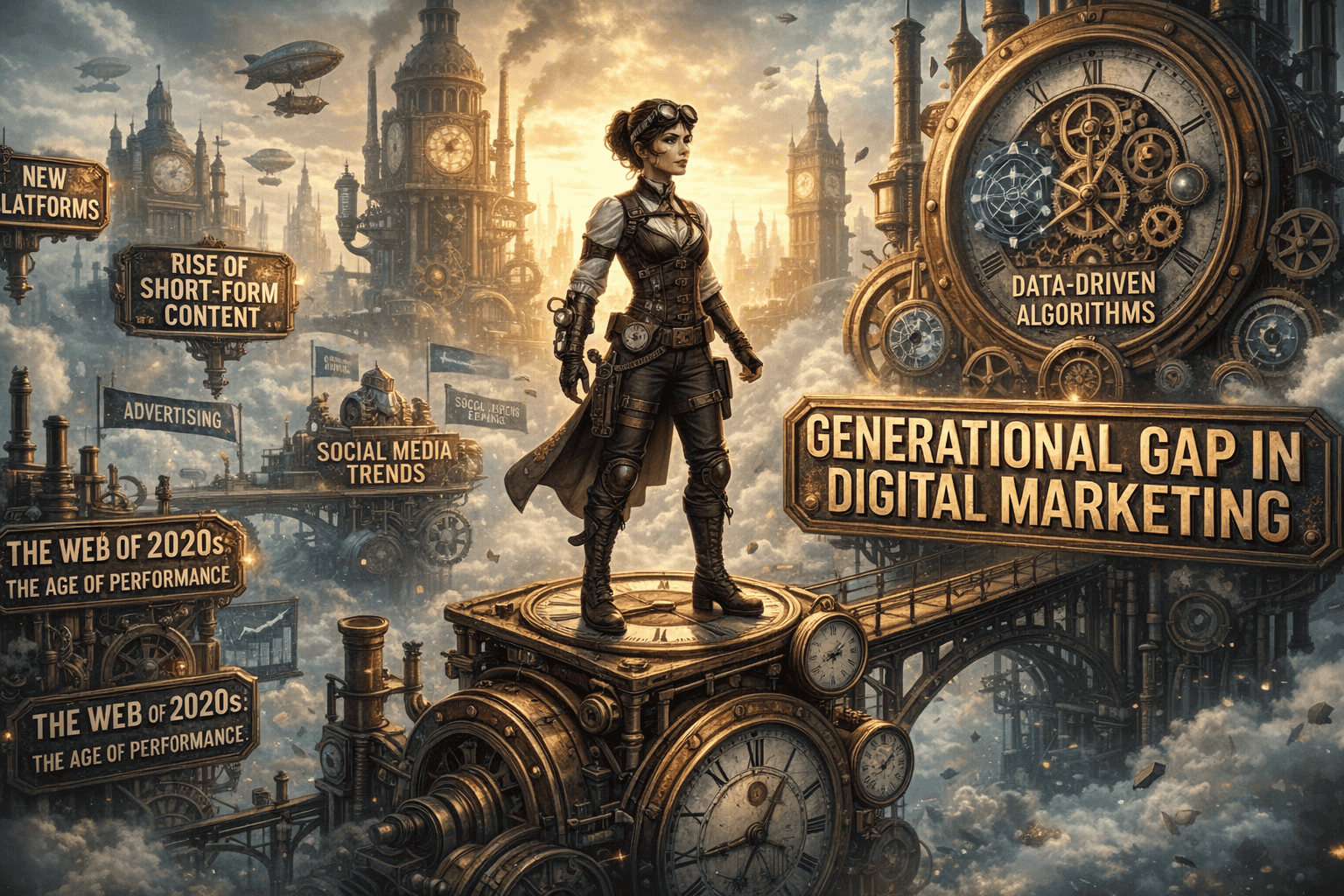
Looking at this evolution makes it clear why a gap now exists between digital marketing professionals.
Those who began their careers in the early 2000s built their experience in a web environment that was fundamentally different from today’s ecosystem.
Their skills are not wrong. They were simply developed in a different technological context.
- The web of 2000 was primarily a publishing space.
- The web of 2010 became a social environment.
- By 2020 it had evolved into a customer acquisition machine driven by advertising.
- In 2026 it is increasingly a system for algorithmic attention distribution.
When professionals with different backgrounds collaborate within the same team, it is natural for them to interpret strategies differently.
And this is where the true generational gap in digital marketing begins to appear.
Understanding Change to Interpret the Future
The evolution of digital marketing from 2000 to 2026 shows how the internet has transformed from an informational space into a complex system for distributing attention.
Today, working in digital marketing means understanding how platforms, algorithms, and recommendation systems operate.
Technical skills remain important, but the ability to interpret digital systems and adapt strategies to a constantly evolving environment has become even more critical.
Understanding this transformation does not mean abandoning past experience. It means integrating it into a new ecosystem where online visibility is shaped by dynamics very different from those of the early web.